Latest insights
California Just Admitted Rooftop Solar Contracts Were the Problem - Senate Bill 868
California Just Admitted Rooftop Solar Contracts Were the Problem
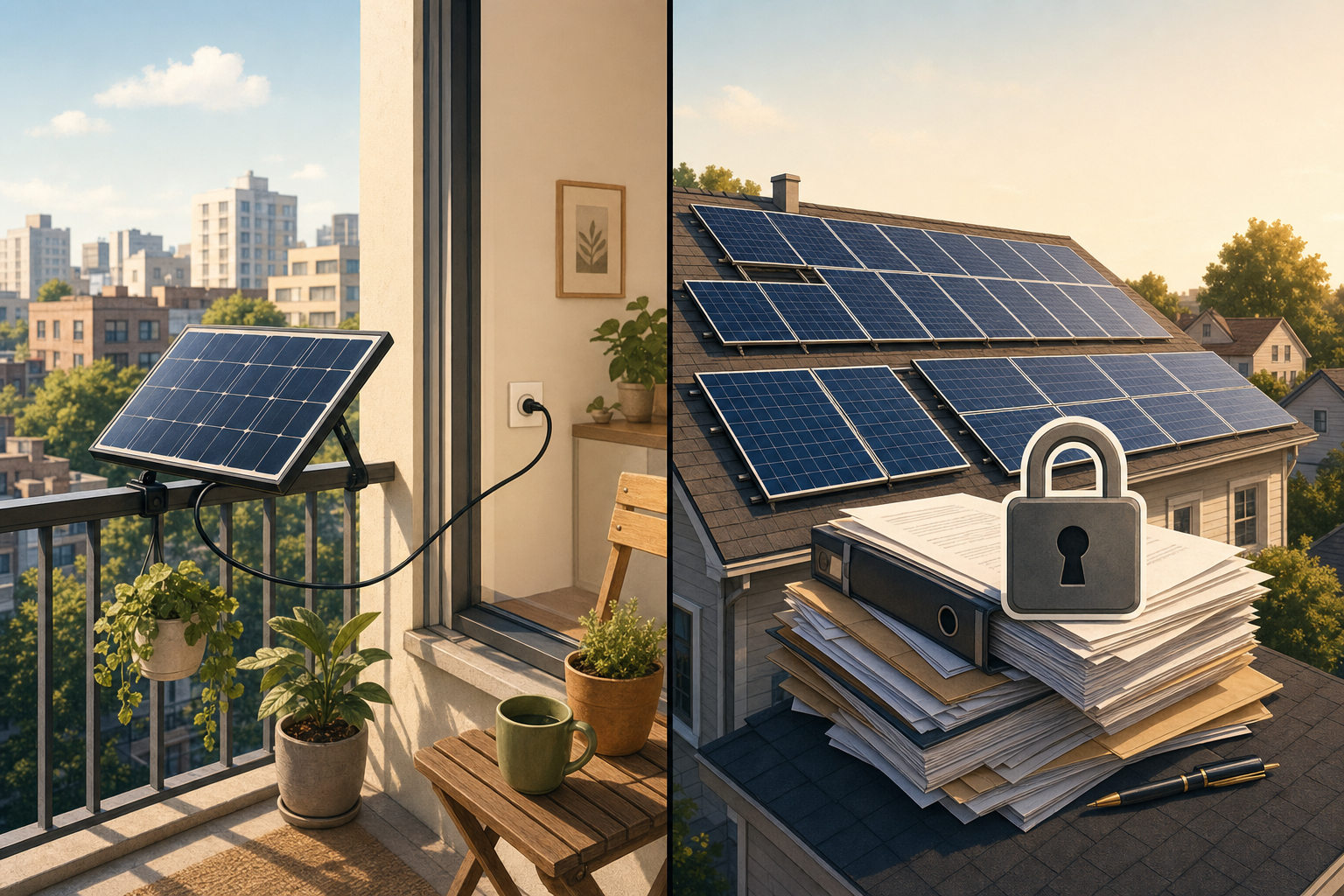
Sacramento lawmakers are racing to make solar power simpler than it's ever been. Senate Bill 868, known as the Plug and Play Solar Act, cleared the California State Senate on a 35-1 vote in May and is now moving through the Assembly. Its entire premise is simple: let people plug a small solar panel into a wall outlet and start saving on electricity — no permits, no 20-year contract, no lien on the house.
If that sounds like the opposite of what you were sold, you're not imagining things. And for homeowners across California still locked into rooftop solar leases and power purchase agreements from the last decade, SB 868 is worth paying attention to — not because it applies to your existing system, but because of what it reveals about how the old model was built.
What SB 868 Actually Does
The bill, authored by State Senator Scott Wiener, creates a legal category for "portable solar generation devices" — small setups, typically 200 to 1,800 watts, that plug directly into a standard 120-volt outlet through a small inverter capped at 1,200 watts of AC output. A single 400-watt unit can offset roughly 14% of an average apartment's electricity usage, saving households an estimated $250 to $450 a year, according to the bill's sponsors at the Environmental Working Group.
The systems start around $500. No financing agreement. No 25-year commitment. No document attached to your property deed.
Most importantly, SB 868 explicitly exempts these devices from the utility interconnection process — the same red tape that traditional rooftop systems have to navigate through agreements with utilities like Pacific Gas and Electric, Southern California Edison, and San Diego Gas & Electric. As the bill's supporters put it, current rules make ordinary homeowners jump through the same hoops as a full-scale power plant just to plug in a small panel.
That's the part worth sitting with. The state is now writing legislation specifically to protect people from the exact bureaucratic structure that rooftop solar companies built their entire sales model around.
The Contrast With What You Signed
If you went solar through a lease or a power purchase agreement (PPA) during the rooftop solar boom, your experience probably looked nothing like what SB 868 describes:
- A 20-to-25-year contract attached to your home, not a $500 plug-in device you can take with you if you move — see how this plays out with Sunrun leases, Vivint Solar contracts, and Tesla Energy agreements
- A UCC-1 lien filed against your property, often tied to financing through GoodLeap, Mosaic, or Sunnova — rather than zero legal claim on the house
- A formal utility interconnection agreement, the very process lawmakers are now trying to eliminate for small systems because it's considered unnecessary red tape
- System sizing and savings promises built around net metering rates that existed before NEM 3.0 gutted export compensation for new customers by roughly 75%
None of this means your existing system is illegal or that SB 868 changes your contract. It doesn't. But it does mean the state's own energy policy is now built around a completely different philosophy than the one your sales rep was working from — cut the commitment, cut the lien, cut the paperwork.
Why NEM 3.0 Makes This Sting More
SB 868 isn't happening in a vacuum. It comes directly after major cuts to net metering that badly damaged the economics of rooftop solar for both new adopters and existing owners locked into older agreements. Homeowners who signed on when the math worked are now watching that math change under policies they had no say in — while the same legislature simultaneously fast-tracks a low-commitment alternative for everyone else.
If you haven't already, it's worth reading our full breakdown of NEM 3.0 and what it actually changed for existing solar owners, along with how SB 784 is now forcing more transparency in future solar sales — transparency many existing contracts were never held to.
That whiplash is exactly why so many homeowners are re-examining what they signed years ago: escalator clauses that raise lease payments annually regardless of actual savings, PPAs where the "guaranteed production" never materialized, or liens that surface unexpectedly during a home sale or refinance.
What This Means If You're Stuck in a Legacy Contract
SB 868 won't unwind your existing lease or PPA. But it's a useful reference point if you're trying to understand why your contract feels disconnected from where the market and the state are actually heading:
- Simplicity is now the policy goal, not the exception. If lawmakers are actively working to strip out permits, interconnection agreements, and long-term financial commitments for new solar adopters, that's an implicit acknowledgment that those structures were a burden — the same structures many existing rooftop contracts are built on.
- Portability is being treated as a consumer protection. SB 868's plug-in systems can move with you. Most legacy leases and PPAs cannot — they transfer to a new homeowner or trigger a payoff obligation, which becomes its own negotiation during a sale.
- The state is watching the same net metering shift you are. SB 868's sponsors are explicit that they see this bill as one path to rebuild momentum in a solar market that struggled after cuts to net metering policies — the same cuts that may have already changed the value of the system on your roof.
If your solar lease or PPA no longer reflects the deal you thought you signed up for — whether because of escalating payments, a lien complicating a refinance or sale, or savings that never matched projections — it's worth having someone review the actual contract terms rather than assuming there's nothing to be done.
Frequently Asked Questions
Does SB 868 affect my existing rooftop solar lease or PPA?
No. SB 868 creates rules for new, small plug-in solar devices. It does not modify or void existing rooftop solar contracts, leases, or PPAs.
Is plug-in solar a replacement for rooftop solar?
Not directly — plug-in systems are much smaller (up to 1,200 watts AC) and are designed to offset a portion of usage, not replace a full rooftop installation. They're aimed primarily at renters and people who can't install rooftop systems.
When could SB 868 become law?
The bill passed the Senate in May 2026 and is currently in the Assembly Appropriations Committee, expected to be heard in August 2026 before potentially moving to the governor's desk.
If I'm unhappy with my current solar contract, what are my options?
Options vary based on your specific agreement — whether it's a lease, PPA, or loan — and can include renegotiation, transfer, buyout, or in some cases formal exit assistance. A contract review is the right first step.
What if my solar company misrepresented my savings or contract terms?
Misrepresentation claims may fall under consumer protection laws, including the
FTC Holder Rule, which can affect your obligations under a solar loan even if the installer is no longer in business. See our
full guide to solar sales misrepresentation.
The Bottom Line
SB 868 won't touch your existing contract. But it's a clear signal from the state itself: the complexity, the liens, the multi-decade commitments — that model is now considered the problem lawmakers are writing legislation to avoid for everyone else. If your rooftop solar lease, PPA, or loan no longer looks like a good deal in light of NEM 3.0, escalating payments, or promises that didn't hold up, you don't have to just keep paying and wondering.
Get a free, no-obligation review of your solar contract. Our team will walk through your actual lease, PPA, or loan documents, identify what your real options are — renegotiation, transfer, buyout, or exit — and explain them in plain English, with no pressure.
📞 Call (213) 579-5156 or request your free contract review online to talk to someone who can tell you exactly where you stand.
Other insights
More from California Solar Exit