Latest insights
Who Pays for California's Free Solar Programs — and Who Gets Them
Who Pays for California's Free Solar Programs — and Who Gets Them
California has more rooftop solar installations than any other state — over 1.5 million residential systems, according to the California Energy Commission. It also has some of the highest residential electricity rates in the country. Those two facts are not unrelated, and understanding the subsidy structure behind California's solar market helps explain something that confuses a lot of homeowners: why "free solar" programs exist, who actually qualifies for them, and what the difference is between a genuine government-funded solar program and the commercial lease or PPA a private salesperson is offering at your door.
If you signed a solar lease or PPA under the impression it was connected to a government program — or that it was essentially free — this post is directly relevant.
If you were told your solar agreement was tied to a state program, a utility rebate, or government funding that doesn't appear in your contract, contact California Solar Exit for a free contract review.
California's Cap-and-Invest Program: The Engine Behind Solar Subsidies
California's solar subsidy programs don't come from the general fund. They're funded primarily through the state's Cap-and-Invest Program, administered by the California Air Resources Board (CARB). Formerly known as cap-and-trade, the program was extended through 2045 by Assembly Bill 1207 (AB 1207, Irwin) and Senate Bill 840 (SB 840, Limón), enacted in September 2025.
The mechanics: companies that emit greenhouse gases — power plants, industrial facilities, fuel suppliers covering roughly 76% of California's GHG emissions — must purchase allowances from CARB, each representing one metric ton of CO2 equivalent. CARB auctions those allowances quarterly, generating revenues deposited into the Greenhouse Gas Reduction Fund (GGRF). Since the program launched in 2013, California has raised more than $19.2 billion through cap-and-invest auctions. Recent auctions generate between $3 billion and $4.3 billion per year, according to the California Legislative Analyst's Office (LAO).
By statute, at least 35% of GGRF revenues must benefit disadvantaged and low-income communities — 25% directed to investments within disadvantaged communities, and an additional 10% specifically for low-income households. That statutory floor is the legal foundation for the state's subsidized solar programs.
Those costs flow through the system. The CPUC's Public Advocates Office has identified rooftop solar incentives — funded by ratepayers — as among the primary drivers of retail electricity rate increases statewide. The 2026 CARB regulatory update dedicates an estimated $8 billion to the Greenhouse Gas Reduction Fund going forward, alongside $10 billion directed to electricity bill credits for Californians.
The Low-Income Weatherization Program: What It Actually Is
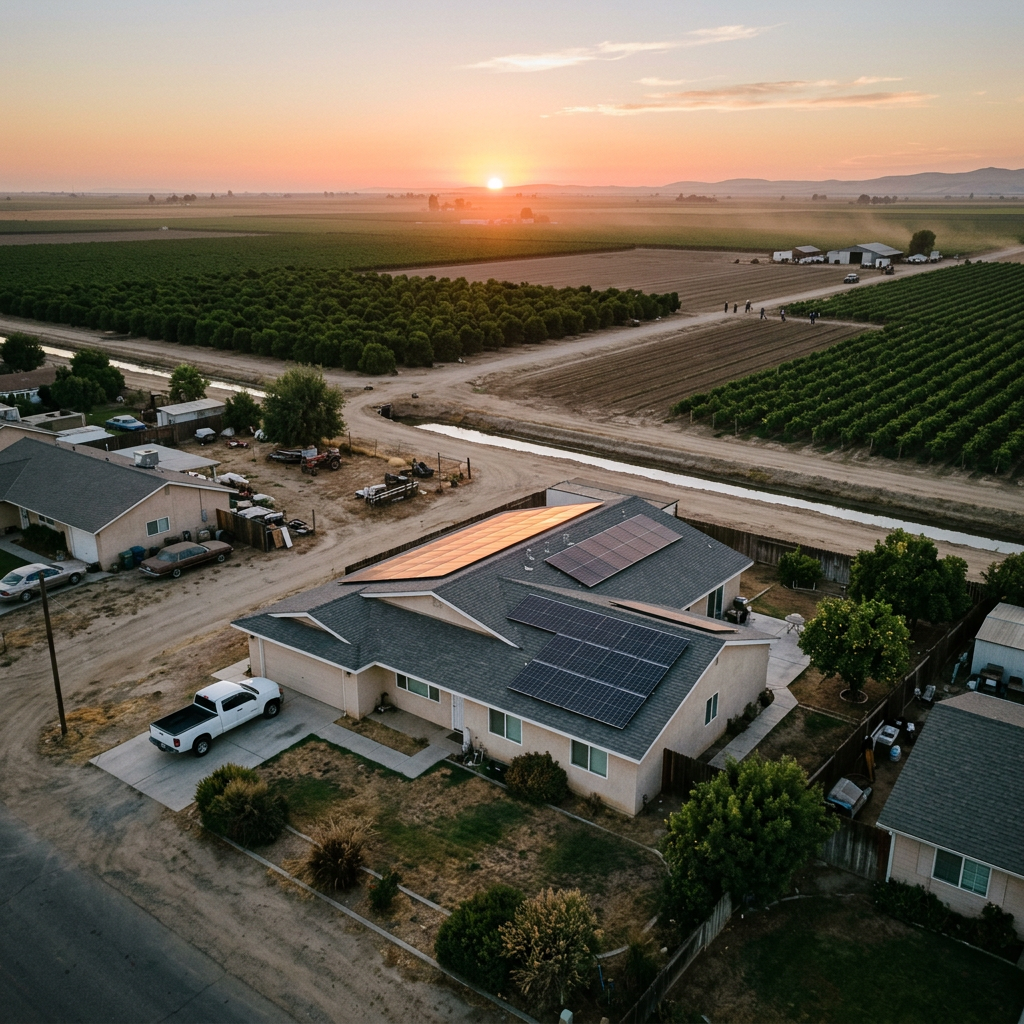
The program generating significant recent attention is the Low-Income Weatherization Program (LIWP), specifically its Farmworker Housing Component, administered by California's Department of Community Services and Development (CSD). Launched in 2019 and expanded to 18 California counties with the highest farmworker populations, the program operates across two regions:
Region 1: Fresno, Kings, Madera, Merced, Napa, San Joaquin, Sonoma, Stanislaus, Tulare
Region 2: Imperial, Kern, Monterey, Riverside, San Luis Obispo, Santa Barbara, Santa Cruz, Ventura
The program is administered by La Cooperativa Campesina de California, a nonprofit established in 1995 to serve California's farmworker communities. La Cooperativa partners with MAROMA Energy Services and a network of local installation contractors. Since 2019, the state has allocated approximately $49 million to the Farmworker Housing Component, serving roughly 2,000 households — an average program delivery cost of approximately $23,000 per household when accounting for the full scope of services: solar PV, HVAC, insulation, window replacement, refrigerators, and other weatherization measures.
To qualify, households must meet all of the following criteria per CSD's program guidelines:
- At least one household member must be an agricultural employee
- The household must be at or below 80% of Area Median Income or 80% of State Median Income, whichever is higher
- The property must be located within one of the 18 targeted counties
- Citizenship is not required — CSD accepts identification from foreign governments for eligibility verification
Services are provided at no cost. The program covers single-family homes and small multifamily buildings of 2–4 units owned or rented by the farmworker family. For more information or to apply, call (833) FOR-LIWP — (833) 367-5497 — Monday through Friday, 9 a.m. to 4 p.m.
This is a genuine, government-administered program funded by CARB cap-and-invest revenues — not a commercial solar product.
The SOMAH Program: Solar for Multifamily Affordable Housing
A parallel program is the Solar on Multifamily Affordable Housing (SOMAH) program, authorized under California law and funded through CPUC-directed cap-and-invest revenues. SOMAH directs up to $100 million per year toward solar installation on apartment buildings in low-income areas. Since 2015, the program has installed approximately 129 megawatts of solar for roughly 65,600 residents, well below the 1 million "solar renters" target advocates sought, in part because projects average three and a half years to navigate required paperwork and inspections. More than 400 applications have been canceled or withdrawn.
Both LIWP and SOMAH represent one end of California's solar subsidy spectrum: programs funded by state climate revenues, administered by government agencies and qualified nonprofits, at no cost to the recipient household.
The commercial solar market — where Sunrun, Sunnova, Tesla Energy, Freedom Forever, and regional dealers operate — is the other end. This is precisely where the misrepresentation problems documented by the California AG, the CSLB, the CPUC, and the DFPI actually occur.
Why This Matters for Homeowners With Commercial Solar Contracts
The existence of genuine government-funded solar programs creates a specific and documented misrepresentation risk in California's commercial solar market. The February 2026 settlement by the Riverside County District Attorney's office involving Vivint Solar — which became a wholly owned Sunrun subsidiary on October 8, 2020 — cited among its alleged violations: misrepresenting relationships with utility companies including Pacific Gas & Electric (PG&E), Southern California Edison (SCE), and San Diego Gas & Electric (SDG&E), and misrepresenting the nature of the solar program being offered. The Riverside County DA noted that Sunrun was not a party to that action.
When a commercial solar sales representative implies — or directly states — that their product is affiliated with a government program, a utility incentive, or a state climate initiative, that representation has a specific legal name under California's Consumer Legal Remedies Act (CLRA): fraudulent misrepresentation that can form the basis for contract rescission.
The questions worth asking about any solar agreement you've signed:
Is this a government program or a commercial product? Government programs like LIWP and SOMAH are administered by CSD or the CPUC, have specific statutory eligibility requirements, and involve no long-term payment obligation. Commercial solar leases and PPAs from private companies are 20–25-year contracts with annual payment escalators — typically around 2.9% per year.
Who is the other party to your contract? If you signed with a private solar company — not the State of California, CARB, CSD, Pacific Gas & Electric, Southern California Edison, or San Diego Gas & Electric — you are in a commercial agreement, not a government program. State agencies do not send salespeople to your door with tablets.
What incentives were in the pitch vs. the contract? The federal Investment Tax Credit (ITC), Net Energy Metering billing, and state cap-and-invest rebates are real programs — but the financial benefit of each accrues differently depending on whether you own the system, lease it, or signed a PPA. In a lease or PPA, the federal ITC goes to the solar company, not the homeowner. If you were told the tax credit would benefit you and it was not reflected in your contract, that is a documented complaint category under California law.
The Accountability Question: Where the Money Goes
California's cap-and-invest system has generated more than $27.9 billion in cumulative GGRF appropriations since 2014, distributed across low-income weatherization, transit, high-speed rail, wildfire resilience, and other programs across 24 state agencies administering 89 programs.
The California Legislative Analyst's Office has noted that ensuring GGRF funding achieves its intended goals effectively is an ongoing legislative priority, and that continued oversight of CARB's rulemaking — particularly following AB 1207 and SB 840 — is essential. The LAO's 2026 analysis of cap-and-invest expenditure plans flagged that GGRF revenues may not be adequate to support all proposed allocations, recommending the Legislature prioritize highest-impact uses.
For the Farmworker Housing Component specifically, a May 2026 City Journal investigation raised financial accountability questions about the relationship between La Cooperativa, MAROMA Energy Services, and John Harrison Contracting — specifically regarding a single individual appearing in executive roles across all three entities that receive, distribute, and execute program funds. CSD has not publicly responded to those specific allegations as of this publication date.
What This Means If You're Trying to Exit a Solar Contract
The policy context matters for one specific, practical reason: if a solar sales representative told you that your lease or PPA was part of a government program, a utility rebate, or a California climate initiative — and that representation was false or misleading — you have grounds for a consumer protection claim under California law regardless of what the written contract says.
The documented complaint categories in California's solar enforcement record — misrepresenting utility company affiliations, misrepresenting the nature of the program, misrepresenting savings and costs, misrepresenting cancellation rights — all intersect directly with the confusion between government solar programs and commercial solar products. For a full breakdown of where to file, see our guide to filing a solar complaint with the CSLB, CPUC, AG, and DFPI.
If any of the following apply to your situation, a contract review is worth pursuing:
- You were told your solar was "free" or "funded by the state"
- You were told the program was affiliated with PG&E, SCE, SDG&E, or a California government agency
- You were told about a tax credit or rebate that did not materialize as described
- Your savings projections have not matched actual utility bills from PG&E, SCE, SDG&E, LADWP, SMUD, or your local utility
California Solar Exit offers a free contract review for California homeowners with solar leases, PPAs, or financed solar loans. Contact us today — no cost to find out where you stand.
Frequently Asked Questions
Is the Low-Income Weatherization Program the same as a commercial solar lease?
No. The
LIWP Farmworker Housing Component, administered by California's Department of Community Services and Development, is a government program funded by CARB cap-and-invest revenues. It is delivered at no cost to eligible households with no long-term payment obligation. A commercial solar lease or PPA from Sunrun, Sunnova, or Freedom Forever is a 20–25-year contract with a private company that includes monthly payments and annual rate escalators.
Do you have to be a U.S. citizen to qualify for California's government solar programs?
For the LIWP Farmworker Housing Component, citizenship is not required. CSD accepts identification from foreign governments. Income eligibility at or below 80% of Area or State Median Income, residence within the 18 targeted counties, and agricultural employment are the primary qualifying factors.
How is cap-and-invest funding different from what I pay in a solar lease?
Cap-and-invest revenues come from companies that emit greenhouse gases, deposited into the Greenhouse Gas Reduction Fund and distributed by state agencies to qualified programs. A solar lease payment goes directly to a private company under a long-term contract you signed. The two are legally and financially distinct — government programs involve no payment obligation for the recipient household.
Can a solar company legally claim to be affiliated with a California government program?
No. A commercial solar company misrepresenting affiliation with the State of California, a utility, or a government program violates California's Consumer Legal Remedies Act (CLRA), the Unfair Competition Law (UCL), and the
CPUC's Solar Consumer Protection Guide requirements. The February 2026 Riverside County DA settlement with Vivint Solar cited this exact category of alleged violation.
What is the Solar on Multifamily Affordable Housing (SOMAH) program?
SOMAH is a California program funded through cap-and-invest revenues and administered by the
CPUC that installs solar on affordable multifamily housing. Neither SOMAH nor the LIWP Farmworker Housing Component involves door-to-door sales, long-term contracts, or payment obligations for recipient households.
What if I was told my solar was "free" or government-funded but I'm now paying a monthly lease?
That is one of the documented misrepresentation categories in California's solar enforcement record. If your sales presentation included claims about government affiliation, free solar, or utility company partnership that do not appear in your written contract, contact California Solar Exit for a
free contract review. The gap between what was said and what you signed is the starting point for a consumer protection claim under California law.
Other insights
More from California Solar Exit