Latest insights
Solar Companies Targeting Seniors and Non-English Speakers in California: What the Law Says
Solar Companies Targeting Seniors and Non-English Speakers in California: What the Law Says
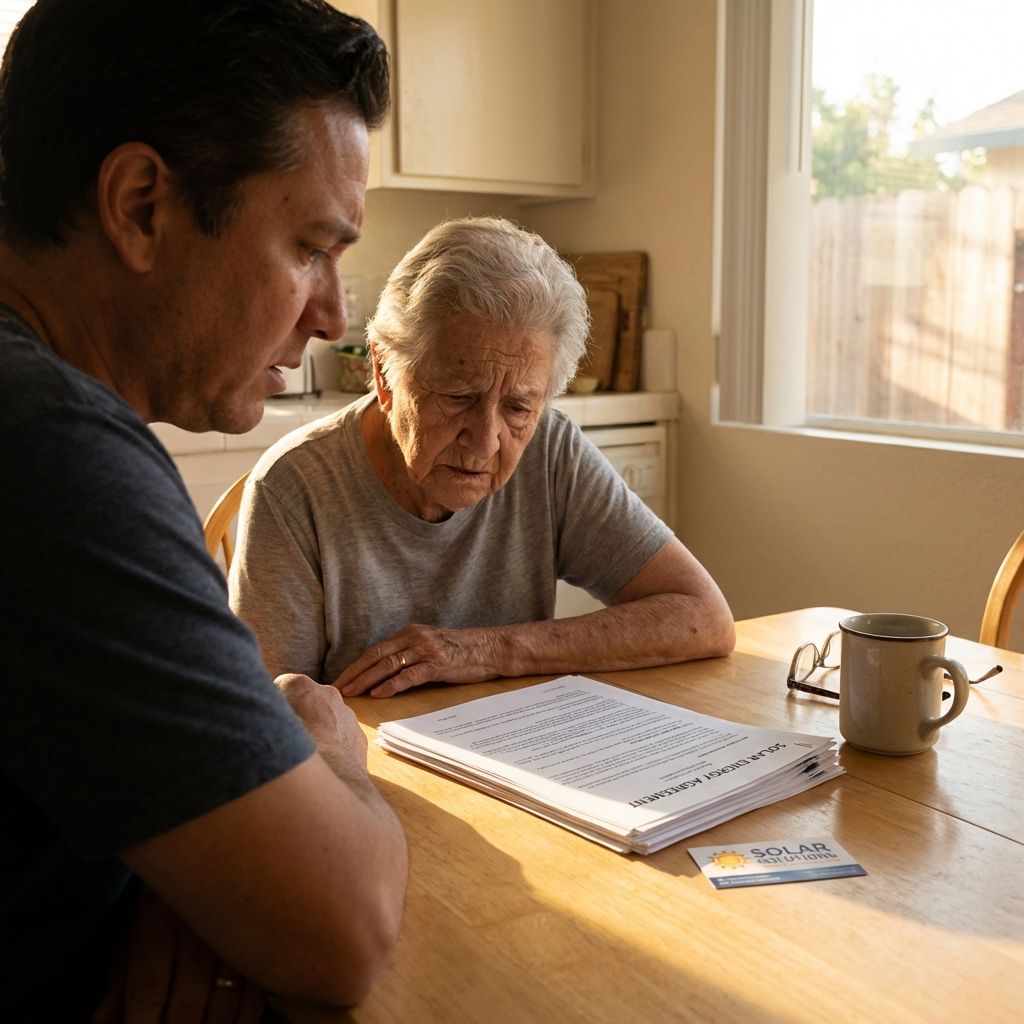
Not every California homeowner who ended up in a bad solar contract was simply unlucky. Consumer protection agencies and state attorney general offices have documented a consistent pattern: solar companies disproportionately target seniors on fixed income, non-English speakers, and lower-income homeowners — the populations least equipped to evaluate a complex 25-year financial contract under high-pressure sales conditions.
The CFPB found that one-third of the 8.4 million solar direct mail pieces sent between 2021 and 2023 targeted adults over 60. That is not coincidence. It is strategy.
Why These Groups Are Targeted
The targeting is deliberate and economically rational from the solar company's perspective. Here's why each group is specifically sought out:
Seniors on fixed income — retirees often own their homes outright, have established credit histories, and are home during the day when door-to-door sales teams are working. They are also less likely to have a family member present to review a contract, more likely to trust an authority figure, and — critically — more likely to have low tax liability, making the tax credit promises that drive many sales conversations impossible for them to fully realize.
Non-English speakers — California's large Spanish-speaking population has been specifically targeted by solar companies that conduct the sales pitch in Spanish but present the contract in English. California Civil Code Section 1632 requires that contracts negotiated in Spanish must be provided to the consumer in Spanish before signing. Many solar companies have violated this requirement systematically.
Lower-income homeowners — utility bills represent a larger percentage of household income for lower-income families, making the promise of reduced energy costs particularly compelling. Predatory solar financing structured around dealer fees and escalators hits these households hardest when the promised savings don't materialize.
The Specific Tactics Used
Consumer protection filings and attorney general complaints reveal consistent sales tactics used against vulnerable populations:
"Freezing" energy costs for seniors — salespeople told seniors on fixed income that solar would "lock in" or "freeze" their energy costs for 25 years. What they omitted: the escalator clause that increases the payment every year. A senior told their costs would be frozen while signing a contract with a 2.9% annual escalator was misled about a material contract term.
Government impersonation — salespeople claiming to represent SCE, PG&E, SDG&E, or a government energy efficiency program to gain entry and trust. The FTC's Impersonation Rule, effective April 2024, makes this practice specifically illegal.
Rushed signings without translation — non-English speaking homeowners were walked through e-signature processes in a language they didn't understand, initialing documents without meaningful comprehension of the terms.
Targeting through direct mail and door-knocking — CFPB data shows concentrated direct mail campaigns in ZIP codes with high concentrations of seniors and Hispanic households throughout California's Central Valley, Inland Empire, and San Diego County.
Isolation tactics — sales visits conducted when adult children or other family members weren't present, sometimes explicitly scheduled to avoid family members who might ask harder questions.
What California Law Provides
California has some of the strongest elder and consumer protections in the country, and several apply directly to predatory solar targeting.
California Elder Abuse and Dependent Adult Civil Protection Act (Welfare and Institutions Code Section 15600+) — provides enhanced protections for adults over 65 against financial abuse, including solar contracts entered under undue influence or misrepresentation. Remedies include treble damages and mandatory attorney fees in successful cases.
California Civil Code Section 1632 — requires that any contract for goods or services over $250, negotiated primarily in Spanish, be provided to the consumer in Spanish before signing. Violation gives the consumer the right to rescind the contract.
California Unruh Civil Rights Act — prohibits discrimination in business transactions. Targeting specific populations with predatory terms that wouldn't be offered to others may implicate this statute.
California Unfair Competition Law (Business and Professions Code Section 17200) — the broad "unfair" prong covers business practices that are oppressive or substantially injurious to consumers, even without technical fraud. Systematic targeting of vulnerable populations with escalating contracts they can't afford to exit fits squarely within this framework.
FTC Impersonation Rule (effective April 2024) — makes it specifically illegal for any business to impersonate a government entity or utility company during a sales pitch. Civil penalties apply.
Signs Your Sale May Have Been Predatory
Not every sale to a senior or non-English speaker is predatory. These indicators, taken together, suggest a case worth reviewing:
- The sale was conducted in a language other than English but the contract was only in English
- The buyer is over 65 on fixed income with a 20–25 year contract and a tax liability below 30% of system cost
- The sales visit occurred when family members were not present, and the salesperson discourraged calling them
- The salesperson claimed to represent a utility company or government program
- The buyer was told their costs would be "frozen" or "locked in" without disclosure of the escalator
- The contract was signed the same day as the first sales visit with no cooling-off notice provided
- The buyer has no meaningful memory of what they agreed to
Three or more of these indicators in a single case is a strong signal that consumer protection law may provide relief.
Frequently Asked Questions
Can a senior rescind a solar contract signed years ago? Potentially yes, depending on the grounds. California's elder abuse statutes have specific limitations periods, and the cooling-off rule violation — if the cancellation notice was never properly given — may create an ongoing right to cancel regardless of how much time has passed. Each case is fact-specific.
My parent signed a solar contract I'm concerned about. What can I do? If your parent is over 65 and you believe they were misled, you may have standing to pursue a claim on their behalf depending on the circumstances. Document everything — the contract, the sales materials, the sales visit date, and what your parent recalls being told. A free contract review is the right first step.
What if the contract was in English but my family member doesn't read English well? If the negotiation was conducted primarily in Spanish and the contract was only provided in English, California Civil Code Section 1632 may give your family member the right to rescind regardless of whether they signed.
Does it matter if the solar company has since gone bankrupt? It complicates the picture but doesn't eliminate your rights. The contract has likely been transferred to a third party — a lender, servicer, or acquiring company. Consumer protection claims may still be available against the original seller depending on the timing and the nature of the transfer.
Were you or a family member sold solar under these circumstances? Book a free consultation or call (213) 579-5156. We review contracts for seniors and non-English speaking homeowners across all of California — remote consultations available.
Other insights
More from California Solar Exit