Latest insights
Is Your Solar Arbitration Clause Enforceable? What Cabatit v. Sunnova Corp. Means for California Homeowners
Is Your Solar Arbitration Clause Enforceable? What Cabatit v. Sunnova Corp. Means for California Homeowners
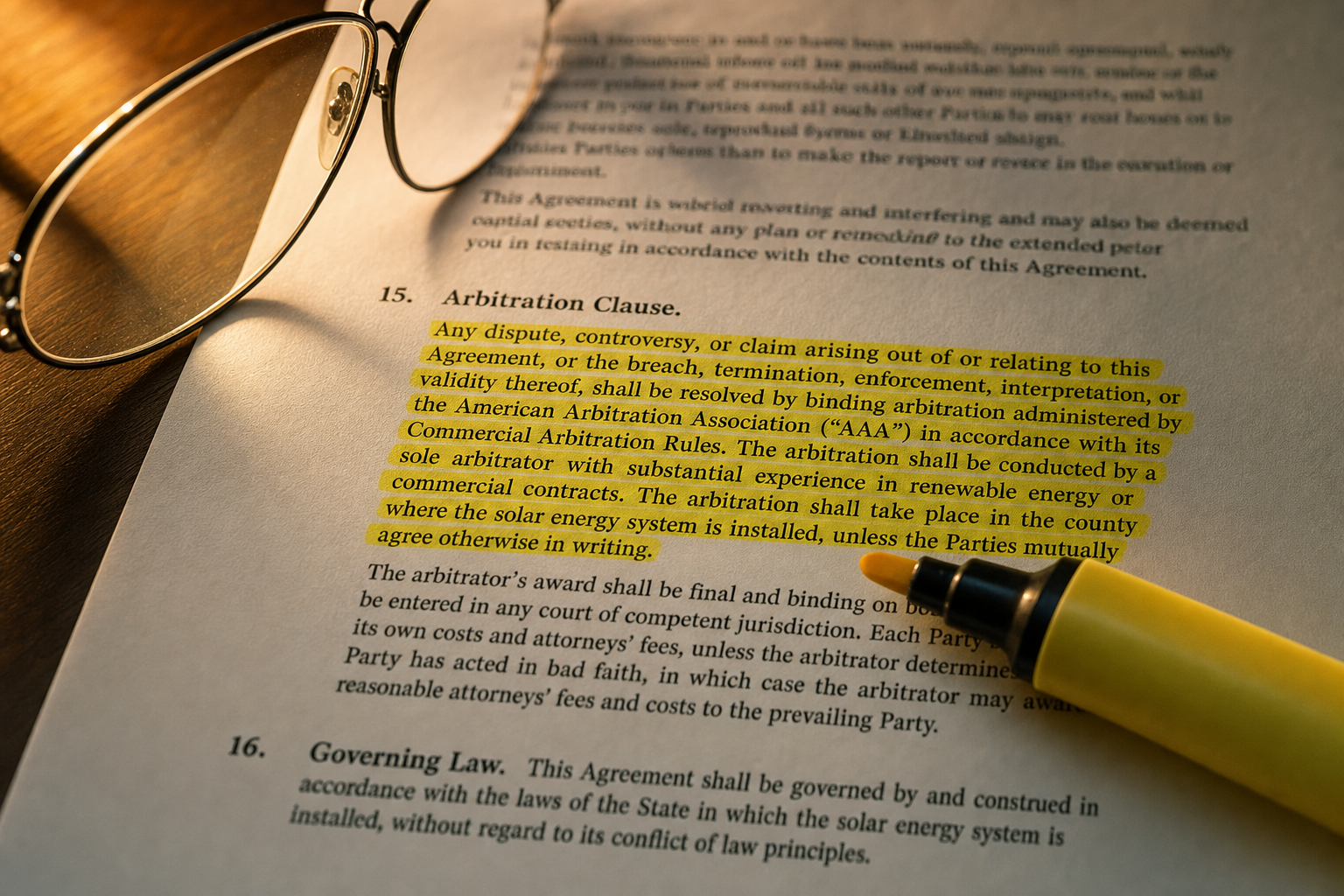
Quick answer: Most California solar contracts include a mandatory arbitration clause, meaning disputes go to a private arbitrator instead of a courtroom. But that clause isn't automatically enforceable. In Cabatit v. Sunnova Energy Corp. (2021), a California appeals court threw out Sunnova's arbitration clause entirely, ruling it unconscionable because the homeowners were never given a copy of the contract, the clause was never explained to them, and the terms were one-sided. If your contract shares those warning signs, your arbitration clause may be challengeable too.
What Happened in Cabatit v. Sunnova Energy Corp.?
In this real, published case from California's Third Appellate District, a couple signed a solar lease agreement with Sunnova Energy Corporation after a door-to-door sales visit. The salesperson scrolled through the contract on a screen, had the homeowner initial where indicated, and never explained the arbitration clause or provided a copy of the agreement. When the Cabatits later sued Sunnova over roof damage from the installation, Sunnova tried to force the case into arbitration. The trial court found the arbitration clause unconscionable and refused to enforce it — and the appeals court agreed, publishing the decision specifically so it could be cited in future cases.
What Makes an Arbitration Clause "Unconscionable" Under California Law?
California courts evaluate unconscionability on two fronts, and both generally need to be present. Procedural unconscionability looks at how the contract was presented — was it a take-it-or-leave-it agreement with no real opportunity to negotiate or review it? Courts treat standard-form consumer contracts as presumptively procedurally unconscionable, and it gets worse when a homeowner isn't given a copy or isn't told what they're agreeing to. Substantive unconscionability looks at the actual terms — are they one-sided? In the Cabatit case, the clause required homeowners to arbitrate while allowing Sunnova to file most of its own claims directly in court, which the court found had no legitimate justification.
Does Your Contract Show the Same Warning Signs as the Cabatits'?
A few specific facts worth checking against your own experience: were you given a full, signed copy of your contract at the time you signed, or only later, or not at all? Did the salesperson explain the arbitration clause specifically, or was it buried in pages you were rushed through? Does the arbitration requirement apply only to you, while the solar company reserves the right to sue you directly in court for certain claims like non-payment? Was English not your first language, and was the contract never offered in the language actually used during the sales conversation? None of these alone guarantees a clause is unenforceable, but they're the same fact pattern that succeeded in Cabatit.
Does This Mean Arbitration Is Always Bad for You?
Not necessarily, and it's worth being honest about that. Arbitration isn't automatically worse for homeowners — it can move faster than court litigation, and there are documented cases of homeowners winning outright in arbitration against major solar lenders. The real issue in Cabatit wasn't arbitration itself, it was that the clause was imposed without disclosure and structured to favor only one side. A properly disclosed, mutual arbitration clause is a different situation from one that mirrors what happened to the Cabatits.
What About McGill v. Citibank and Public Injunctive Relief?
This is a related but separate legal principle worth knowing. Under McGill v. Citibank, N.A. (2017), the California Supreme Court held that an arbitration clause cannot force a consumer to waive their right to seek "public injunctive relief" under statutes like the Consumer Legal Remedies Act, the Unfair Competition Law, or the False Advertising Law — remedies that benefit the public generally, not just the individual consumer. Sunnova actually raised McGill as part of its appeal in Cabatit, though the court's unconscionability finding meant it didn't need to resolve that question separately. Either doctrine can be relevant depending on the specific claims involved in your situation.
What Should You Do If You Think Your Arbitration Clause Is Unenforceable?
Start by pulling your actual signed contract and comparing what you were given, and when, against what the arbitration clause itself requires. Document whether the clause was explained to you, whether it applies equally to both parties, and whether you received a translated copy if your sales conversation happened in a language other than English. This isn't something to resolve by arguing with a customer service line — a formal legal challenge to an arbitration clause's enforceability is exactly the kind of specific, fact-intensive claim our contract review process is built to evaluate. If misrepresentation was involved in your original sale more broadly, our guide to spotting a solar scam covers the related red flags worth documenting too.
FAQ
Do all California solar contracts require arbitration?
Most do, though not universally — some major lenders, like Service Finance and Dividend, have historically not included arbitration clauses in their contracts. Check your specific agreement rather than assuming.
What did the court decide in Cabatit v. Sunnova?
The court ruled Sunnova's arbitration clause unconscionable and unenforceable because the homeowners weren't given a copy of the contract, the clause wasn't explained, and the terms were one-sided in the company's favor.
Does an unfair arbitration clause mean my whole solar contract is void?
Not automatically. A successful unconscionability challenge typically invalidates the arbitration clause specifically, allowing your dispute to proceed in court, rather than voiding the entire underlying contract on its own.
Is arbitration always bad for solar homeowners?
No. Arbitration can move faster than litigation, and homeowners have won cases in arbitration against major solar lenders. The issue in Cabatit was the way the clause was imposed and structured, not arbitration as a concept.
What is public injunctive relief, and why does it matter for solar contracts?
It's relief that benefits the public generally, not just the individual consumer, under statutes like the CLRA and Unfair Competition Law. Under McGill v. Citibank, arbitration clauses cannot force consumers to waive the right to seek it.
Not sure if your solar contract's arbitration clause is actually enforceable?
Get a free, no-pressure contract review. Call (213) 579-5156 or visit californiasolarexit.com.
Daniel Merritt is a Senior Solar Contract Analyst at California Solar Exit with over a decade of experience evaluating residential solar lease, PPA, and loan agreements under California consumer protection law.
Other insights
More from California Solar Exit