Latest insights
Solar Scams in California: How the Tactics Work, Your Legal Rights, and What to Do If You've Already Signed
Solar Scams in California: How the Tactics Work, Your Legal Rights, and What to Do If You've Already Signed
Quick answer: Most California solar companies are legitimate, but the state's residential solar market — the largest in the country — has drawn a persistent minority of bad actors. The most common tactics are false "free solar" claims, fake utility affiliation, high-pressure same-day signing, hidden dealer fees buried in financing, and savings projections built on outdated or expired tax and export-rate assumptions. California law gives you real protections, including a right to cancel within 3–5 days of signing and consumer fraud remedies that extend well beyond that window if you were misled.
If you're searching "solar scam California" right now, you're probably in one of two situations: you're being pitched right now and something feels off, or you already signed and you're trying to figure out whether what happened to you was actually illegal. This guide covers both.
What Counts as a Solar Scam in California?
Not every disappointing solar deal is a scam in the legal sense — but a documented pattern of misrepresentation, undisclosed fees, or high-pressure sales tactics can cross into fraud, deceptive trade practice, or elder financial abuse under California law. The Contractors State License Board has formally warned California consumers about misleading door-to-door and direct-mail solar advertising, and the California Public Utilities Commission requires every solar customer connecting to PG&E, SCE, or SDG&E's grid to sign a mandatory consumer protection disclosure specifically because false claims are common enough to require it.
The Most Common Solar Scam Tactics California Homeowners Report
"Free solar" and government program pitches. A salesperson claims a government program covers the full cost of your system. There is no such program in California — what you're actually signing is a 20–25 year loan or PPA, and "free" is doing the work of hiding the interest rate and total repayment amount.
Fake utility affiliation. Some reps imply they work with or for PG&E, SCE, or SDG&E, or that they're scheduling a mandatory "energy audit." Utilities do not send solar salespeople to your door. Any suggestion otherwise is a serious red flag.
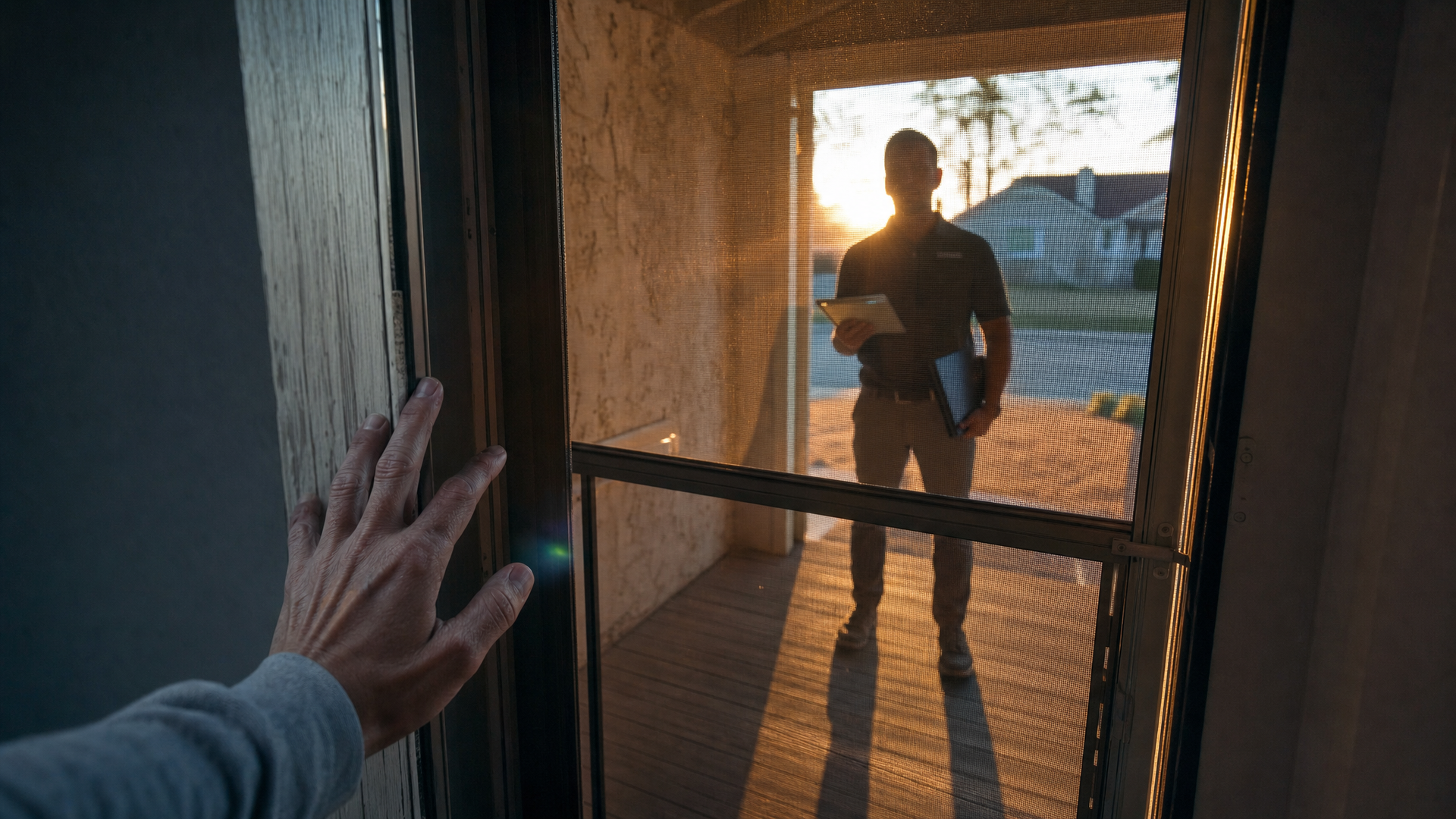
High-pressure, same-day signing. Urgency is the tell — claims that a rebate expires today, that rates are about to spike, or that a neighbor just locked in a special deal. Legitimate installers don't need you to decide before dinner.
Hidden dealer fees baked into financing. Solar lenders routinely charge "dealer fees" that inflate your loan principal without appearing as a line item — we've documented this in detail for GoodLeap loans specifically, where fees have run 10–35% of system cost.
Undisclosed escalator clauses. A lease or PPA payment that climbs 2.9–3.9% every year can turn a $130 monthly payment into $230+ by year 20 if it was never clearly explained at signing. We break down exactly how this works in our solar escalator clause guide.
Savings projections built on outdated math. Contracts sold before April 2023 often assumed export credit rates that no longer exist under NEM 3.0, and contracts sold in 2025 or 2026 sometimes still reference the federal residential solar tax credit as if it's available — it expired for residential systems at the end of 2025. If your quoted savings depended on either of those, the math was wrong before you ever signed.
Unlicensed or unverifiable contractors. California requires solar installers to hold an active CSLB license. Reps who can't produce one, or who rush past the question, are a hard stop.
Is Solar Itself a Scam, or Just Some of the Sellers?
Solar itself isn't a scam — millions of California homeowners have systems that perform as promised and save real money. The problem is concentrated in the sales layer: door-to-door and telemarketing channels that pay commission on the size of the deal, not its accuracy, and that operate largely disconnected from the installer's own reputation. That's also why the same bad tactics keep surfacing across different company names — including installers that have since gone bankrupt and left customers without a clear point of contact for warranty or service issues.
What Legal Protections Do California Homeowners Have?
California's Home Solicitation Sales Act, codified in Business and Professions Code §7159, gives you the right to cancel a contract signed at your home within 3 business days — 5 days if you're 65 or older — for any reason, no penalty. Beyond that window, homeowners misled during the sales process may have claims under the state's Unfair Competition Law (§17200) and the Consumer Legal Remedies Act (Civil Code §1750). As of January 1, 2026, SB 784 also requires solar dealers to disclose dealer fees upfront — a protection that didn't exist for contracts signed before that date, which is exactly why we cover how to use that gap in our guide to filing a solar complaint in California. Homeowners 65 and older may also qualify for enhanced remedies under California's elder financial abuse statutes, which we detail in our full guide to getting out of a solar contract.
Already Signed and Think You Were Scammed? Here's Where to Start
If what you're reading above sounds like your situation, don't try to piece together a plan from scratch. Start here:
- Not sure if your specific contract qualifies? See our 9 warning signs it's time to cancel
- Know you were misled and want next steps? Read what to do if you were scammed by a solar company
- Building your case? Our documentation checklist tells you exactly what to collect before evidence disappears
- Have a lease specifically? See how to cancel a solar lease in California
- Have a PPA instead? See solar PPA cancellation options
- Not sure which one you signed? Our loan vs. lease breakdown walks through the difference
How Do I Report a Solar Scam in California?
Beyond pursuing cancellation of your own contract, you can report deceptive solar sales to the CSLB, the CPUC, the California Attorney General, and — for financing-related issues — the DFPI, along with the FTC at ReportFraud.ftc.gov. We walk through exactly which agency handles which type of complaint, with direct links, in our step-by-step solar complaint guide. The FTC's own consumer guidance is also a useful independent reference if you want to verify any of this outside of what we tell you.
FAQ
Is solar a scam in California?
No — most California solar installations perform as promised. The scams are concentrated in a minority of sales channels using deceptive tactics like false utility affiliation, hidden fees, and outdated savings projections, not in solar technology itself.
What's the most common solar scam in California right now?
Savings projections that don't account for NEM 3.0's reduced export rates or the expired federal tax credit are currently the most widespread issue, since many homeowners signed contracts built on numbers that are no longer accurate.
How long do I have to cancel a solar contract in California?
You have 3 business days to cancel for any reason under the Home Solicitation Sales Act — 5 days if you're 65 or older. After that window, cancellation depends on whether you can show misrepresentation, non-disclosure, or another statutory violation.
Can I still cancel if it's been months since I signed?
Possibly. The 3-5 day window is a no-penalty right, but separate claims under California's Unfair Competition Law or Consumer Legal Remedies Act can apply well beyond that if you were misled during the sales process — a free contract review can tell you whether your situation qualifies.
Where do I report a solar company for deceptive sales practices?
File complaints with the CSLB, CPUC, the California Attorney General, the DFPI for financing issues, and the FTC at ReportFraud.ftc.gov. Our complaint guide breaks down which agency to use for your specific issue.
Think you were misled by a solar company in California?
Get a free, no-pressure contract review. Call (213) 579-5156 or visit californiasolarexit.com.
Daniel Merritt is a Senior Solar Contract Analyst at California Solar Exit with over a decade of experience evaluating residential solar lease, PPA, and loan agreements under California consumer protection law. He has reviewed thousands of contracts from GoodLeap, Mosaic, Sunnova, Sunrun, and Freedom Forever for homeowners across Los Angeles, Orange County, San Diego, and the Inland Empire.
Other insights
More from California Solar Exit