Latest insights
Your Federal Legal Rights Against Solar Fraud: FTC, TILA, and CFPB Explained
Your Federal Legal Rights Against Solar Fraud: FTC, TILA, and CFPB Explained
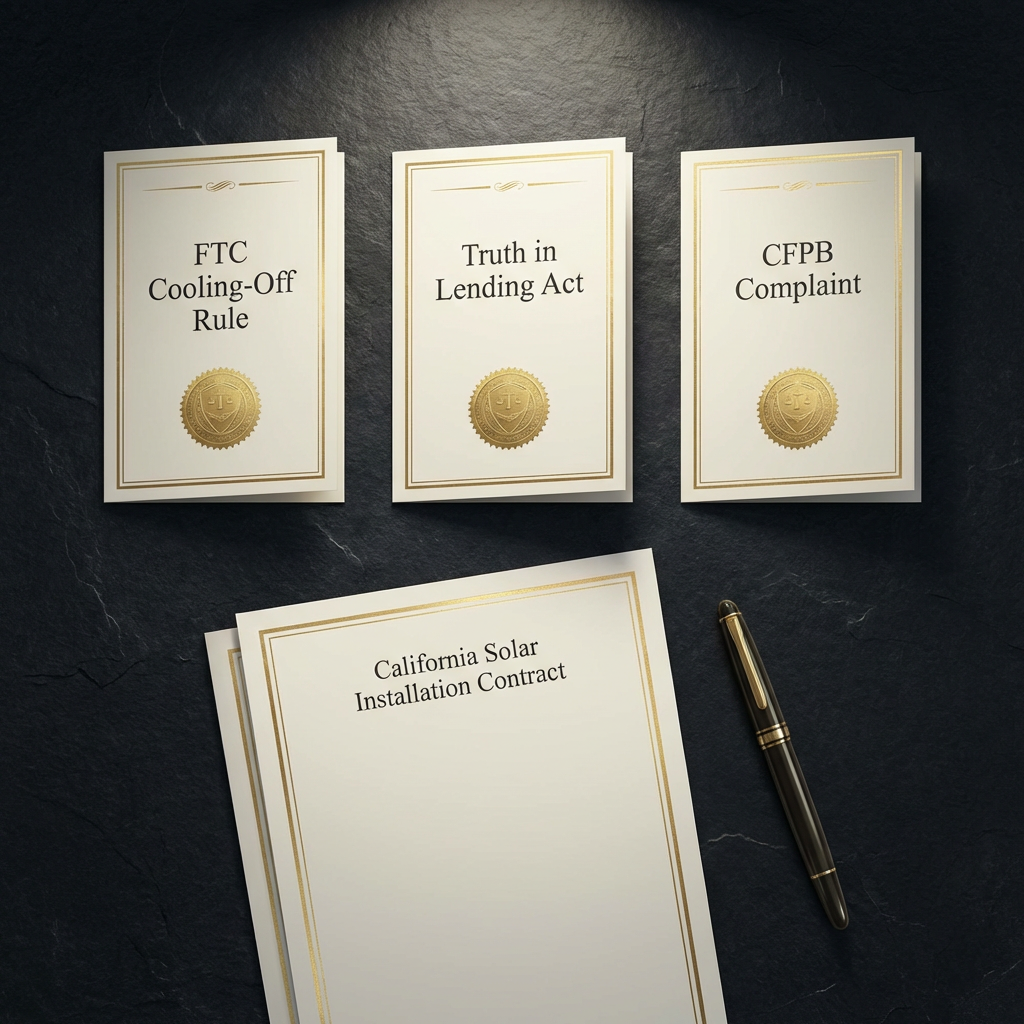
Most California homeowners who've been misled by a solar company don't realize they have federal protections — not just state ones. Three separate federal laws apply directly to the most common solar fraud patterns, and each one carries its own remedies that exist independent of anything California law provides.
Understanding these laws doesn't require a law degree. It requires knowing which one applies to your situation — and what it actually gives you.
The FTC Cooling-Off Rule (16 CFR 429)
This is the single most powerful and most frequently violated federal protection in residential solar sales.
What it does: Gives you three business days to cancel any sale of $25 or more made at your home — or anywhere other than the seller's permanent place of business.
What it requires of the seller: Two copies of a written "Notice of Cancellation" form must be provided at the time of sale, on a document separate from the main contract, with its own signature line. The seller must also inform you verbally of your right to cancel.
Why it matters for solar: Door-to-door solar sales are the primary target of this rule. If the cancellation form was not provided, provided incorrectly, or buried inside the main contract rather than on a separate document, the violation is established. The consequence: your cancellation window may never have legally started — meaning the right to cancel may still be open today regardless of how long ago you signed.
Enforcement and remedies: The FTC enforces this rule and private right of action exists in most states. In California, Civil Code Section 1689.5 reinforces and in some cases extends the federal baseline, providing additional state-level remedies on top of the federal protections.
The Truth in Lending Act (TILA) and Regulation Z
If your solar system was financed through a loan, TILA is the federal law most directly relevant to hidden dealer fees and undisclosed finance charges.
What it does: Requires lenders to clearly disclose the true cost of credit before you sign — including the APR, all finance charges, the total amount financed, the total of all payments, and the payment schedule.
Why it matters for solar: The CFPB has documented that solar lenders routinely add dealer fees of 10–30% to loan balances without clearly disclosing them as finance charges. A $40,000 system becomes a $50,000–$52,000 loan. If the dealer fee was not clearly disclosed as part of the finance charge calculation — if the loan documents simply showed a total financed amount without explaining why it exceeded the system's cash price — there is a potential TILA violation.
Enforcement and remedies: TILA violations carry statutory damages of up to $4,000 per violation in individual cases, plus actual damages and attorney fees. In cases involving significant disclosure failures, rescission of the loan — cancellation of the entire financing agreement — is available for up to three years from the date of the transaction.
The three-year rescission window under TILA is particularly significant. Many California homeowners who financed solar in 2022 and 2023 may still be within the rescission period if their loan documents contained material disclosure failures.
CFPB Consumer Financial Protection
The Consumer Financial Protection Bureau doesn't create a private right of action the way TILA does — but its role in the solar fraud landscape is significant for two reasons.
What it does: The CFPB oversees consumer financial products, including solar loans. It has authority to investigate lenders, issue civil penalties, and require remediation for affected consumers.
Why it matters for solar: The CFPB has published multiple reports specifically documenting hidden dealer fees, deceptive loan structures, and predatory lending practices in residential solar financing. These reports carry significant evidentiary weight in consumer protection claims — when a homeowner argues their lender engaged in undisclosed dealer fee practices, CFPB findings documenting the same practice across the industry strengthen that argument considerably.
In August 2024, the CFPB joined the FTC and U.S. Treasury in a joint interagency partnership specifically targeting deceptive solar sales. This coordination signals active federal enforcement attention on the industry.
How to use it: File a complaint directly at consumerfinance.gov/complaint. Each complaint creates an official record, triggers a required response from the lender, and contributes to the evidentiary record supporting broader enforcement action. Filing costs nothing and takes approximately 15 minutes.
The FTC Impersonation Rule (Effective April 2024)
This is the newest federal protection and directly addresses one of the most common solar sales tactics — salespeople claiming to represent your utility company or a government program.
What it does: Makes it specifically illegal for any business to impersonate a government entity, government official, or another business during the course of marketing or sales.
Why it matters for solar: "We're here from SCE about your solar eligibility" is a direct violation of this rule if the salesperson is not actually from SCE. Claiming to represent a government energy efficiency program, the Department of Energy, or any utility company during a sales pitch — when you don't — is now a specifically enumerated federal offense carrying civil penalties.
Enforcement: FTC civil penalties. If you believe a solar salesperson impersonated a utility or government entity during your sales visit, report it at reportfraud.ftc.gov and document the details of what was said as specifically as possible.
How These Laws Work Together
Federal and California state consumer protection laws are not mutually exclusive. A single solar sale can violate the FTC Cooling-Off Rule, TILA, and California Business and Professions Code Section 17200 simultaneously. Each violation carries its own remedies, and pursuing one doesn't preclude pursuing others.
For most California homeowners, the strongest cases combine a federal violation — typically a cooling-off rule failure or TILA disclosure failure — with California's broader unfair competition law, which requires a lower threshold of proof and provides a four-year statute of limitations running from discovery.
Frequently Asked Questions
Do I need to file a federal complaint before pursuing a California claim? No. State and federal claims are independent. Filing an FTC or CFPB complaint is free and creates a useful record, but it's not a prerequisite to pursuing a California consumer protection claim.
How long do I have to bring a TILA claim? One year for damages claims from the date of the violation. Three years for rescission claims from the date of the transaction. The rescission window is the more powerful remedy and the more important deadline to track.
What does rescission under TILA actually mean? If a court grants rescission, the loan is cancelled — you return the panels (or their equivalent value) and the lender returns all payments made. In practice, most TILA rescission claims are settled before reaching that point, often through loan modification or principal reduction.
Can I bring a TILA claim against a lender even if my complaint is really with the solar installer? In some circumstances yes. TILA has provisions — particularly around affiliated business arrangements — that can create lender liability for installer conduct. This is fact-specific and depends on the relationship between your installer and lender.
Not sure which federal protections apply to your situation? Book a free consultation or call (213) 579-5156. We review solar contracts across all of California — remote consultations available.
Other insights
More from California Solar Exit