Solar energy was supposed to be one of the best financial decisions a California homeowner could make. For millions of people, it hasn't worked out that way.
Approximately 4.7–5 million U.S. homes now have rooftop solar. The residential solar market grew more than 700% in the last decade, driven by aggressive government incentives, falling panel costs, and door-to-door sales teams deployed across every major Sun Belt market. But consumer complaints have grown even faster than the industry itself.
The FTC documented a sevenfold increase in solar consumer complaints between 2012 and 2016 — and the pace has accelerated sharply since. State-level complaints have surged more than 500% since 2018. Attorney general offices in California, Florida, Texas, and Arizona now maintain dedicated solar complaint intake systems. That's not a coincidence — it's a systemic response to a systemic problem.
When Three Federal Agencies Coordinate, the Problem Is Real
In August 2024, the CFPB, FTC, and U.S. Treasury took the rare step of forming a joint interagency partnership specifically to combat deceptive solar sales practices. When three federal agencies coordinate enforcement action on a single industry, that signals the problem goes well beyond individual bad actors.
Among the most alarming findings: the CFPB documented that solar lenders routinely add hidden "dealer fees" of 10–30% to loan balances above the actual cash price of the system. A $40,000 solar installation becomes a $50,000–$52,000 loan — and the homeowner typically has no idea. With 58% of all residential solar projects in 2023 financed through loans, this exposes an enormous pool of consumers to predatory lending terms.
Why California Is Ground Zero
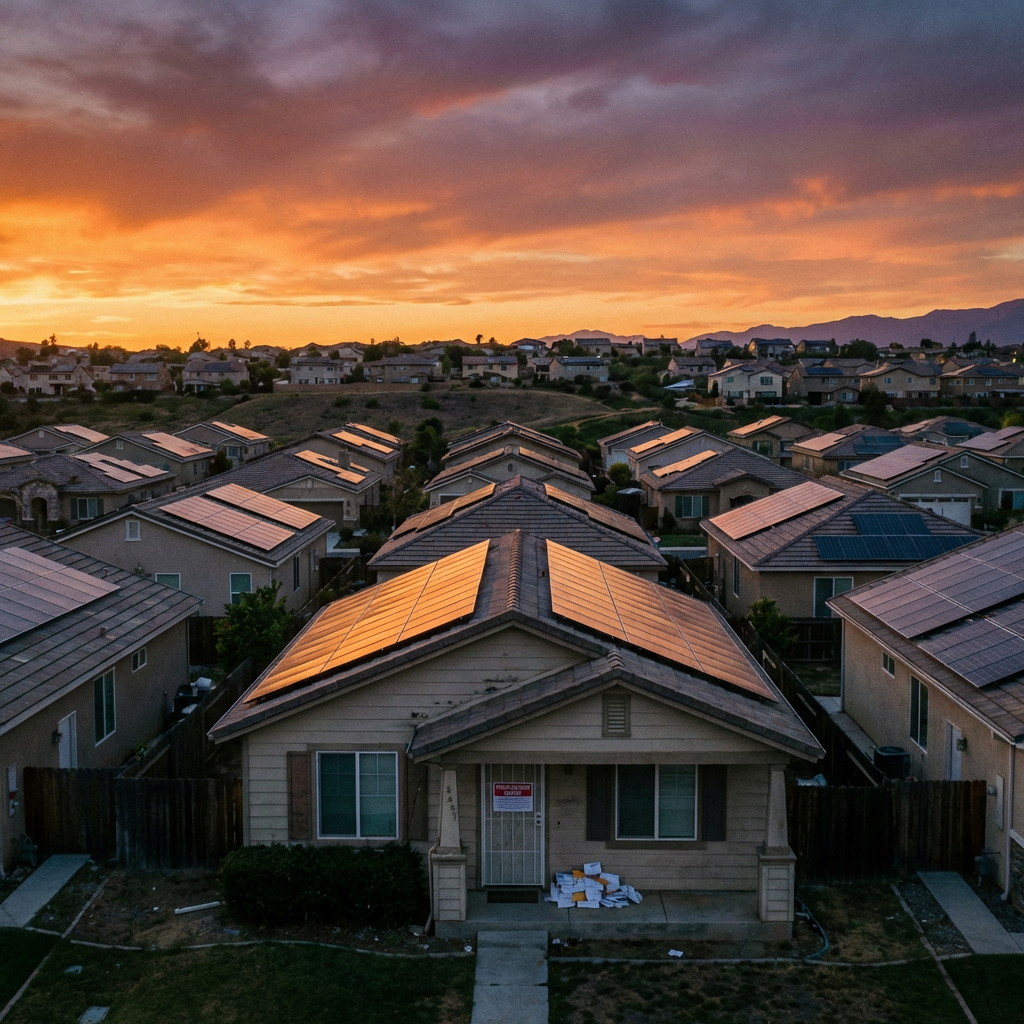
California has more rooftop solar than any other state — and more solar complaints. Several factors converge here specifically:
NEM 3.0 — the net energy metering reform that took effect in April 2023 — dramatically reduced the export credits California homeowners receive for sending excess solar power back to the grid. Systems sold before NEM 3.0 were projected under the old, more favorable rate structure. Homeowners who signed contracts in 2021 and 2022 are now discovering their actual savings are a fraction of what they were promised.
Aggressive door-to-door sales culture — California's warm climate and high utility rates made it the primary target market for large national solar companies deploying door-to-door sales forces. Many of these companies — including SunPower, Sunnova, and dozens of smaller regional operators — have since gone bankrupt, leaving homeowners with active contracts held by third parties they never agreed to work with.
High loan amounts — California's higher home values and larger systems mean loan amounts frequently exceed $40,000–$60,000. Hidden dealer fees at 10–30% represent $4,000–$18,000 in undisclosed costs on a single transaction.
The 7 Most Common Ways California Homeowners Get Trapped
The solar complaint crisis isn't random. The same patterns appear across thousands of cases:
- Inflated savings promises — projections built on best-case production numbers that don't match real-world output
- Hidden dealer fees — loan amounts 10–30% higher than the actual system cost, rarely disclosed at signing
- Tax credit misrepresentation — homeowners told they'd receive the 30% federal ITC as a refund check, when it's actually a credit against taxes owed
- Cooling-off violations — door-to-door contracts signed without the required written cancellation notice, meaning the right to cancel may never have legally started
- The escalator trap — annual payment increases of 1.9–3.5% that can nearly double a monthly payment over 25 years
- Forged or incomplete documentation — contracts signed on tablets where homeowners never saw the full terms, with supplementary pages sometimes added after signing
- Predatory targeting — seniors on fixed income and non-English speakers disproportionately sold contracts they couldn't fully evaluate
What California Law Actually Gives You
California homeowners have the strongest solar consumer protections in the country. California Business and Professions Code Section 17200, combined with Civil Code 1689.5, provides both a broad private right of action for unfair business practices and an indefinite cooling-off period if the required cancellation notice was never properly given.
That last point matters more than most homeowners realize. If the salesperson who came to your door didn't provide a separate written "Notice of Cancellation" form with its own signature line — as required by federal law under FTC Cooling-Off Rule 16 CFR 429 — your right to cancel may never have legally expired.
You're Not Stuck. But You Need to Know Where You Stand.
The single biggest mistake California solar homeowners make is assuming that because they signed something, they're permanently bound by it. Consumer protection law exists precisely because contracts signed under misrepresentation, incomplete disclosure, or high-pressure tactics are not always enforceable.
The first step is understanding what your contract actually says — and what it should have said.
Book a free consultation or call
(213) 579-5156. California Solar Exit reviews solar contracts across all contract types — leases, PPAs, and loans — at no cost before you commit to anything. We serve homeowners across all of California with remote consultations available.