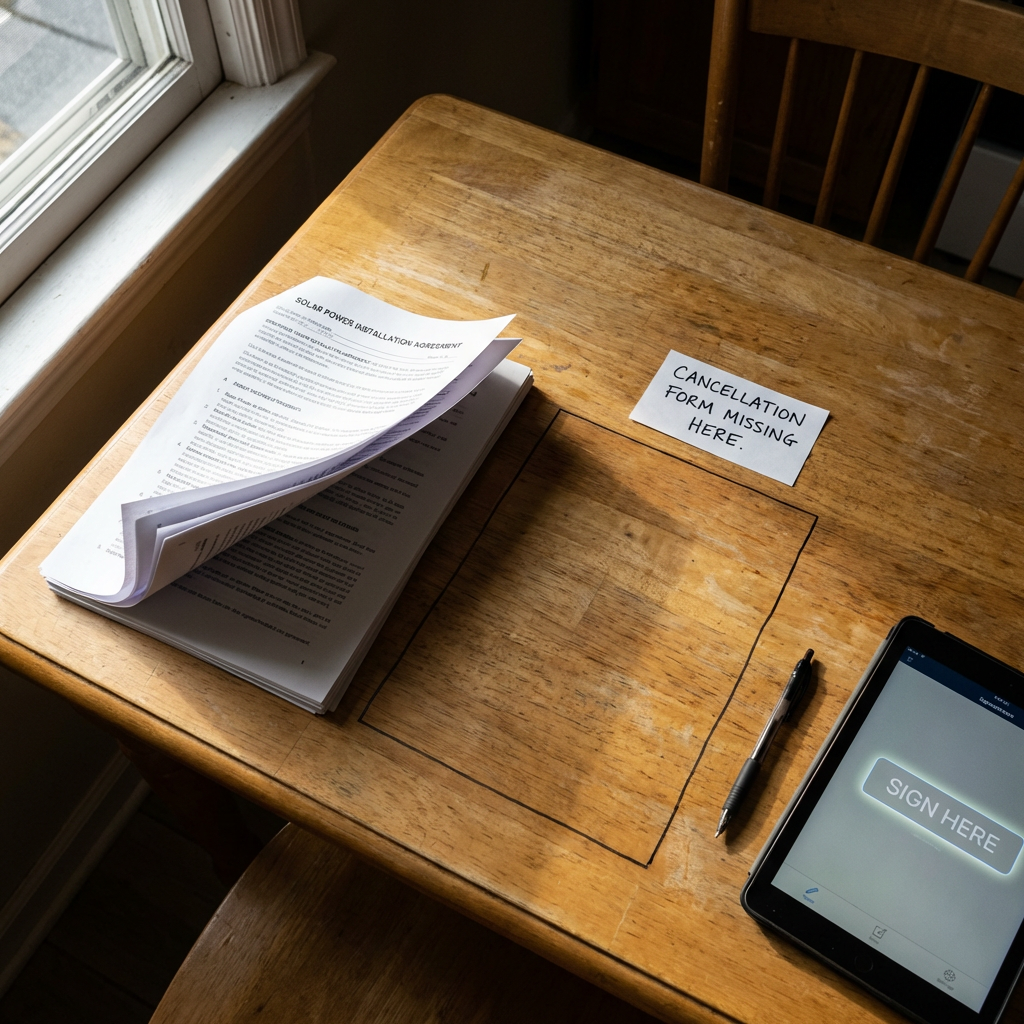
If a salesperson came to your door, gave you a pitch, and got you to sign a solar contract on the spot — there's a federal law that was supposed to protect you. Many solar companies either didn't follow it, or followed it badly enough that your right to cancel may never have legally started.
This is not a technicality. It is one of the most powerful and underused consumer protections available to California solar homeowners.
The FTC Cooling-Off Rule (16 CFR 429)
Under federal law, any sale of $25 or more made at your home — or anywhere other than the seller's permanent place of business — must include a written 3-day right to cancel. The seller is required to:
- Inform you verbally of your right to cancel at the time of sale
- Provide you with two copies of a written "Notice of Cancellation" form
- That form must be on a separate document with its own signature line — not buried in the main contract
This is not optional. It is not a courtesy. It is a legal requirement, and it applies to every door-to-door solar sale in the United States.
What Most Solar Companies Got Wrong
In practice, solar companies violated this rule in several consistent ways:
No cancellation notice at all — the salesperson left with a signed contract and no separate cancellation form was ever provided.
Notice buried in the main contract — some companies included cancellation language inside the body of the main agreement rather than on a separate document with its own signature line. This does not satisfy the rule.
Electronic signing on a tablet — contracts signed on a tablet or phone during the sales visit often skipped the cancellation notice entirely, or presented it as a checkbox the homeowner scrolled past without reading.
Verbal mention only — telling a homeowner they have three days to cancel without providing the written form does not satisfy the requirement.
Why This Matters More Than You Think
Here is the critical consequence most homeowners don't know: if the required cancellation notice was not properly provided, your 3-day cancellation window may never have legally begun.
California's Civil Code Section 1689.5 reinforces this at the state level and in some cases extends the cooling-off period further than the federal baseline. Under California law, if the notice of cancellation was not given in the required form, the cancellation right remains open — potentially indefinitely.
This means a homeowner who signed a solar contract two or three years ago, without ever receiving a proper cancellation notice, may still have a legal basis to cancel that contract today.
How to Check Your Contract Package
Pull out everything you received at the time of signing — the main contract, any addenda, and any separate documents. You are looking for a document titled "Notice of Cancellation" that:
- Is separate from the main contract
- Has its own signature line or acknowledgment
- States clearly that you have the right to cancel within three business days
- Provides an address or method for submitting the cancellation
If that document doesn't exist in your contract package — or if the cancellation language only appears inside the body of the main agreement — the required notice was likely not properly given.
Also check whether you signed electronically on the day of the sales visit. If so, request a complete copy of everything you signed from the solar company and compare it against what you actually remember seeing.
Frequently Asked Questions
Does the cooling-off rule apply if I called the solar company and invited them to my home? Generally yes. The FTC rule applies to sales made at your home regardless of who initiated the visit, with narrow exceptions that don't typically apply to residential solar.
What if I signed at a home show or fair, not at my house? The rule applies to any location that is not the seller's permanent place of business. A booth at a county fair or home improvement expo qualifies — the seller's "place of business" means their actual office, not a temporary sales location.
If the cancellation window is still open, how do I cancel? Cancellation must typically be in writing, delivered to the company by the method specified in the notice — or by certified mail if no method was given. Do not cancel verbally or by phone only. Document everything.
Can I cancel even if installation is already complete? This is more complex once work has been performed, but a cooling-off violation doesn't automatically disappear because time has passed or panels are on the roof. The legal analysis depends on your specific facts, state law, and what remedies are available. Get a professional review before taking any action.
My contract has an arbitration clause — does that affect this? Arbitration clauses limit where disputes are resolved, not whether your legal rights exist. A cooling-off violation is still actionable in arbitration. Some California consumer protection claims also have specific exemptions from mandatory arbitration.
Not sure if you ever received a proper cancellation notice?
Book a free consultation or call
(213) 579-5156. We review contract packages across all of California — remote consultations available.