Latest insights
The Solar Escalator Trap: How a Small Annual Increase Can Double Your Payment
The Solar Escalator Trap: How a Small Annual Increase Can Double Your Payment
When the salesperson mentioned the annual escalator, they probably called it something like "a small adjustment to keep pace with inflation" or "a minor yearly increase." What they likely didn't show you was what that increase looks like in year 15, year 20, or year 25.
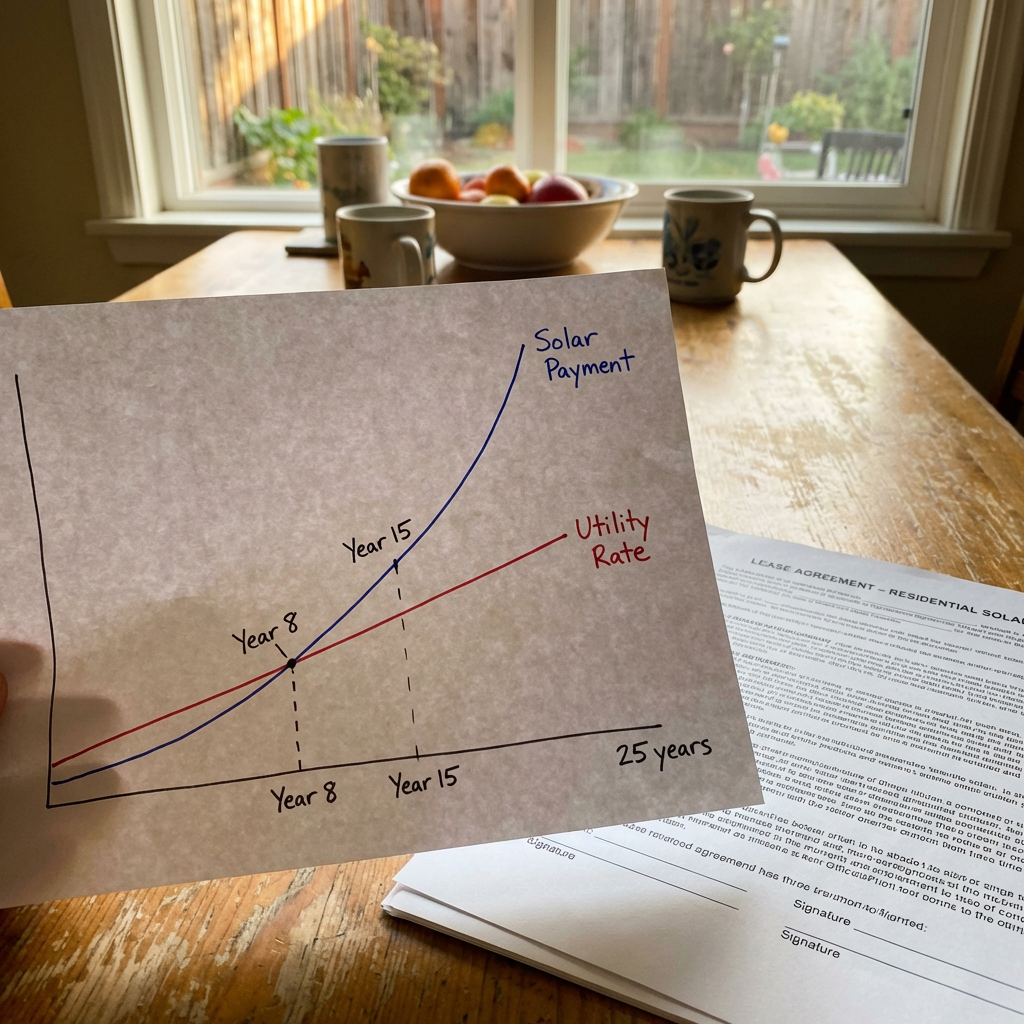
At 2.9% per year, your solar payment nearly doubles over the life of a 25-year contract. And in many parts of California, utility rates have not increased at the rate that was projected when your escalator was justified. Within 5–10 years, a significant number of homeowners are paying more for solar than they would have paid for grid power.
This is the escalator trap — and it's built directly into the contract terms of most California solar leases and PPAs.
How the Escalator Actually Works
A solar lease or PPA escalator is a contractual clause that increases your monthly payment by a fixed percentage every year for the life of the agreement. Typical escalator rates in California contracts run 1.9–3.5% annually.
Here's what that looks like in real numbers. If your starting payment is $150/month with a 2.9% escalator:
- Year 1: $150/month
- Year 5: $168/month
- Year 10: $194/month
- Year 15: $224/month
- Year 20: $259/month
- Year 25: $299/month — nearly double the starting payment
Over the full 25-year term, you'll pay approximately $56,000 on a contract that started at $150/month. A salesperson who showed you only the year-one payment and called the escalator "minor" was presenting an incomplete picture of your financial commitment.
The Utility Rate Assumption Problem
The escalator was typically justified during the sales pitch with a projection showing utility rates increasing faster than your solar payment. "Your utility bill will go up 5–6% a year," the salesperson said. "Your solar payment only goes up 2.9%. You'll always come out ahead."
There are two problems with this framing.
First, utility rate projections are estimates — and often optimistic ones designed to make the escalator look favorable by comparison. California utility rates have increased, but not uniformly, not predictably, and not always at the rates used in solar sales projections.
Second, NEM 3.0, which took effect in April 2023, changed the fundamental economics of California residential solar. Under the new net billing tariff, the value of excess solar energy exported to the grid dropped approximately 75% for most California utilities. A homeowner sold a lease in 2021 with projections showing robust export credit income now receives a fraction of that value — while their escalating payment continues to rise on schedule.
The gap between the projected savings and the actual outcome widens every year. By year 10, many California homeowners are paying more in combined solar and utility costs than they would have paid for grid power alone.
Finding the Escalator in Your Contract
Your escalator percentage is in your lease or PPA agreement — typically in a section labeled "payment schedule," "annual adjustment," or "escalation rate." It may also appear in a separate exhibit or addendum attached to the main contract.
To calculate what your payment will be in future years, multiply your current payment by 1.0X (where X is your escalator percentage) raised to the power of each remaining year. A 2.9% escalator is 1.029. Your year 10 payment is your current payment multiplied by 1.029 to the power of 10.
Compare that projected payment against current utility rates in your area using your utility's published tariff schedules — available on PG&E, SCE, and SDG&E's websites. If your solar payment in year 10 or 15 exceeds what you'd pay for grid power at current rates, the escalator has already made the contract economically unfavorable.
When the Escalator Becomes a Legal Issue
An escalator clause itself is not automatically illegal. What may be actionable is how it was presented — or not presented — during the sales process.
If the salesperson used utility rate escalation projections to justify your solar escalator but those projections were inflated or based on pre-NEM 3.0 assumptions, that may constitute misrepresentation under California's Unfair Competition Law. If the long-term payment schedule was never shown to you at signing — only the year-one payment — that omission may support a UDAP claim. And if the escalator was presented as matching or trailing utility rate increases when the salesperson had reason to know those projections were unrealistic, the case for misrepresentation strengthens further.
Frequently Asked Questions
Can I negotiate the escalator out of my contract? Some solar companies will negotiate escalator terms, particularly if you can demonstrate the projection used to justify it was inflated. Most won't do this voluntarily — but a documented misrepresentation claim changes the negotiating dynamic significantly.
What if my escalator is below 2%? Is that still a problem? Lower escalators compound more slowly, but the same analysis applies — if utility rates don't increase as projected, any escalator creates a growing payment gap over time. The question is whether the escalator was honestly presented in context of realistic utility rate projections.
Does the escalator apply to a solar loan? No. Solar loan payments are fixed at the interest rate set at origination and don't escalate annually. The escalator trap is specific to leases and PPAs where you don't own the system.
I'm selling my home — does the buyer have to accept my escalating payment? The buyer must either qualify to assume your lease or PPA — including the escalating payment schedule — or you must buy out the contract before closing. As your payment grows in later years, finding a buyer willing to assume it becomes increasingly difficult.
Concerned about where your escalating payment is heading? Book a free consultation or call (213) 579-5156. We review lease and PPA terms across all of California — remote consultations available.
Other insights
More from California Solar Exit