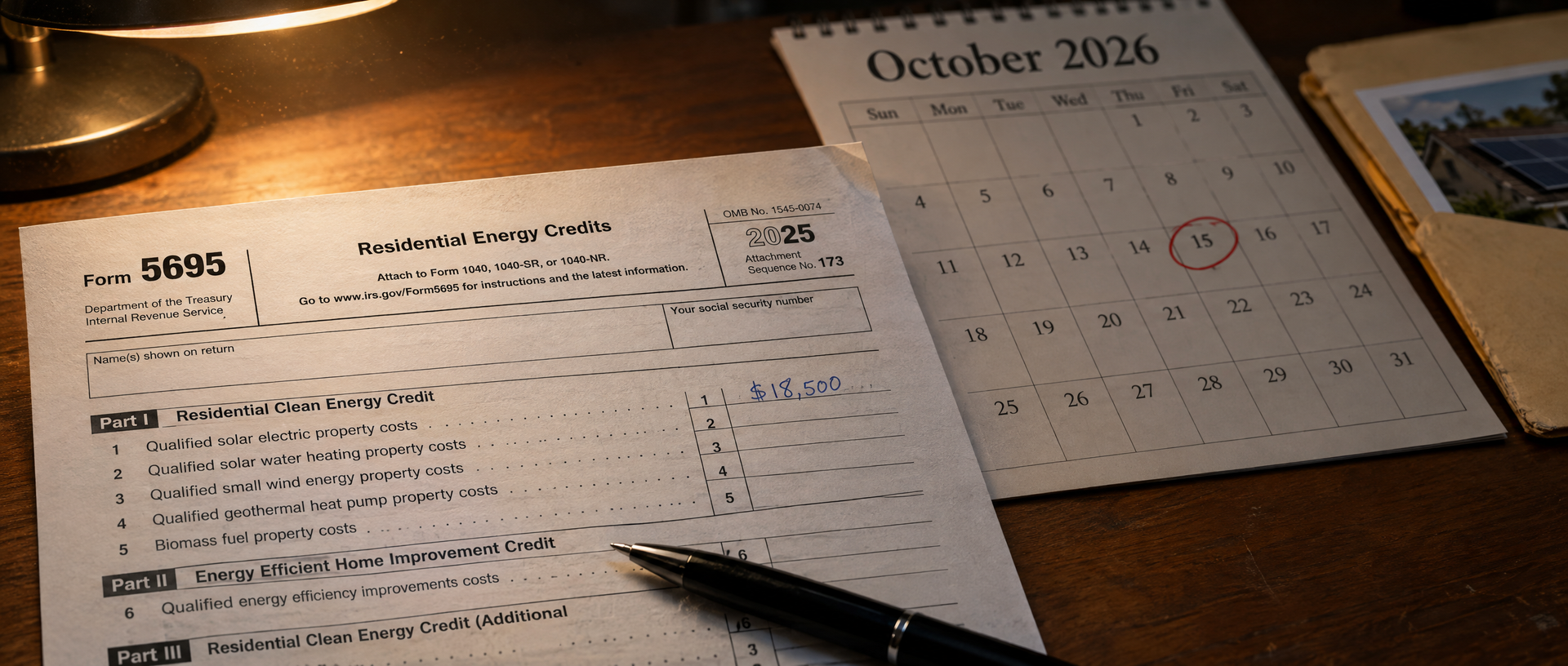
Every guide to the federal solar tax credit's expiration mentions the same date: April 15. That was the standard deadline to file your 2025 tax return and claim the 30% Residential Clean Energy Credit on a system placed in service before December 31, 2025 — the last year the credit existed at all before the One Big Beautiful Bill Act eliminated it entirely.
What almost nothing mentions is what happens if you filed for an extension. If you submitted IRS Form 4868 back in the spring, your actual filing deadline isn't April 15 — it's October 15. And since that credit is gone for good starting in 2026, with no phase-down and no way to claim it retroactively once this window closes, October 15 isn't just your extended tax deadline. It's your last real chance to claim 30% of your 2025 solar installation cost.
Why This Deadline Is Genuinely Different From a Normal Late Filing
Missing a normal tax deadline usually means penalties and interest, but the underlying credit or deduction is still there waiting for you the following year. This is different. Section 25D doesn't exist anymore for 2026 and beyond — there's no version of "I'll just claim it next year" available here. If your extended return isn't filed with Form 5695 attached by October 15, and you installed in 2025, the credit isn't delayed. It's gone, permanently, the same way it would be for someone who tried to install a brand-new system today and discovered there's nothing left to claim at all.
What "Placed in Service" Actually Means for Your 2025 Installation
This matters most for anyone who financed a system in 2025 counting on that credit as part of the math. If your salesperson built your savings projection around getting a third of the cost back from the IRS, and you haven't actually filed and claimed it yet, that number only becomes real once Form 5695 is filed with your return. An unclaimed credit isn't automatic — it's not something the IRS applies for you.
The credit hinges on your system being "placed in service" — a specific technical requirement, not just a contract signing date. Your system needs to have been fully installed, passed final inspection, and actually interconnected with your utility by December 31, 2025 to qualify at all. A system that was contracted in 2025 but didn't complete interconnection until January or later doesn't qualify, regardless of when you signed the paperwork or made your first payment. If there's any ambiguity about your actual interconnection date, that's worth confirming with your installer or your utility's records before you file, not after.
What You'll Actually Need Before October 15
A few things worth confirming before that date arrives:
Your installation paperwork showing the actual placed-in-service date, ideally your Permission to Operate documentation from your utility, since that's the clearest evidence of when your system actually went live rather than just when it was purchased or contracted.
Form 5695 attached to your return, filled out with your total qualifying system cost, since this is the specific form the credit is calculated and claimed on — it doesn't happen automatically just because you mention solar to your accountant.
An understanding of your actual tax liability for the year. If the credit amount is larger than what you owe in taxes, the unused portion can generally be carried forward to future tax years rather than being wasted outright, which is worth confirming with whoever's preparing your return if this applies to your situation.
If the Math Never Made Sense in the First Place
If you're not sure whether your 2025 installation actually qualifies, or whether the savings math you were originally sold on ever accounted for this correctly, that's a different question worth a real review — one that has nothing to do with a filing deadline and everything to do with what you were actually told at the time you signed. A salesperson who promised a tax credit without explaining that it depended on your actual tax liability, or who never mentioned the placed-in-service requirement at all, may have left you with a savings projection that was never accurate to begin with, regardless of whether you make this October deadline.
Installed solar in 2025 and want to make sure you're not leaving that credit on the table before October 15?
Or wondering whether your original savings pitch ever added up?
Call (213) 579-5156 or visit californiasolarexit.com.
Daniel Merritt is a Senior Solar Contract Analyst at California Solar Exit.