Latest insights
Solar Cancellation in California: What Actually Works, and What's Just a Sales Tactic

Solar Cancellation in California: What Actually Works, and What's Just a Sales Tactic
If you've searched "solar cancellation california" hoping for a straightforward answer, here's the honest one: it depends entirely on what kind of contract you have, how long ago you signed it, and what actually happened during the sale. There's no single button anyone can push. But there are real, working paths out of a bad solar deal, and most homeowners never hear about most of them because the company on the other end of the phone has no reason to mention them.
If you just signed, this part is simple
California gives you a genuine, no-questions-asked window to walk away. As of January 1, 2026, SB 784 extended that window to five business days for most homeowners and seven days if you're 65 or older — up from the old three-and-five-day rule. If you're inside that window, cancellation is a matter of sending written notice before it closes, not a legal fight.
Almost everyone reading this, though, is past that window. That's when it gets more interesting.
What if you're already years into the contract?
This is where most of the actual legal work happens, and it splits along a few different paths depending on your situation:
Something about the sale itself was misleading. Inflated savings projections, a hidden lien you were never told about, a misrepresented relationship with your utility — any of these can support a cancellation claim well outside the standard rescission window, under California's broader consumer protection statutes. We've laid out the nine most common signs that a contract like this is worth a real second look.
Your installer is gone, but your loan or lease isn't. This is one of the most common situations we see, and it's often the most fixable. Under the federal FTC Holder Rule, a lender who financed your system through a dealer arrangement can be held to the same claims and defenses you'd have against the installer directly — which matters enormously now that California has seen a wave of installer bankruptcies. We've documented several of these directly: Freedom Forever, and the pattern of arbitration wins against lenders like Tech CU after Pink Energy's collapse.
The contract's arbitration clause might not even be valid. A surprising number of solar arbitration clauses don't hold up once challenged — because the homeowner was never given a copy of what they signed, because a signature is disputed, or because the underlying sale itself was fraudulent enough to undermine the whole agreement. We've covered real, decided cases on this, including Cabatit v. Sunnova and a case involving a dementia patient whose signature was never validly obtained.
Why these paths lead to genuinely different outcomes
It's worth understanding that these aren't three versions of the same result. A rescission inside the SB 784 window ends the contract cleanly, as if it never happened, with no buyout and no lingering balance. A misrepresentation claim outside that window is a negotiated or litigated resolution — it can mean cancellation, a reduced balance, or damages, but it takes building an actual case rather than sending a single letter. An FTC Holder Rule claim against a lender doesn't necessarily cancel your obligation to the installer; it shifts who you're actually fighting, from a company that may no longer exist to a bank that's still very much in business and has a much stronger incentive to resolve things quietly. And a successful arbitration challenge doesn't resolve your underlying dispute at all — it just moves that dispute into a courtroom instead of a private arbitration room, which is often a meaningfully better position to negotiate from. Knowing which of these you're actually pursuing matters, because "I want out" and "I want the arbitration clause thrown out" are different goals with different evidence requirements.
What a company will tell you when you call to cancel — and why it's often wrong
Most solar companies have a standard response to a cancellation request, and it's rarely "sure, no problem." More often, it's an offer to "buy you out" for somewhere between $15,000 and $40,000, framed as your only real option. That's not a legal conclusion — it's the company protecting an asset on its books. Whether you actually owe anything close to that number depends on facts specific to your contract, not on what a retention specialist tells you over the phone.
Where to actually start
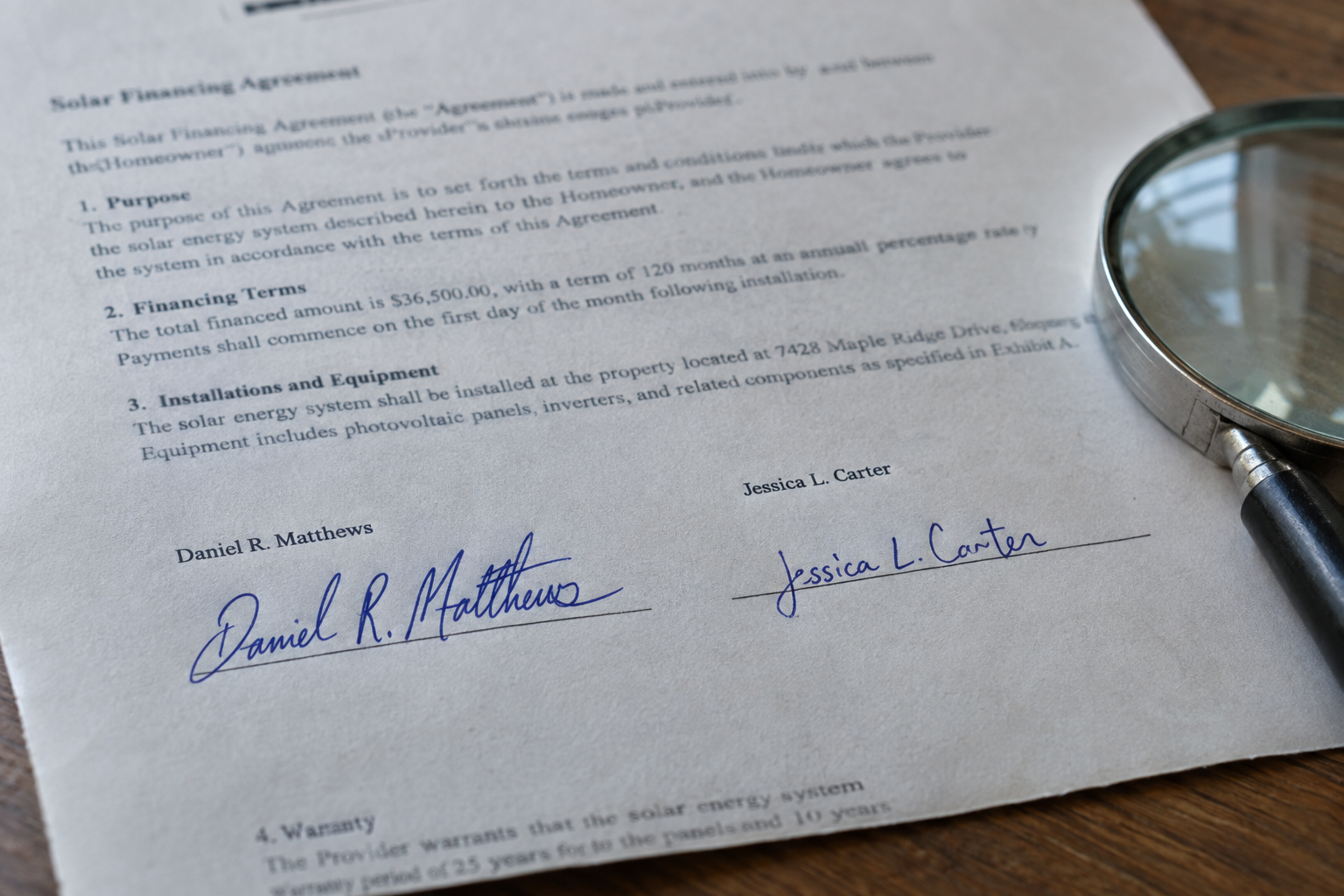
If you're trying to figure out which of these paths applies to you, start by pulling together what you actually have. Our documentation guide covers this in depth, but at minimum that means your original signed contract, utility bills from six months before installation through today, and anything in writing from the sales process — texts, emails, the original proposal with its savings projections. If your installer went out of business, note which company it was and roughly when; that alone often points directly to which lender inherited the obligation and whether an FTC Holder Rule claim is realistic.
Our complete guide to getting out of a solar contract walks through the legal mechanics of each path in more depth than makes sense to repeat here.
A few things worth knowing before you call anyone
Does it matter which company originally sold me the system if they're no longer in business?
Yes, significantly. Knowing your original installer helps identify which lender or successor entity actually holds your obligation now, which determines whether an FTC Holder Rule claim applies to your situation.
Can I pursue more than one of these paths at the same time?
Often yes. A misrepresentation claim and a challenge to an arbitration clause frequently arise from the same underlying facts, and pursuing them together as part of one case is common rather than picking just one in isolation.
Is there a deadline for pursuing a misrepresentation claim if I'm past the rescission window?
It depends on the specific legal theory and when the misrepresentation was discovered, not a fixed number of days like the rescission window. This is exactly the kind of detail worth reviewing case by case rather than assuming a hard cutoff.
What if my solar company's "buyout" offer seems reasonable — should I just take it?
Not without understanding what you'd actually be giving up first. A buyout offer is a negotiating position from a company motivated to keep the payments coming, not a neutral assessment of what you legally owe.
Not sure which path applies to your situation?
That's exactly what a free review is for.
Call (213) 579-5156 or visit californiasolarexit.com.
Daniel Merritt is a Senior Solar Contract Analyst at California Solar Exit.
Other insights
More from California Solar Exit