Latest insights
Filing Bankruptcy in California? Here's What Actually Happens to Your Solar Lease or Loan
Filing Bankruptcy in California? Here's What Actually Happens to Your Solar Lease or Loan
Quick answer: Solar loans and solar leases are treated completely differently in personal bankruptcy. A solar loan, secured by a UCC-1 lien, follows the same reaffirm-surrender-redeem framework as a car loan. A solar lease or PPA is treated as an "executory contract," which you either assume (keep) or reject (exit) — and rejecting a bad solar lease through bankruptcy is a genuinely powerful, underused exit mechanism most homeowners have never heard of. This is a major financial decision with consequences well beyond your solar contract, not something to undertake casually just to get out of a bad deal.
Why Are Solar Loans and Solar Leases Treated So Differently in Bankruptcy?
This comes down to what you actually own. A solar loan means you own the equipment outright, with the lender holding a security interest (typically a UCC-1 lien) against it — legally, this is secured debt, just like a car loan or mortgage. A solar lease or PPA means the solar company still owns the equipment and you're paying for its use or the power it produces — legally, this is an ongoing service agreement, what bankruptcy law calls an "executory contract," where both sides still have obligations left to perform. Different legal category, different set of options.
If You Have a Solar Loan: What Do Reaffirm, Surrender, and Redeem Actually Mean?
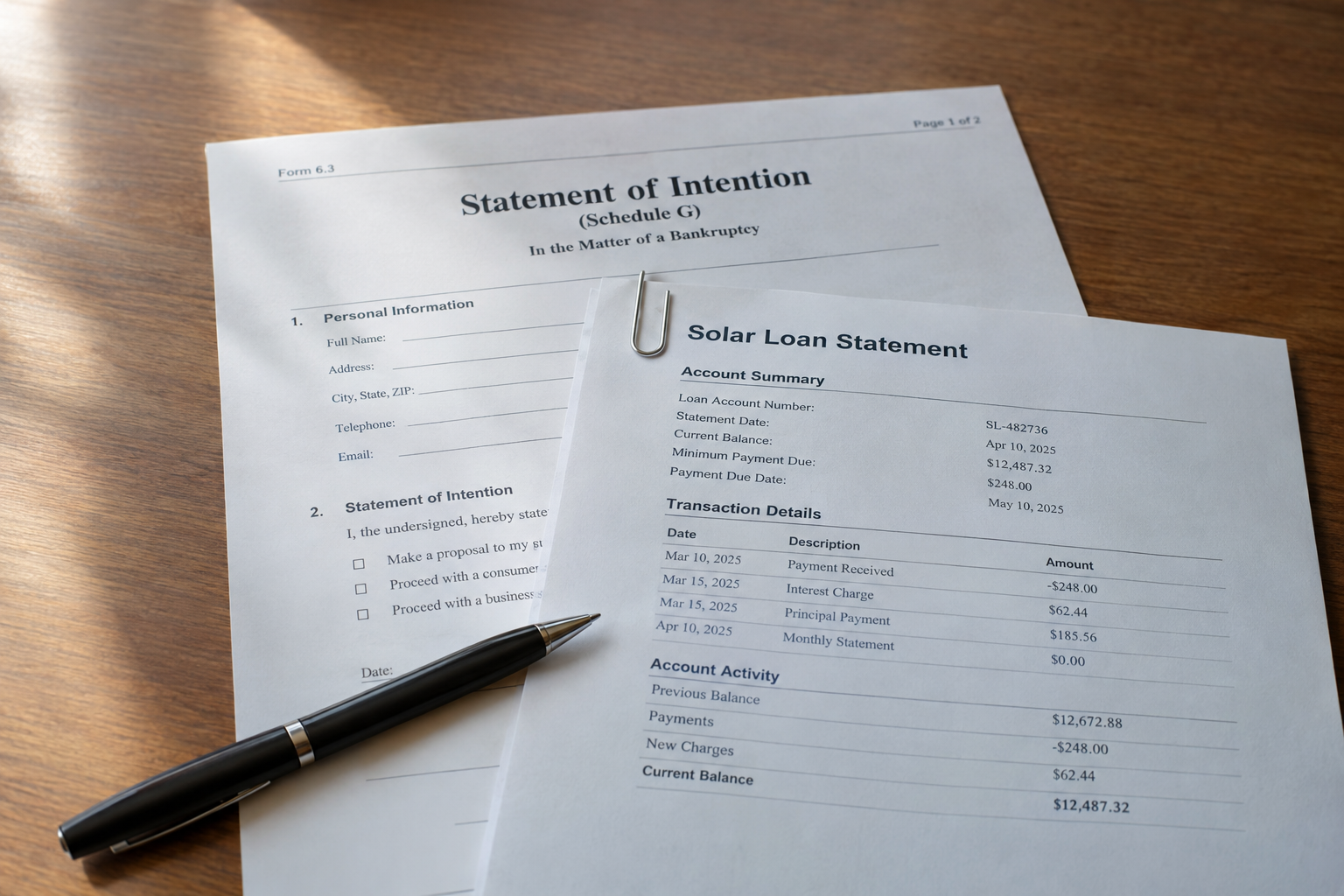
In Chapter 7, filing bankruptcy discharges your personal liability for most debts, but a lien survives bankruptcy regardless — the lender can still repossess the collateral if you stop paying, discharge or not. You generally have three options, declared on a Statement of Intention filed with the court: reaffirm the debt (sign a new agreement remaining personally liable, keep paying, keep the panels), surrender the collateral (stop paying, give up the panels — though a lender repossessing rooftop solar equipment is logistically impractical, which can create real negotiating leverage), or in rare cases redeem it (pay the collateral's current value in a lump sum, uncommon for solar equipment specifically).
If You Have a Solar Lease or PPA: What Does Assume or Reject Actually Mean?
This works differently. Because a lease or PPA is an executory contract, you don't reaffirm it — you either assume it (formally continue the agreement under its existing terms, subject to curing any default) or reject it (a court-authorized decision to exit the contract entirely). In Chapter 7, you generally have 60 days after your case begins to decide, or the contract is automatically deemed rejected. In Chapter 13, you make this decision as part of your repayment plan, with the court's approval.
Why Can Rejecting a Solar Lease in Bankruptcy Be More Powerful Than a Standard Cancellation?
This is worth understanding clearly, because it's a genuinely different mechanism than the cancellation strategies we cover elsewhere. Rejecting an executory contract in bankruptcy is a legal right built directly into the Bankruptcy Code — it's not a negotiation with the solar company or a request they can refuse. When you reject a lease or PPA, it's treated as a breach that occurred just before your filing date, converting any resulting damages claim the solar company might have into an ordinary unsecured debt in your bankruptcy case, often paid at cents on the dollar or discharged entirely, rather than an ongoing 20-year payment obligation. This doesn't mean bankruptcy is a shortcut for exiting an unwanted solar lease — it means that if you're already filing bankruptcy for broader financial reasons, a bad solar lease can potentially be resolved through that same process rather than needing to be fought separately.
Should You Actually Reaffirm a High-Interest Solar Loan?
This is worth pausing on, since it's easy to reflexively want to "keep everything." As one bankruptcy attorney has put it plainly: it's fair to question why you'd want to reaffirm a debt carrying a 20-25% effective interest rate — exactly the kind of burden bankruptcy exists to provide relief from in the first place. Reaffirming means voluntarily giving up the discharge protection you'd otherwise have on that specific debt. If your solar loan carries the kind of undisclosed dealer fees or inflated rates we cover in our general solar loan guide, reaffirming it during bankruptcy deserves real scrutiny, not an automatic yes.
Does Chapter 7 vs. Chapter 13 Change Anything for Solar?
The underlying framework is similar, but who makes the call differs. In Chapter 7, a trustee has some authority over your executory contracts, though in practice most decisions rest with you through the Statement of Intention process. In Chapter 13, you retain control and propose how each contract gets handled directly in your repayment plan, which the court then approves — generally giving you more direct say over the outcome than Chapter 7's more limited timeline allows.
Is This a Major Financial Decision, Not a Solar-Specific Shortcut?
Yes, and this needs to be said plainly. Personal bankruptcy affects your credit for years, involves real costs and a public court filing, and touches every debt you have — not just your solar contract. This isn't something to consider solely because you're unhappy with a solar lease. But if you're already facing bankruptcy for broader financial reasons, understanding exactly how your solar obligation fits into that process — and that a bad lease specifically has a real legal exit path through rejection — is information worth having rather than discovering after the fact.
FAQ
Is a solar loan treated the same as a solar lease in bankruptcy?
No. A solar loan is secured debt, handled through reaffirmation, surrender, or redemption. A solar lease or PPA is an executory contract, handled through assumption or rejection.
What does it mean to "reject" a solar lease in bankruptcy?
It's a court-authorized exit from the contract, treated as a breach occurring just before your filing date. Any resulting claim the solar company has becomes an unsecured debt in your case rather than an ongoing payment obligation.
Should I reaffirm my solar loan if I file for bankruptcy?
Not automatically. Reaffirming means giving up discharge protection on that specific debt, which deserves real scrutiny, especially if the loan carries a high effective interest rate or undisclosed fees.
How long do I have to decide whether to assume or reject a solar lease in Chapter 7?
Generally 60 days after your case begins, or the contract is automatically deemed rejected if you take no action.
Should I file bankruptcy just to get out of a bad solar lease?
No. Bankruptcy is a major financial decision affecting your credit and all of your debts, not a solar-specific shortcut. It's relevant information if you're already considering bankruptcy for broader financial reasons.
Considering bankruptcy and unsure how your solar lease or loan fits in?
Get a free, no-pressure contract review first.
Call (213) 579-5156 or visit californiasolarexit.com.
Daniel Merritt is a Senior Solar Contract Analyst at California Solar Exit with over a decade of experience evaluating residential solar lease, PPA, and loan agreements under California consumer protection law.
Other insights
More from California Solar Exit