Latest insights
Sunlight Financial's Bankruptcy: What California Homeowners With a Sunlight-Financed Solar Loan Should Know
Sunlight Financial's Bankruptcy: What California Homeowners With a Sunlight-Financed Solar Loan Should Know
Quick answer: Sunlight Financial, one of the largest point-of-sale lenders for residential solar in the country, filed a "prepackaged" Chapter 11 bankruptcy on October 30, 2023, listing at least $500 million in liabilities. It was acquired by an investor consortium and emerged from bankruptcy roughly six weeks later, and it continues originating and servicing solar loans today. That matters for California homeowners in a specific way: if your solar installer went out of business or disappeared, your Sunlight-financed loan almost certainly didn't go anywhere — you're likely still expected to pay it, even for a system that's no longer being serviced by anyone.
What Happened to Sunlight Financial?
Sunlight Financial built its business as a point-of-sale finance platform, partnering with solar contractors nationwide to offer homeowners financing at the moment of sale rather than being a direct installer itself. Rising interest rates and a slowdown in new solar installations put real financial pressure on the company through 2022 and 2023, and by August 2023 the company's own financial filings raised doubts about its ability to continue operating. On October 30, 2023, Sunlight filed for Chapter 11 bankruptcy protection in Delaware as part of a pre-arranged sale to a group of investors, including affiliates of Greenbacker Capital Management, Sunstone Credit, and IGS Ventures, along with its secured lender, Cross River Bank. The restructuring closed quickly — Sunlight emerged from bankruptcy on December 7, 2023, now fully owned by that investor consortium.
Why Does Sunlight Financial Still Exist If It Went Bankrupt?
This is the detail that surprises a lot of homeowners: a "prepackaged" Chapter 11 like Sunlight's is fundamentally different from the kind of bankruptcy that shuts a company down. It's a financial restructuring — the company's debt and ownership structure gets reorganized, but the underlying business, including its loan portfolio and servicing obligations, continues operating. In practice, this means your loan agreement with Sunlight Financial is still fully in force. The bankruptcy didn't cancel anything you owe — it changed who owns the company collecting your payments.
The Pattern We Keep Seeing: Installer Gone, Lender Still Collecting
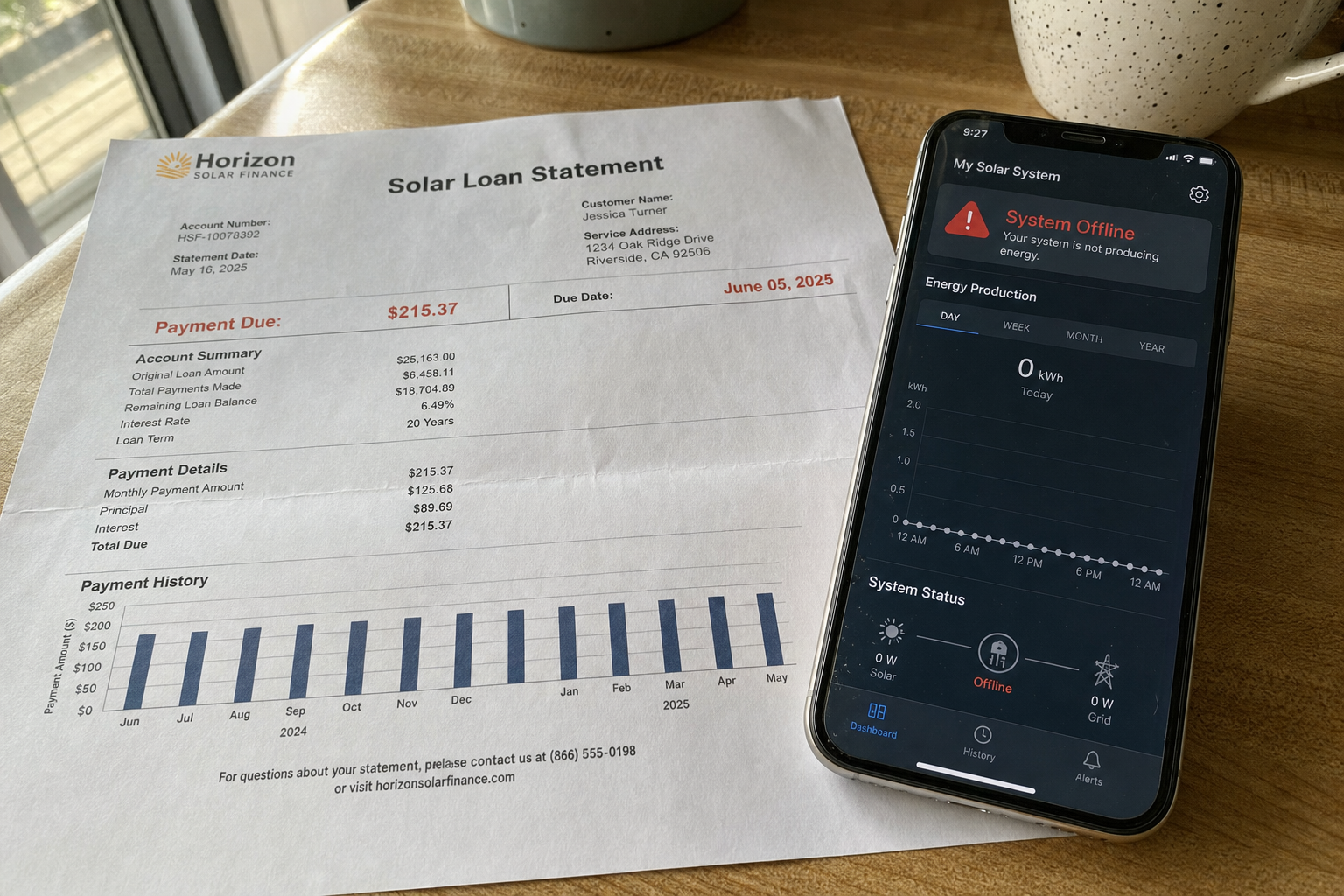
This is exactly the scenario that generates the most frustrated calls we get. A homeowner's installer goes out of business — and California has seen a wave of this with companies like Freedom Forever — leaving no one to service a malfunctioning system, honor a workmanship warranty, or answer basic questions. Meanwhile, the loan that financed that system, if it went through Sunlight Financial, keeps generating a monthly bill regardless of whether the system is even producing power. We've seen this complaint pattern described directly by Sunlight-financed customers: a system stops working, the original installer is unreachable, and the lender continues expecting payment as if nothing happened.
Does the FTC Holder Rule Apply to a Sunlight Financial Loan?
Potentially, yes, and this is worth understanding clearly. The FTC Holder Rule is a federal regulation stating that a lender who finances a consumer purchase inherits the same legal claims you had against the company that actually sold you the system. If your original installer misrepresented your system's performance, savings, or warranty coverage, that claim doesn't disappear just because the installer is gone — it can potentially be raised directly against Sunlight Financial as the loan holder. This is a meaningfully different position than simply being told "call your installer" when the installer no longer exists to call.
What If Your Installer Was Financed Through Sunlight and No Longer Exists?
Start by pulling your complete loan agreement and confirming exactly what Sunlight Financial's own documentation says about your rights when the selling dealer is no longer operating. Document your system's actual performance against what you were promised at signing — utility bills before and after installation are some of the strongest evidence in these cases. Our documentation checklist covers exactly what to gather before you make your case to Sunlight directly.
What Should You Do If Sunlight Financial Won't Help With a Non-Working System?
If Sunlight isn't responding meaningfully to a legitimate service or warranty issue tied to a defunct installer, filing a formal complaint creates pressure that a phone call alone doesn't. Our guide to filing a solar complaint in California covers which state agency — the CSLB, the CPUC, the DFPI, or the California Attorney General — actually handles a lender dispute like this. It's also worth knowing that Sunlight Financial isn't the only financing structure with this kind of complexity — PACE-financed systems through programs like HERO carry an entirely different, property-tax-based set of rules, so confirming exactly what kind of financing you actually have is the right first step regardless of which lender is involved.
FAQ
Is Sunlight Financial still operating after its 2023 bankruptcy?
Yes. Sunlight Financial completed a "prepackaged" Chapter 11 restructuring, was acquired by an investor consortium, and emerged from bankruptcy in December 2023. It continues originating and servicing solar loans today.
Do I still have to pay my Sunlight Financial loan if my installer went out of business?
Generally yes, the loan obligation continues regardless of your installer's status. However, the FTC Holder Rule may allow you to raise claims related to the original sale directly against Sunlight as the loan holder.
What is the FTC Holder Rule, and does it apply to Sunlight Financial loans?
It's a federal rule stating a lender who finances a consumer purchase inherits the same legal claims the consumer had against the original seller. It can potentially apply to a Sunlight-financed solar loan if your installer misrepresented terms or performance.
What should I do if my Sunlight-financed system isn't working and my installer is gone?
Document your system's performance against what was promised, gather your complete loan agreement, and consider filing a formal complaint with a state regulatory agency if Sunlight isn't providing meaningful help directly.
Is Sunlight Financial the same as a PACE or HERO loan?
No. Sunlight Financial is a traditional personal loan lender, while PACE programs like HERO are structured entirely differently, repaid through property tax assessments rather than a standard monthly loan payment.
Stuck with a Sunlight Financial loan and a solar system nobody will service? Get a free, no-pressure review.
Call (213) 579-5156 or visit californiasolarexit.com.
Daniel Merritt is a Senior Solar Contract Analyst at California Solar Exit with over a decade of experience evaluating residential solar lease, PPA, and loan agreements under California consumer protection law.
Other insights
More from California Solar Exit