Latest insights
Does Disputing a Solar Loan Hurt Your Credit Score in California? What FCRA Actually Protects
Does Disputing a Solar Loan Hurt Your Credit Score in California? What FCRA Actually Protects
Quick answer: A financed solar loan reports to credit bureaus the same way any installment loan does — and missed payments during an undisputed standoff can genuinely damage your score. But a properly documented legal dispute is different from silently stopping payment: the Fair Credit Reporting Act gives you real rights to challenge inaccurate reporting, and a structured cancellation or settlement handled correctly typically doesn't carry the same credit consequences as simply going dark on your lender.
How Does a Solar Loan Actually Show Up on Your Credit Report?
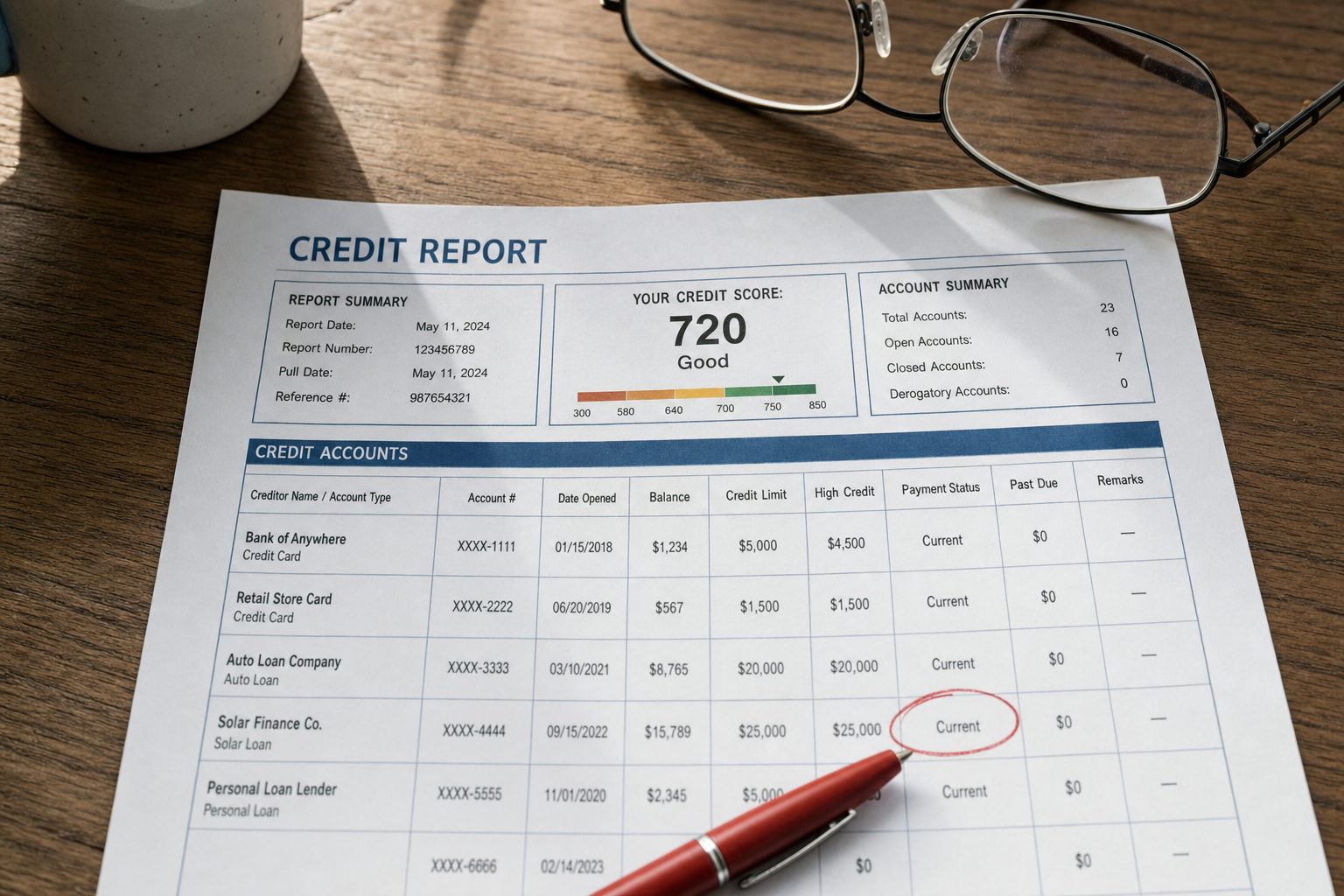
A financed solar system is reported to credit bureaus as a standard installment loan tradeline — the same category as an auto loan or personal loan — showing your original loan amount, current balance, payment history, and account status. This applies whether your loan is through Mosaic, GoodLeap, Sunlight Financial, Dividend Finance, or another major solar lender. On-time payments build positive history the same way any installment loan does; missed or late payments get reported as delinquent, and a lender can eventually report the account to collections or, in more severe cases, pursue lien enforcement tied to the UCC-1 filing on your property.
Why Is "Just Stop Paying" the Advice We Keep Warning Against?
This warning shows up across nearly every solar contract situation we cover, and it's worth explaining exactly why: unilaterally stopping payment without a documented dispute strategy doesn't create any formal record that you're contesting the debt — from the lender's system, it just looks like a missed payment. That missed payment gets reported to credit bureaus on a normal delinquency timeline, typically escalating at 30, 60, and 90 days past due, regardless of how legitimate your underlying grievance against the installer or lender actually is. The problem isn't that you're wrong to be upset — it's that silence looks identical to nonpayment on a credit report, no matter what's actually happening behind it.
What Is the Fair Credit Reporting Act, and How Does It Protect You?
The Fair Credit Reporting Act (FCRA) is the federal law governing how credit reporting agencies and the companies that furnish information to them are required to handle accuracy and disputes. Under FCRA, you have the right to dispute information on your credit report that you believe is inaccurate, and the credit bureau is required to investigate that dispute, typically within 30 days, and correct or remove information that can't be verified as accurate. This is a formal, legally enforceable process — distinct from simply calling your lender and complaining, and distinct from just not paying and hoping it works out.
How Do You Actually Dispute Inaccurate Solar Loan Reporting?
If your solar loan is being reported inaccurately — payments applied incorrectly, a balance that doesn't match your actual contract terms, or reporting that continues after a legitimate cancellation or settlement — you can file a dispute directly with the credit bureau reporting the information (Equifax, Experian, or TransUnion) and separately with the lender itself. Keep a complete paper trail: your original contract, all payment records, any written communication about your dispute, and copies of what you submit. If the bureau's investigation doesn't resolve it, escalating to the Consumer Financial Protection Bureau creates an additional layer of formal, documented pressure — the CFPB has specifically flagged solar lending practices in the past, including a 2024 report on misleading fee disclosures across the industry.
Does a Documented Legal Dispute Protect Your Credit Differently Than Silence?
Yes, meaningfully. When a solar contract is properly rescinded under California's Consumer Legal Remedies Act or Home Solicitation Sales Act, or resolved through a negotiated settlement, the underlying debt obligation is formally addressed — which is fundamentally different from an account just sitting delinquent while you wait to see what happens. A structured resolution gives you documentation to support removing or correcting negative reporting tied to the disputed period, where an undocumented standoff leaves you with nothing but a damaged score and a debt that's still technically owed. This is exactly why we advise against stopping payment without a strategy already in place — the strategy is what protects your credit, not the act of nonpayment itself.
What About Solar Leases and PPAs — Do Those Report to Credit Bureaus Too?
It depends on the specific company and structure. Some leases and PPAs are reported similarly to loans, while others may not report to credit bureaus in the same standardized way an installment loan does, though non-payment can still trigger collections activity and, depending on your contract, other consequences separate from credit reporting. If you're not sure how your specific agreement is structured or reported, that's worth confirming directly rather than assuming either way — our documentation checklist covers what to pull together before that conversation.
FAQ
Does canceling a solar contract automatically hurt my credit score?
Not necessarily. Cancellation before installation typically doesn't affect credit at all, and a properly documented legal cancellation or negotiated settlement after installation generally doesn't carry the same consequences as an undocumented missed-payment standoff.
What's the difference between disputing a solar loan and just not paying?
A formal dispute, whether through the FCRA process, a legal rescission claim, or a negotiated settlement, creates documentation that addresses the debt. Simply not paying creates no such record and reports as an ordinary delinquency regardless of your underlying grievance.
How long does a credit bureau have to investigate a dispute under FCRA?
Generally around 30 days from when you file the dispute, though this can vary by circumstance. The bureau must correct or remove information it cannot verify as accurate.
Can I dispute a solar loan balance if I was misled about the loan terms?
Potentially, especially if the misrepresentation involved undisclosed dealer fees, misleading tax credit claims, or terms that didn't match what you were told. This is exactly the kind of situation a documented contract review is built to evaluate.
Do solar leases and PPAs report to credit bureaus the same way loans do?
Not always. Reporting practices vary by company and contract structure, so it's worth confirming directly how your specific agreement is handled rather than assuming.
Worried a solar dispute could hurt your credit? Get a free, no-pressure review before you make any payment decisions.
Call (213) 579-5156 or visit californiasolarexit.com.
Daniel Merritt is a Senior Solar Contract Analyst at California Solar Exit with over a decade of experience evaluating residential solar lease, PPA, and loan agreements under California consumer protection law.
Other insights
More from California Solar Exit