Latest insights
How to Document Your Solar Case Before Contacting an Attorney
How to Document Your Solar Case Before Contacting an Attorney
Most California homeowners who've been misled by a solar company wait too long to start gathering evidence — and by the time they consult an attorney or file a complaint, key documents have been deleted, memories have faded, and the salesperson who made the promises is long gone.
Documentation is the difference between a strong consumer protection claim and one that's difficult to substantiate. The good news: most of what you need already exists. You just need to know where to find it and how to preserve it.
This guide tells you exactly what to collect, where to get it, and how to organize it so that whoever reviews your case — a consumer protection attorney, the California AG, or California Solar Exit — can evaluate it immediately.
Why Documentation Matters More in Solar Cases
Solar fraud cases have a specific evidentiary challenge: the most damaging misrepresentations were often made verbally, by a salesperson who no longer works for the company, about projections that were only shown on a screen and never printed.
What closes that gap is the paper trail that does exist — and in most solar cases, that paper trail is substantial if you know where to look. Utility bills, monitoring data, loan statements, permit records, and e-signature audit trails together tell a story that is often more compelling than any verbal account.
Courts and regulators are experienced with solar fraud cases. They know what the documents should show. Your job is to make sure yours are complete.
The Core Documentation Checklist
Your contract and all related documents
Photograph or scan every page of your signed contract — front and back — including all exhibits, addenda, and amendments. If you signed electronically, request a complete copy from the solar company in writing and keep their response. Compare what you receive against what you remember signing. Note any pages or addenda you don't recognize.
Also request the audit trail or certificate of completion from your e-signature platform — DocuSign, Adobe Sign, or the company's proprietary system. This document shows the sequence and timing of every signature event and can reveal whether documents were added or modified after your signing session.
Your original sales proposal and savings projection
This is the single most important document in an inflated savings claim. It shows exactly what you were promised in writing — production figures, savings amounts, utility rate assumptions, and system specifications. If you don't have it, request it from the company. If they don't provide it, that refusal is itself documented evidence.
Also preserve any printed brochures, handouts, or marketing materials the salesperson left at your home.
All communications with the solar company
Save every email and text message with the salesperson, installer, and company — including any communications after installation about system problems, performance complaints, or attempts to resolve issues. Screenshot text conversations and save them to cloud storage. Export email threads and save them as PDFs.
If the salesperson made verbal promises that don't appear in the written contract, write down exactly what was said, when, and who was present — while it's still fresh. Dated written notes of verbal representations have been admitted as evidence in consumer protection proceedings.
Solar monitoring data
Your inverter or monitoring system — Enphase Enlighten, SolarEdge, or the company's proprietary portal — holds production records from the day your system was activated. Screenshot or export at least 24 months of production data showing actual kilowatt-hours produced per month. Compare this directly against the monthly production figure in your original sales proposal. A sustained shortfall of more than 10–15% is significant.
If you no longer have access to your monitoring portal — because the company went bankrupt or changed systems — contact your inverter manufacturer directly. Enphase and SolarEdge maintain production records independently of the installer.
Utility bills — before and after
Pull 24 months of utility bills from before your solar installation and every bill since. Most California utilities — PG&E, SCE, and SDG&E — allow you to download historical bill data directly from your online account going back several years. This data shows your pre-solar baseline consumption and cost, and your post-solar utility costs, allowing a direct comparison against what was promised.
Your loan documents
If you financed your system, collect your complete loan agreement, the lender's disclosure statement, and any correspondence from the lender. Identify the total loan amount and compare it against the cash price of the system as shown in your sales proposal or installation agreement. Document any gap that exceeds 15% — this is likely a hidden dealer fee.
Also note whether your loan has a "required prepayment" or "expected tax credit payment" provision. If it does, document what you were told about this provision at signing versus what your actual tax liability was in the year of installation.
Permit and inspection records
Request your building permit from your city or county building department. The permit application lists the specific equipment — panel model, inverter model, system size — submitted for regulatory approval. Compare this against the equipment specifications in your contract. Discrepancies between what was permitted and what was contracted — or between what was permitted and what was actually installed — are significant.
Most California jurisdictions have online permit portals where you can search by address. San Bernardino County, Los Angeles County, Orange County, and San Diego County all maintain searchable online permit databases.
Records of any UCC or fixture filings
Search your county recorder's online database using your name and property address. Solar lenders frequently file UCC-1 financing statements or fixture filings to secure their interest in the panels. If you find a filing you were never told about, screenshot it and note the filing date, the filer's name, and the collateral description.
A log of all contact attempts
Keep a running log — dated, with notes — of every attempt you make to contact the solar company, lender, or installer, and their response or lack of response. Include phone calls, emails, and any in-person visits. If a company stops responding after you raise concerns, that pattern of non-response is itself evidence.
How to Organize Everything
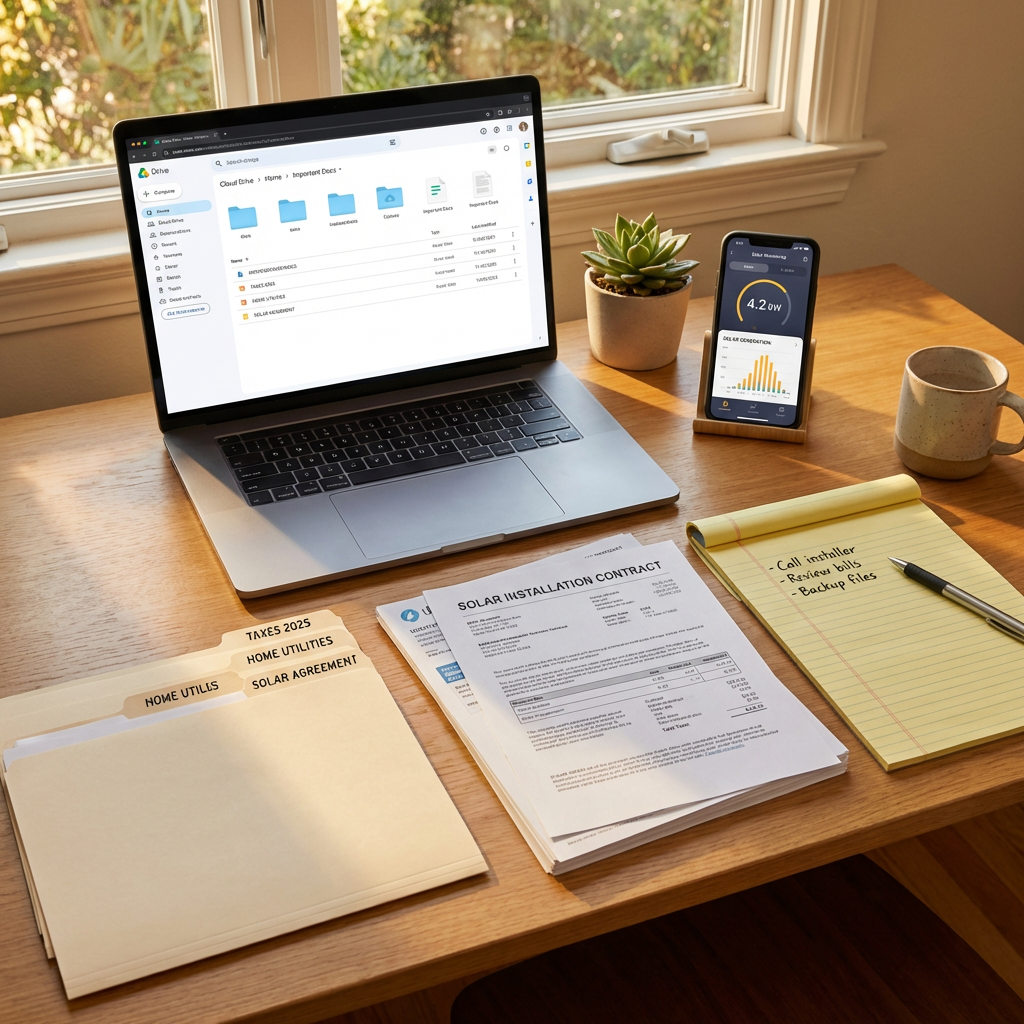
Store all documentation in a shared cloud folder — Google Drive or Dropbox — organized into clearly labeled subfolders:
- Contract & Signing Documents
- Sales Proposal & Marketing Materials
- Communications (Emails & Texts)
- Monitoring Data
- Utility Bills (Pre-Solar)
- Utility Bills (Post-Solar)
- Loan Documents
- Permit & Inspection Records
- UCC/Lien Records
- Contact Log
This structure allows any attorney, consumer protection analyst, or agency reviewer to find exactly what they need immediately. Organized evidence is the strongest evidence — and disorganized evidence, even when substantively strong, costs time and money to reconstruct.
Share the folder link rather than emailing attachments. It's easier to update and ensures everyone is working from the same complete set of documents.
What to Do If Documents Are Missing
Company won't provide your contract: Send a written request by certified mail. Their refusal or non-response is documented and itself supports a claim.
Can't access monitoring data: Contact your inverter manufacturer directly — Enphase and SolarEdge both have customer support lines and maintain records independently.
Sales proposal was only shown on a screen: Request it from the company in writing. If they claim it doesn't exist, that's significant. If you remember specific numbers, write them down now with the date of your recollection.
E-signature audit trail unavailable: Request the certificate of completion from the signing platform by name — DocuSign, Adobe Sign — using the email address you signed with.
Permit records not online: Call your city or county building department directly and request a copy of the permit for your property address. This is a public record and must be provided.
Frequently Asked Questions
How far back should my utility bills go? Ideally 24 months before installation. At minimum 12 months. This establishes your pre-solar baseline consumption and average monthly cost — the comparison point for any savings claim.
What if the salesperson communicated only by phone and I have no written record? Write down everything you remember — specific promises, specific numbers, specific phrases — as soon as possible and date the document. Note any witnesses who were present. Verbal representation records carry more weight when they're specific, contemporaneous, and consistent with other evidence.
My monitoring portal shows good production numbers — does that hurt my case? Not necessarily. Strong production doesn't preclude a misrepresentation case if the savings projection was built on false utility rate assumptions, an undisclosed escalator, a hidden dealer fee, or a tax credit the homeowner couldn't claim. Production is one component of the overall financial picture.
Should I contact the solar company before I have all my documents? Generally no. Contacting the company before your documentation is complete can result in admissions being walked back, records being altered, or the company positioning itself before you know what you have. Get organized first.
Ready to have your documentation reviewed? Book a free consultation or call (213) 579-5156. We review solar contracts and supporting documentation across all of California — remote consultations available.
Other insights
More from California Solar Exit