Latest insights
California's Solar Shade Law: Can a Neighbor's Trees or Your HOA Legally Block Your Panels?
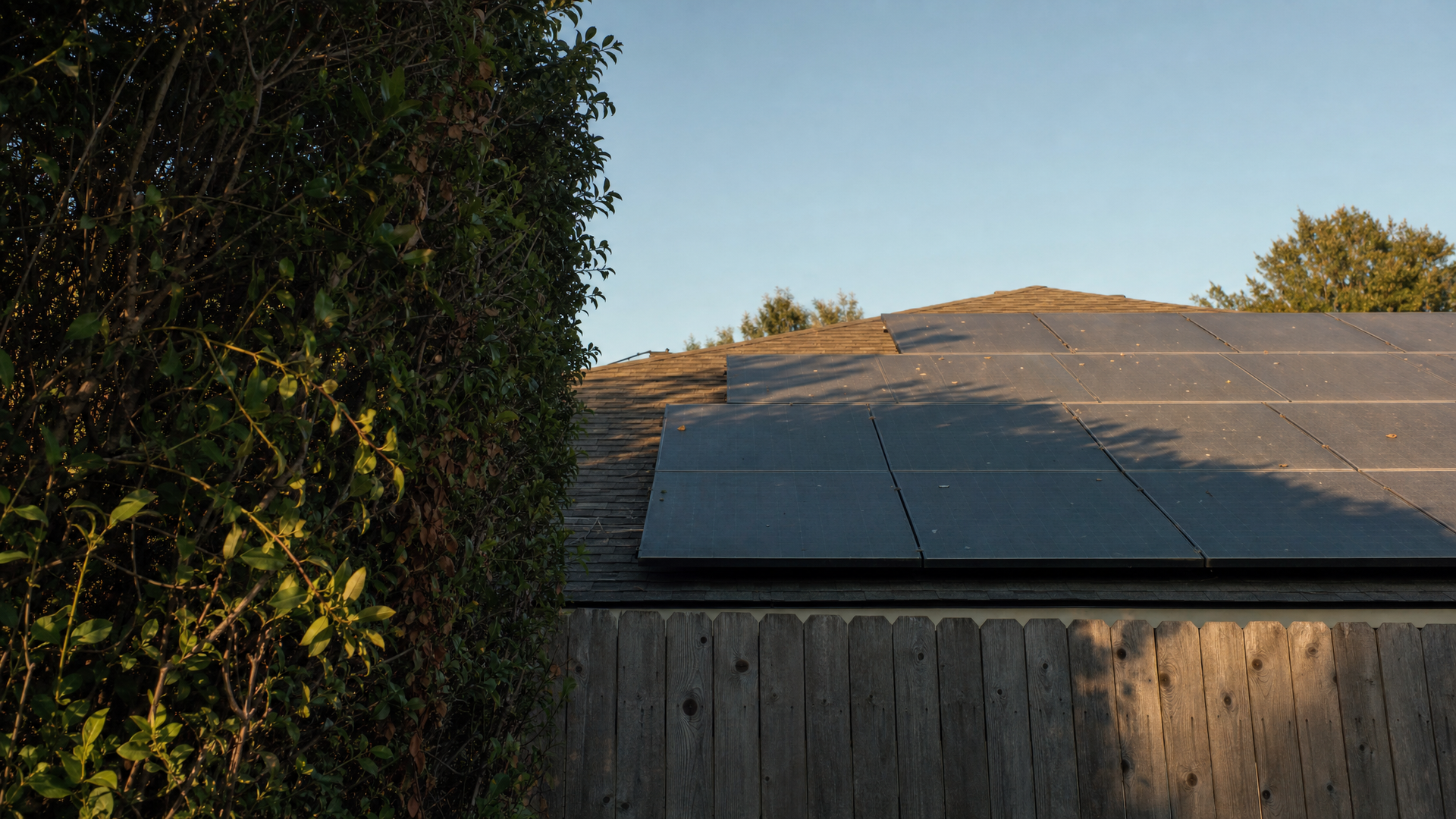
California's Solar Shade Law: Can a Neighbor's Trees or Your HOA Legally Block Your Panels?
Solar disputes usually make headlines about sales tactics and bankrupt installers. A quieter but genuinely litigated category involves something much more mundane: a neighbor's tree, or a homeowners association's architectural committee, standing between a solar system and the sun it needs.
Can My HOA Legally Restrict My Solar Panels?
Mostly no — California's Civil Code Section 714, part of the state's Solar Rights Act, voids any covenant, restriction, or condition in an HOA's governing documents that "effectively prohibits or restricts" installing or using a solar energy system. This applies to CC&Rs, architectural guidelines, and HOA rules across the state — an association generally cannot simply say no to solar.
There's a real exception, though: an HOA can impose "reasonable restrictions" — rules about placement, screening, or aesthetics — as long as they don't significantly increase the system's cost or meaningfully cut into its efficiency or electricity output. Where that line falls has been the subject of real disputes, and an HOA pushing a homeowner toward a less efficient roof placement "for aesthetics" can cross from a reasonable restriction into an unenforceable one, depending on the actual performance impact.
What Is California's Solar Shade Control Act?
It's a separate, older law — the Solar Shade Control Act, enacted in 1978 under Governor Jerry Brown and codified at Public Resources Code §§ 25980–25986 — that regulates trees and shrubs on a neighboring property, not an HOA's rules. It prohibits a neighbor's trees or shrubs from casting a shadow over more than 10% of a solar collector's absorption area between 10 a.m. and 2 p.m., the hours of peak solar production. A 2009 amendment grandfathered in trees that were already there before the solar system was installed — so the law only reaches new growth, not existing landscaping the solar owner should have anticipated — and shifted violations from a criminal matter to a civil one, enforced through a private nuisance claim rather than prosecution.
What Real Disputes Have Looked Like
This law has produced real, expensive litigation, not just a hypothetical in a textbook. In a widely covered 2008 Sunnyvale case, a homeowner was found to have violated the Act after neighbors' redwood trees grew to shade a solar system — the tree owners spent roughly $37,000 in legal fees before ultimately cutting the trees down. In Culver City, a solar owner who'd invested about $80,000 in his system watched a neighbor spend roughly $60,000 planting palm trees along the property line, prompting the city to step in and mediate. And in Sher v. Leiderman (1986), the California Court of Appeal ruled the Act only protects active solar collectors — not homes designed for passive solar heating through south-facing windows — narrowing what actually qualifies for protection under the statute.
What the Shade Control Act Doesn't Cover
- Trees or shrubs that were already in place and already casting shade before your solar system was installed
- Passively solar-heated homes that rely on window placement rather than an actual solar collector, per Sher v. Leiderman
- Shading between 2 p.m. and 10 a.m., outside the statute's protected window
- HOA aesthetic placement rules that don't cross into "unreasonable" territory under Civil Code § 714
When Shading Undermines What You Were Sold
If your system was sold with specific savings or output projections — and an HOA-mandated placement, or an unresolved neighbor shading dispute, has meaningfully cut into what the system actually produces — that's worth examining against what you were originally told at signing. A sales projection that assumed unobstructed roof placement, when the HOA or site conditions never allowed for that, is a different problem than ordinary underperformance, and it's the kind of gap covered in our guide to solar misrepresentation in California.
Red Flags Worth Checking
- Your solar company or installer never assessed shading risk from existing or future tree growth before placing your system
- Your HOA restricted your panel placement to a shadier or less optimal section of your roof
- A neighbor's tree has grown noticeably since your system was installed and your production has visibly dropped
- Nobody sent written notice to the tree-owning neighbor before pursuing any legal remedy, which the Act generally expects as a first step
- Your original sales contract's savings projections assumed a roof placement or sun exposure your HOA never actually permitted
What to Do
- Document the shading — photos at different times of day, ideally between 10 a.m. and 2 p.m., along with your system's production data before and after the shading began.
- Send written notice to the neighbor describing the issue before pursuing any formal legal action — this is generally treated as a prerequisite step.
- Review your HOA's governing documents against Civil Code § 714 if you're facing placement restrictions, and get any denial or restriction in writing.
- If mediation with a neighbor or HOA doesn't resolve it, a real estate or nuisance attorney can evaluate whether a nuisance claim under the Solar Shade Control Act is worth pursuing — these disputes can get expensive quickly, as the cases above show.
- If the underlying issue traces back to what you were told at the time of sale, that's a separate question worth a professional contract review on its own terms.
Frequently Asked Questions
Can my HOA just deny my solar panel application outright?
Generally no. California's Civil Code § 714 voids HOA restrictions that effectively prohibit solar installation, though the HOA can impose reasonable, narrowly tailored placement or aesthetic conditions that don't significantly cut into cost or performance.
What if my neighbor's tree was already blocking my roof before I installed solar?
The Solar Shade Control Act generally doesn't apply — a 2009 amendment grandfathered in trees and shrubs that predate the solar installation, since the law is meant to prevent new growth from blocking an existing system, not to force removal of established landscaping.
Is violating the Solar Shade Control Act a crime?
Not since 2009. It's now a civil matter, pursued through a private nuisance claim, not criminal prosecution.
How much shading is actually illegal under California law?
The Act prohibits a neighbor's tree or shrub from shading more than 10% of a solar collector's absorption area during the 10 a.m. to 2 p.m. window — shading outside that window, or below that threshold, isn't covered.
Dealing with an HOA dispute or a neighbor's shading affecting your solar system's performance — or wondering whether it ties back to what you were originally promised? California Solar Exit reviews solar contracts for homeowners across Los Angeles, Orange County, San Diego, the Inland Empire, Sacramento, and the Bay Area.
Call (213) 579-5156 for a free review, or book a consultation online.
Daniel Merritt, Senior Solar Contract Analyst
California Solar Exit — this content is for general informational purposes only and does not constitute legal advice or create an attorney-client relationship. Homeowners facing an HOA or neighbor dispute should consult a real estate or nuisance attorney about their specific situation.
Other insights
More from California Solar Exit