Latest insights
How to Get Out of an EnFin Solar Loan in California
How to Get Out of an EnFin Solar Loan in California
If your solar system was financed through EnFin, you're not dealing with a rare or obscure lender — and you're not imagining the problems. A major national plaintiffs' firm is actively investigating the company right now, and the pattern they're describing matches what California homeowners have been reporting for months.
What Is EnFin?
EnFin is a residential solar financing company that launched in 2021 and is owned by Qcells, one of the largest solar panel manufacturers in the country. Because the manufacturer, the lender, and often the installer relationship all trace back through the same corporate umbrella, homeowners frequently end up unsure who's actually responsible when something goes wrong — the installer who sold the system, or the finance company collecting the payment. EnFin isn't tied to a single installer; it's used as a financing option across multiple solar companies, including Sunrun installations in some cases.
EnFin Is Under Active Legal Investigation Right Now
The national law firm Lieff Cabraser is currently investigating EnFin and its banking partner, Hatch Bank, over allegations of predatory solar financing. The firm's public investigation describes a pattern where door-to-door sales reps market financing at rates that look low on the surface, while a substantial upfront fee — reportedly 10% to 40% of the total loan — gets secretly folded into the loan principal without clear disclosure. The result: homeowners end up financing far more than the actual cash cost of their system, with the difference collected as an undisclosed fee.
This matches what's showing up in EnFin's own Better Business Bureau complaint record — homeowners describing loan balances in the tens of thousands of dollars they say they never agreed to, promises about tax-credit-driven principal reductions that didn't materialize, and requests for panel removal or loan payoff that went unanswered for months at a time.
The Pattern Behind the Complaints
- Hidden dealer fees — often 20% to 25% of the loan amount, absorbed into the principal rather than disclosed as a separate line item
- Interest-only payment structures in the first year or more, meaning the balance barely moves even after a year of on-time payments
- Unresponsive customer service — multiple documented complaints describe months of unanswered emails after requesting a payoff quote or system removal
- Broken promises about tax-credit-driven "recast" or re-amortization — homeowners told their payment would drop after applying a tax credit to the principal, only to find the loan re-amortized on a different basis than promised
- Confusion over who's responsible — the installer, EnFin, and the panel manufacturer are all connected through Qcells, which makes it unclear who owns a given problem
Is an EnFin Loan Legally Different From Other Solar Loans?
Not in the fundamental mechanics — like most solar loans, an EnFin loan is typically secured by a UCC-1 financing statement filed against your property, and the same FTC Holder Rule protections that apply to other solar financing apply here too — meaning claims against the installer for misrepresentation can potentially be raised against the loan itself, not just the sales contract. What's different is the specific, currently-documented pattern of undisclosed dealer fees, which gives EnFin borrowers something a lot of solar loan holders don't have: an active, formal legal investigation already describing the exact problem they're dealing with.
Red Flags Worth Checking on Your EnFin Loan
- Your loan balance is noticeably higher than the price you were quoted for equipment and installation
- You were told the loan carried a low or "promotional" rate, but the total amount financed doesn't match what a low-fee loan at that rate would produce
- Your payments have been interest-only or your principal has barely moved despite a year or more of on-time payments
- You were promised a tax-credit-driven balance reduction that didn't happen the way it was described
- You've contacted EnFin about a payoff quote, dispute, or removal request and gotten no substantive response
What to Do
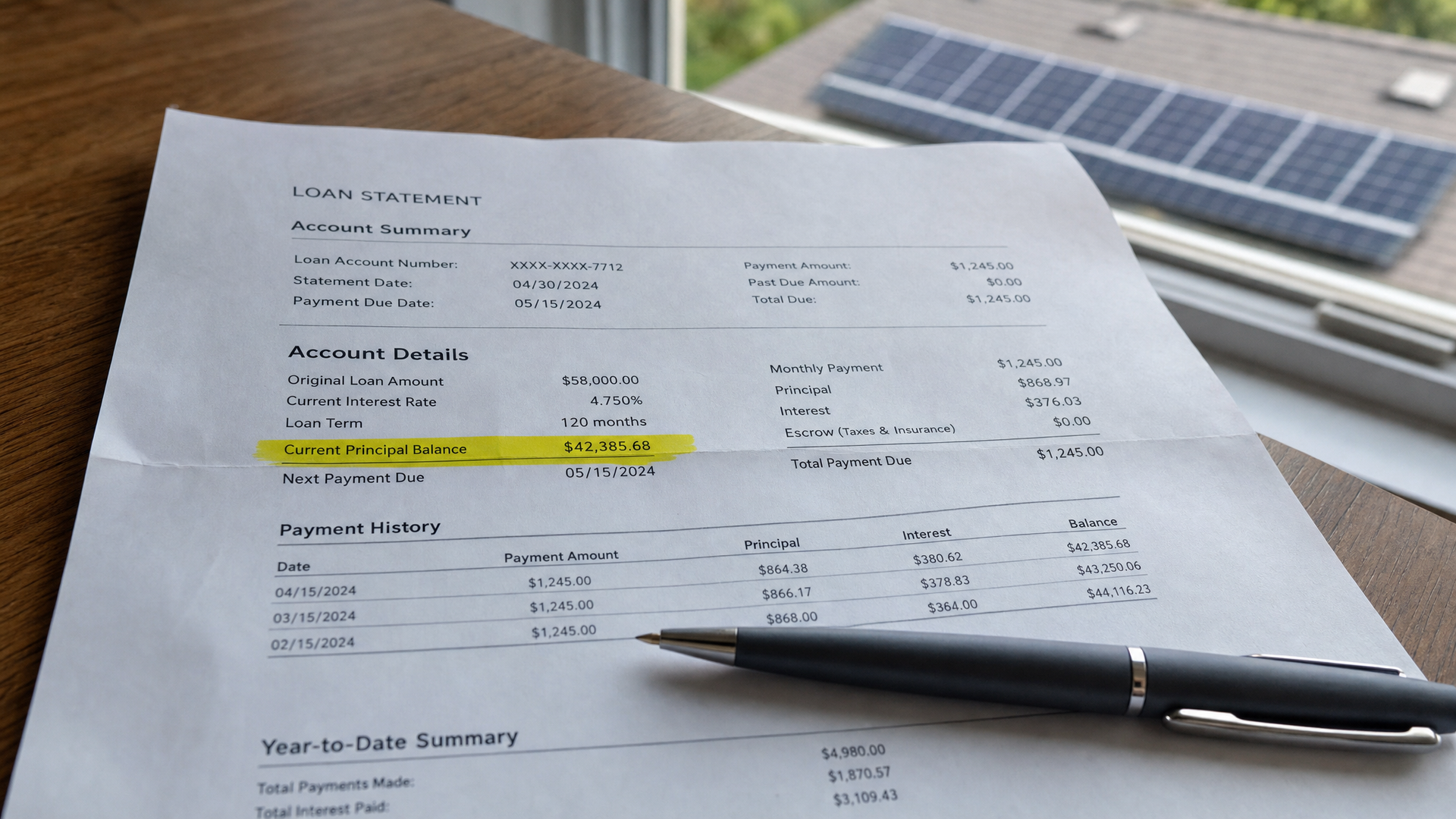
- Pull your original loan documents and compare the total financed amount against your actual signed equipment and installation quote — the gap, if there is one, is the dealer fee question.
- Request a full payoff statement in writing and keep a record of every attempt to reach EnFin if you don't get a timely response.
- Document your original sales conversation — what you were told about the rate, the fee structure, and any tax-credit-related promises.
- File a complaint with the California Department of Financial Protection and Innovation, which regulates solar loan financing in the state, alongside any complaint with the BBB or CSLB.
- Get the loan reviewed — an undisclosed dealer fee baked into the principal is exactly the kind of misrepresentation that can support a rescission or contract-cancellation claim, independent of whatever EnFin's own investigation ultimately concludes.
Frequently Asked Questions
Is EnFin a legitimate company?
EnFin is a real, operating financing company owned by Qcells — it's not a scam operation. That said, it's currently the subject of an active law firm investigation into undisclosed fee practices, and its BBB complaint record shows a consistent pattern worth taking seriously if it matches your own experience.
Can I get out of an EnFin solar loan?
It depends on your specific contract and how the loan was disclosed at signing. If there's a gap between what you were quoted and what you were actually financed, or if promised terms didn't materialize, that's grounds for a review — a legitimate loan simply having a higher-than-ideal rate is a different situation from an undisclosed fee baked into the principal.
Does the ongoing investigation into EnFin mean I automatically have a claim?
Not automatically, but it means the specific problem — undisclosed dealer fees — is documented and taken seriously by regulators and plaintiffs' attorneys, which strengthens an individual complaint that matches the same pattern.
Who do I contact if EnFin isn't responding to me?
Beyond continuing to contact EnFin directly in writing, file complaints with the California DFPI and the BBB, and consider getting your loan documents reviewed to determine whether the underlying contract itself has grounds for cancellation.
Stuck with an EnFin solar loan that doesn't match what you were quoted? California Solar Exit reviews solar contracts for homeowners across Los Angeles, Orange County, San Diego, the Inland Empire, Sacramento, and the Bay Area.
Call (213) 579-5156 for a free review, or book a consultation online.
Daniel Merritt, Senior Solar Contract Analyst
California Solar Exit — this content is for general informational purposes only and does not constitute legal advice or create an attorney-client relationship.
Other insights
More from California Solar Exit