Latest insights
Sunnova Bankruptcy: What California Customers Need to Know in 2026
Sunnova Bankruptcy: What California Customers Need to Know in 2026
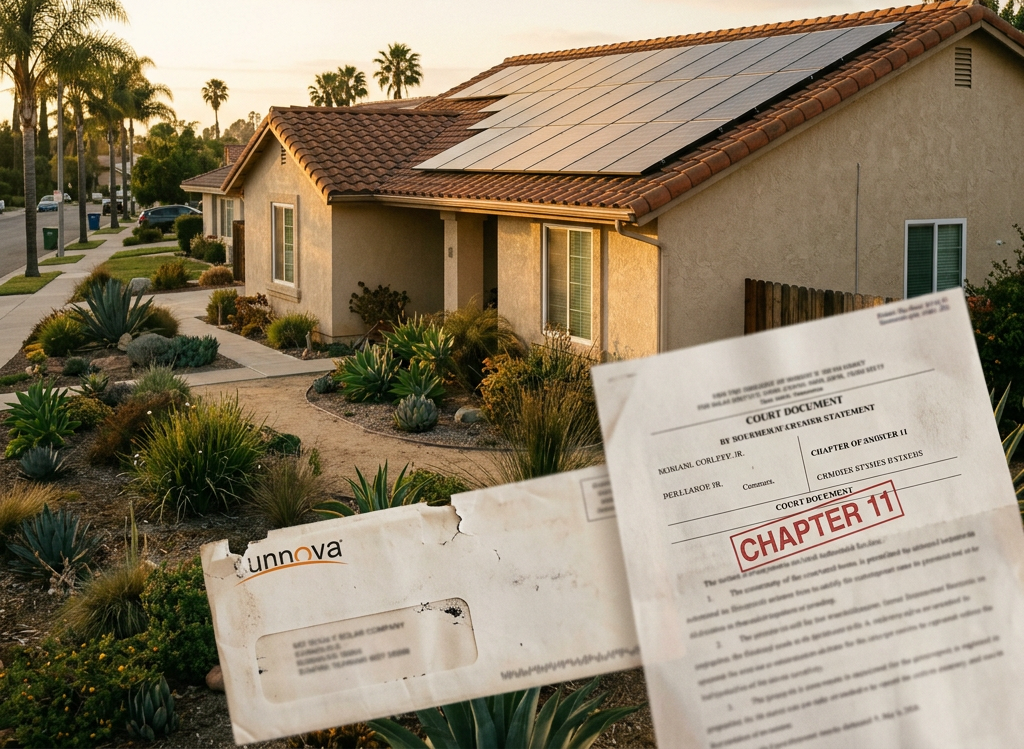
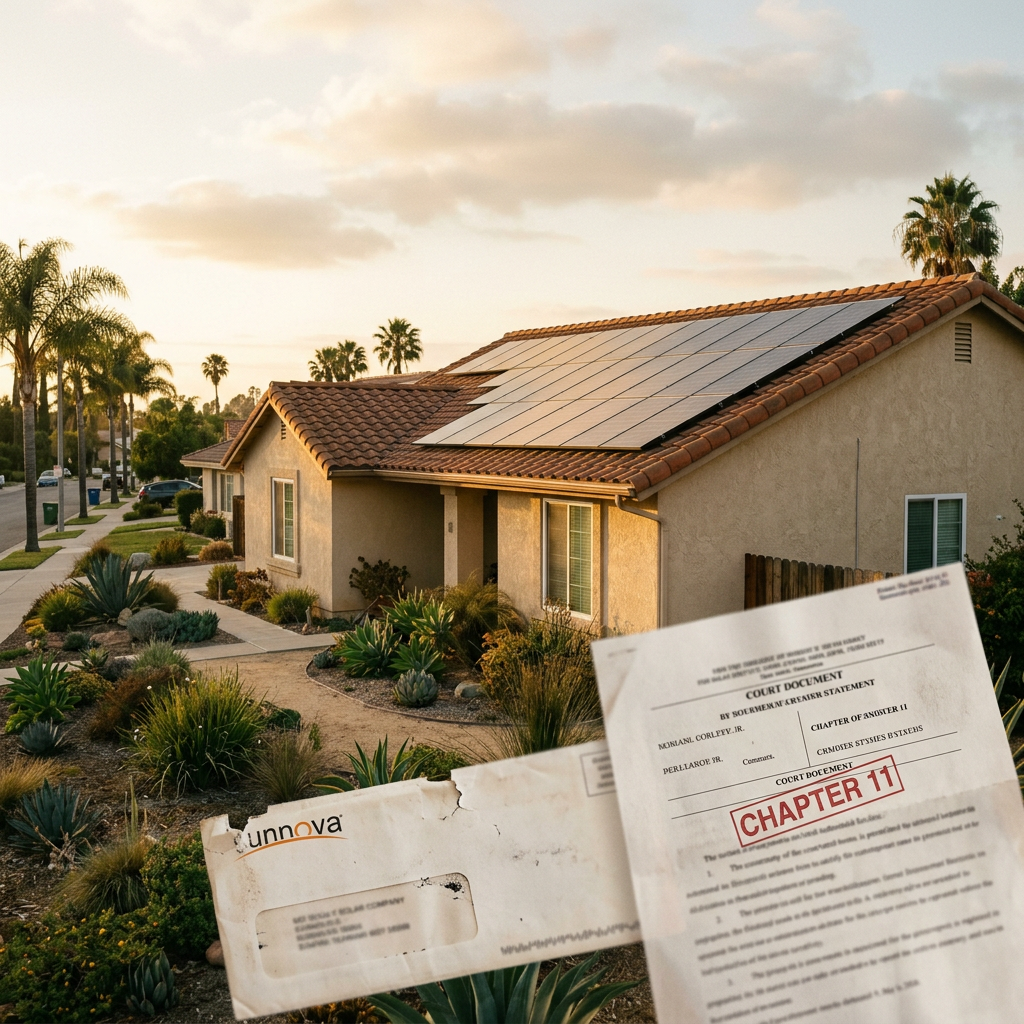
If you have a Sunnova solar lease, PPA, or loan on your California home, here's the short version: Sunnova is gone. The company filed Chapter 11 bankruptcy on June 8, 2025, the bankruptcy court confirmed the restructuring plan on November 12, 2025, and a new entity called SunStrong Management now services your contract. Your monthly payment didn't go away. Your contract didn't get torn up. The lien on your home is still there.
But your situation has changed in ways most California homeowners haven't fully thought through — and there are exit doors that opened during the restructuring that weren't there before.
This guide walks through what actually happened, what it means for your specific contract type, and what your real options look like in 2026.
What Actually Happened to Sunnova
Sunnova Energy International was the second-largest installer of third-party owned residential solar in the United States, with more than 500,000 customers concentrated heavily in California, Texas, and Puerto Rico. The company had grown aggressively on cheap debt — the Department of Energy had even committed up to $3 billion in loan guarantees through Project Hestia, the largest federal solar commitment ever made.
That model fell apart fast. Rising interest rates pushed Sunnova's cost of capital from 2.8% in 2021 to 6.8% by 2024. California's NEM 3.0 cut net metering credits by roughly 75% and helped trigger a 45% drop in California solar installations. The Trump Administration terminated the DOE loan guarantee. The residential solar industry contracted 31% in 2024. Sunnova entered bankruptcy with $8.9 billion in long-term debt and $13.5 million in cash.
Chapter 11 filed June 8, 2025 in the U.S. Bankruptcy Court for the Southern District of Texas, Houston (Case No. 25-90160). On November 12, 2025, Judge Alfredo R. Perez confirmed the company's restructuring plan. The Effective Date hit November 14, 2025. Substantially all of Sunnova's assets — including your contract — were sold to Solaris Assets LLC, an entity backed by GoodFinch Management that paid roughly $118 million for the portfolio. SunStrong Management, an experienced renewable energy asset manager, took over servicing.
Sunnova itself has ceased independent operations.
What This Means for Your Contract
This is the part where the answer depends on what you signed. The bankruptcy treats each contract type differently under Section 365 of the Bankruptcy Code, and the practical reality on the ground also varies.
If You Have a Sunnova Lease (about 31% of customers)
Your lease is what bankruptcy law calls an "executory contract" — both parties still have ongoing obligations. The court allowed Solaris/SunStrong to assume the lease, which means it survived the bankruptcy intact. You still owe the monthly payment. You still have the rate escalator. The system on your roof is still owned by the lender. The UCC-1 fixture filing on your property is still there.
What's different: your service relationship is now with SunStrong Management, not Sunnova. Billing, monitoring, maintenance requests, and customer service all go through SunStrong. If your panels stop producing or your inverter fails, you are calling a different company than the one whose name is on your contract.
If You Have a Sunnova PPA (about 28% of customers)
Same legal mechanics as a lease. The PPA was assumed and assigned to the new owner group. Your kilowatt-hour rate, the production guarantee (if you have one), and the escalator clause all survived. SunStrong handles servicing.
The practical concern with PPAs is whether the new owners will honor production shortfall remedies the same way Sunnova promised them. PPAs typically include a "true-up" if the system underproduces a guaranteed kWh threshold. How aggressively the new servicer enforces or pays out on those guarantees is something California PPA holders should watch closely in 2026.
If You Have a Sunnova Solar Loan (about 24% of customers)
Loan customers are in a different position because the underlying lender — typically GoodLeap, Mosaic, Dividend Finance, Sunlight Financial, or one of Sunnova's white-labeled lending partners — was usually a separate entity from Sunnova. Your loan didn't necessarily go through bankruptcy with Sunnova at all.
What did go through bankruptcy: the workmanship warranty, the production guarantee, the system monitoring, and the maintenance obligations Sunnova had promised. If your panels stop working in 2026 and you call the number on your old Sunnova paperwork, you're going to get routed to SunStrong (for serviced customers) or hit a dead end. If your loan was sold off separately, you may now have a loan with one company and a system serviced by another — or worse, a system with no clear servicer at all.
If You Have a Sunnova Service or Accessory Loan (about 12%)
Customers with battery storage loans, EV charger financing, generator loans, or HVAC bundled with their solar are in the most fragmented position. These products were the last to be sold and the most likely to have orphaned warranty obligations. Read your paperwork carefully and call SunStrong to confirm who is responsible for service on each piece of equipment.
The Service Quality Question
This is the part Sunnova customers across California — from San Diego's coastal neighborhoods to the Inland Empire to Bay Area suburbs — are asking and not getting good answers on.
SunStrong Management took over a half-million-customer portfolio in late 2025. Their job is to maximize the cash flow on those contracts for the new owners. That is not the same job Sunnova had, which was to grow a customer base. The incentives have shifted from "keep the customer happy so they refer their neighbor" to "collect the monthly payment and minimize service costs."
What that looks like in practice for a California homeowner whose system stops producing:
- Longer hold times and slower response on service requests
- Stricter interpretation of what's covered under the original warranty
- Less appetite for true-up payments on underproducing systems
- Reduced or eliminated proactive monitoring outreach
- Harder to reach a human about complex billing or contract questions
Your contract didn't change. But your leverage to enforce it is now against a company that bought the receivable for pennies on the dollar and has every reason to do the absolute minimum required.
What This Means for Selling Your Home
The bankruptcy does not fix the lien problem. If you have a Sunnova lease or PPA, there is still a UCC-1 fixture filing on your property. That filing now lists Solaris Assets, SunStrong, or one of the bankruptcy-remote special purpose entities as the secured party — depending on which portfolio your specific contract was bundled into.
When you go to sell your California home, your title company is going to find that UCC-1. The buyer's lender is going to flag it. You will have one of three choices, all the same as before:
- Buy out the lease or PPA before closing — typically $10,000 to $30,000 plus depending on remaining term
- Get the buyer to assume the lease/PPA — requires SunStrong's credit approval of the buyer, and many buyers in 2026 are refusing to take on a Sunnova-originated contract because of the service uncertainty
- Pay off and remove the system — the most expensive option, often $15,000 to $40,000 between buyout and removal
The bankruptcy added a fourth wrinkle: title companies and real estate agents in California are now treating Sunnova-originated UCC-1 filings as a higher-risk closing item because the chain of ownership runs through a Chapter 11 sale. Some title underwriters require additional documentation from SunStrong before they'll insure over the lien. That can delay closings by weeks.
If you have an active listing or a 2026 sale planned, address the lien now, not three days before closing.
Your Actual Exit Options in 2026
The bankruptcy created some new openings and confirmed some that already existed under California law.
1. Cancellation Based on Original Misrepresentation
This is the strongest path for many Sunnova customers. The fact that Sunnova went bankrupt does not eliminate any legal claims you have for how the contract was originally sold. If your sales rep gave you false savings projections, misrepresented the production estimate, hid the lien, forged a signature, or violated California's Solar Energy System Disclosure Document requirements, those grounds for cancellation under California's Consumer Legal Remedies Act, Unfair Competition Law, and Business and Professions Code §7159 still apply.
The bankruptcy actually clears one common defense — Sunnova used to argue these claims belonged in mandatory arbitration. With the original entity dissolved and the contract assigned to a successor, the arbitration analysis is more complex and often weaker for the new servicer.
2. Breach of Contract for Service Failures After the Effective Date
Every service failure that happens after November 14, 2025 — every missed monitoring outreach, every ignored production shortfall, every unanswered maintenance request — is a potential breach against SunStrong. California courts have long recognized that successor servicers inherit the obligations they were paid to perform. If your system has been underproducing and SunStrong is not honoring the production guarantee, document everything.
3. SB 784 Cooling-Off Window (Newer Contracts Only)
If you signed a Sunnova contract on or after January 1, 2026, California's SB 784 expanded cancellation windows apply. If you somehow signed a Sunnova-branded contract late in the bankruptcy or immediately after the asset sale, the new statutory protections give you a stronger and longer window to walk away.
4. Buyout and Be Done
If your contract terms are reasonable and you just want it gone, requesting a current buyout figure from SunStrong is a clean exit. Buyout pricing varies dramatically — some early-vintage Sunnova leases have surprisingly favorable buyout discounts, while later-vintage contracts can be brutally expensive. Get the number in writing before deciding.
5. Lease/PPA Transfer to a Buyer
Possible, but harder than it used to be. SunStrong's credit standards for assumption are tighter than Sunnova's were, and buyer reluctance has gone up.
What You Should Do Right Now
If you're a California Sunnova customer reading this in 2026:
- Pull every document you have — the original contract, any disclosure documents, the proposal that showed savings projections, sales emails, and any production reports
- Document current service issues — system production data, billing communications, maintenance requests and any non-responses, dates and details
- Find your UCC-1 — look at your most recent property title work or pull the UCC-1 from California Secretary of State's database. Confirm whether it's been assigned to a successor entity
- Don't stop paying — under bankruptcy law, you owe the contract obligations. Withholding payment puts you in default, and that's a much weaker legal position than challenging the contract itself
- Get a free contract review — California consumer protection law gives you real leverage if your contract was misrepresented, but the deadlines under various statutes of limitations are running. Sooner is better
Frequently Asked Questions
Is Sunnova still in business? Sunnova Energy International ceased independent operations on November 14, 2025. SunStrong Management now services most existing customer accounts. New solar installations under the Sunnova name are not happening.
Do I still have to pay my Sunnova bill? Yes. Your contract was assumed by the new owner group during bankruptcy. Stopping payments puts you in default and harms your legal options. Continue paying and pursue exit options through the proper legal channels.
Who do I call if my Sunnova system stops working? SunStrong Management is now the servicer for most former Sunnova customers. Contact information should have come in writing after the November 2025 Effective Date. If you never received it, the Sunnova financial restructuring page (www.sunnova.com/lp/financialrestructuring) and the Kroll case site (www.restructuring.ra.kroll.com/Sunnova) have current contact details.
Is the lien on my house still there? Yes. The UCC-1 fixture filing on your California property survived the bankruptcy. It may have been assigned to a successor entity. If you're selling or refinancing, that lien still has to be addressed at closing.
Can I cancel my Sunnova contract because of the bankruptcy? The bankruptcy itself is generally not grounds for cancellation. But if your contract was originally sold through misrepresentation, hidden terms, or sales tactics that violated California consumer protection law, those grounds still apply — and the bankruptcy may actually weaken some of the defenses Sunnova used to raise.
What about my workmanship warranty? Most Sunnova workmanship warranties were assumed by the new servicer for in-service customers. The practical question is how aggressively SunStrong honors them. Document any service failures carefully.
My Sunnova solar loan is with GoodLeap (or Mosaic, Dividend, Sunlight). Did that change? The lender on your loan typically did not file bankruptcy with Sunnova. Your loan obligations to the original lender are unchanged. What changed is who's responsible for the system itself, the warranty, and the production guarantee.
Can I just stop paying and walk away? No. This puts you in default, damages your credit, and weakens any legal claims you might have. The right path is to challenge the contract through legal channels while staying current on payments — or pursuing a buyout.
How do I know if my contract has misrepresentation grounds? Compare what your sales rep promised to what's in the written contract. Compare the production estimate they showed you to your actual production. Look for missing disclosures, escalator language that wasn't explained, and any verbal promises that never made it onto paper. A free contract review can tell you whether you have a real case.
Free Sunnova Contract Review for California Customers
California Solar Exit has helped hundreds of California homeowners challenge solar leases, PPAs, and loans that were sold through misrepresentation, hidden terms, or deceptive tactics. The Sunnova bankruptcy doesn't close the door on those claims — in many cases it opens it wider.
If you have a Sunnova-originated contract on your California home and you're seeing service problems, escalating payments, a lien blocking your home sale, or you suspect you were misled at signing, we'll review your situation for free. Call (213) 579-5156 or book a consultation. We serve homeowners statewide — Los Angeles County, Orange County, San Diego, the Inland Empire, the Bay Area, Sacramento, the Central Valley, and the Central Coast — remotely, so geography doesn't matter.
The bankruptcy didn't take your options away. It changed them. Let's figure out which one is yours.
Other insights
More from California Solar Exit