Latest insights
The Sunrun Solar Lease Trap: What California Homeowners Need to Know Before They Sign
The Sunrun Solar Lease Trap: What California Homeowners Need to Know Before They Sign
If you've gotten a solar quote in California recently, there's a good chance Sunrun was one of the names on the list. They're the largest residential solar installer in the country — responsible for roughly one in five rooftop installations nationwide — and with SunPower having filed for bankruptcy, Sunrun is on track to control nearly half the residential market.
That kind of dominance means more Californians are being pitched their products every day. And the product Sunrun pushes hardest isn't the one that's best for you.
Here's what the sales rep probably didn't walk you through.
How Did Sunrun Get So Big in California?
Sunrun launched in 2007, right when California's solar market was taking off. Governor Arnold Schwarzenegger had just signed the Million Solar Roofs Initiative, which offered major rebates to homeowners who went solar. The problem? Panels were still expensive, and banks weren't lending for residential solar. Most families couldn't afford the upfront cost.
Sunrun solved that by offering solar leases and Power Purchase Agreements (PPAs). Instead of buying the system, you paid a monthly fee for the electricity it produced. No large upfront check. No bank approval. Just sign the paperwork.
It was a genuinely useful product in 2007. But the market has changed dramatically. Solar equipment is now cheaper than ever, loan products are widely available, and the federal Investment Tax Credit (ITC) covers 30% of system costs for owners. The lease model that once solved a real problem now primarily serves Sunrun's investors — not California homeowners.
What's the Real Difference Between Owning and Leasing Solar?
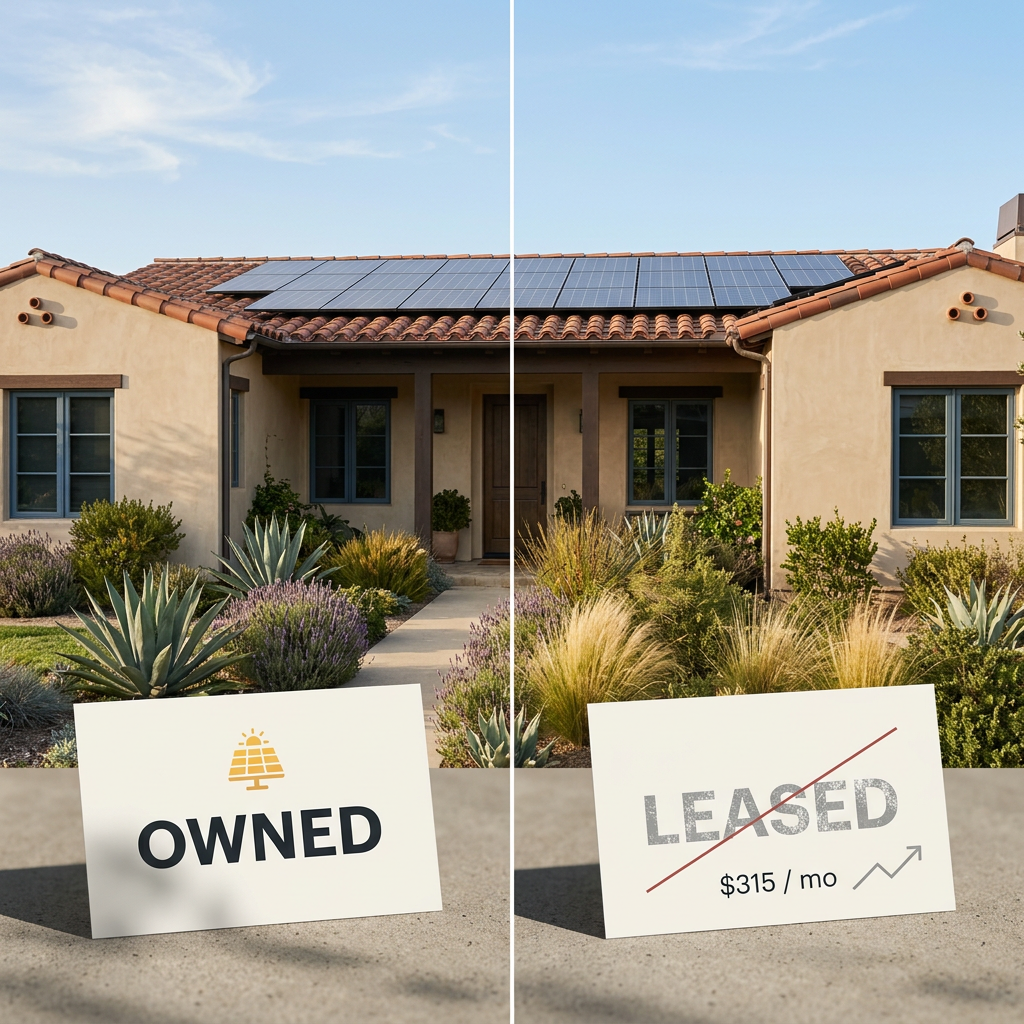
When you own your system — either outright with cash or through a loan — you receive the equipment, the warranty, and the 30% federal tax credit. After the loan is paid off, the electricity your system produces costs you nothing. Modern panels are built to last 40 to 50 years. The math is straightforward.
When you lease, Sunrun owns the equipment. They install it on your roof and charge you a monthly fee. That fee typically starts lower than your current utility bill, which is intentional. Most Sunrun leases also include a 2.9% annual escalator clause — meaning your payments increase every year for 20 to 25 years.
Run that math on a $150/month starting payment with a 2.9% annual increase over 20 years and you'll pay well over $45,000 total — for a system you never own and that would have cost a California homeowner roughly $21,000 to purchase outright after the federal tax credit.
Sunrun also claims the 30% ITC for themselves on every leased system. That's thousands of dollars that could have been yours.
What Are the Three Biggest Lies Sunrun Sales Reps Tell?
California has some of the strictest consumer protection laws in the country through the California Public Utilities Commission (CPUC), but that doesn't stop misleading solar sales pitches. Here are the three most common:
"You can always buy out the system later." Technically true, but the buyout price is set by Sunrun — not the market. They frequently inflate the original system value to maximize their own tax credit claim, which means the "fair market price" you'd pay later is based on that inflated number. Worse, used equipment doesn't qualify for the federal tax credit. In many cases, it's cheaper to remove the old panels and start fresh with a new owned system.
"The lease covers all maintenance." Sunrun will replace broken parts — but so will any reputable installer's warranty on an owned system. What leasing companies don't do is proactively clean your panels, inspect wiring annually, or monitor performance without an alert. You get the same reactive warranty protection either way. Ownership just doesn't cost you 20 years of rent to get it.
"Panels only last 20 years anyway." This was true of older technology. Today's panels are built to last 40 to 50 years, with manufacturers guaranteeing no more than 10% degradation over 30 years. Inverters now carry 25-year warranties. If you own your system, the panels are likely still producing meaningful power long after your loan is paid — for free. If you lease, the agreement ends and you're left with nothing on your roof.
What Is a Prepaid Solar Lease and Is It a Good Deal?
Sunrun also sells a product called a prepaid lease, which sounds like ownership because there are no monthly payments. You pay a lump sum upfront and the system operates for the lease term with no recurring bill.
But you still don't own the panels. Sunrun does. Because you're not the legal owner, you cannot claim the 30% federal Investment Tax Credit — even though you paid a significant amount of money upfront.
Prepaid leases also tend to use lower-cost equipment (common brands include Trina Solar panels with SolarEdge inverters) while pricing the deal in ways that obscure the value gap. You end up paying a premium price for a product that offers neither the monthly savings of a traditional loan nor the tax credit of ownership.
If a rep is quoting you a prepaid lease in California, compare it directly to a loan purchase from an independent installer. The numbers rarely favor the prepaid structure.
What If You're Already Locked Into a Sunrun Lease in California?
This is where it gets more complicated — and it's the situation a lot of California homeowners contact us about. If you've already signed a Sunrun lease and you're experiencing problems, you have options.
NEM 3.0, the current net energy metering policy in California, changed the economics of solar significantly in 2023. Many homeowners who signed leases under NEM 2.0 assumptions are now finding that the financial projections Sunrun presented don't match reality. That gap between what was promised and what's being delivered can be the basis for a formal exit.
At California Solar Exit, we work specifically with homeowners who are locked into solar agreements that aren't performing as sold — whether that's a lease, a PPA, or a financed system tied to a contractor who misrepresented the terms.
If you're dealing with a Sunrun lease that doesn't match what you were told at the point of sale, contact us to review your agreement. We help Californians understand their exit options and take the right steps to get out.
Frequently Asked Questions: Sunrun Solar Leases in California
Can I cancel a Sunrun solar lease in California? Yes, in some circumstances. California has specific consumer protection statutes, and if the terms of your lease were misrepresented at the point of sale, you may have grounds for cancellation or renegotiation. The process depends on your specific contract terms, how long ago you signed, and whether the system has performed as promised.
Does a Sunrun lease affect my home sale in California? Yes. A solar lease is recorded as a lien or UCC filing against your property. Buyers must either assume the lease or Sunrun must approve a transfer. Many home sales in California have fallen through or been delayed because of unresolved solar leases. This is one of the most common problems we help homeowners resolve.
What is a Power Purchase Agreement and how is it different from a lease? A Power Purchase Agreement (PPA) is similar to a lease in that you don't own the equipment. Instead of a fixed monthly payment, you pay a per-kilowatt-hour rate for the electricity the system produces — often with the same annual escalator clauses. Both structures benefit the solar company more than the homeowner over time.
Is Sunrun going out of business? As of 2026, Sunrun is publicly traded on the NASDAQ and is the largest residential solar company in the U.S. However, the company has faced financial pressure and restructuring. If your installer goes out of business while you're under a lease, the lease obligations can transfer to a third party — which is another reason ownership protects you.
What should I do if my Sunrun system isn't producing what was promised? Document everything — your utility bills before and after installation, any monitoring app data Sunrun provides, and your original sales agreement. Then call us. Underperformance compared to contracted projections is one of the strongest bases for a solar contract exit in California.
Ready to Get Out of Your Solar Lease? Call Us Today.
If you're a California homeowner stuck in a Sunrun lease or any other solar agreement that isn't working for you, you don't have to ride it out for 20 years.
California Solar Exit helps homeowners review their contracts, identify their options, and take action. Whether your system is underperforming, your home sale is at risk, or you were misled at the point of sale — we know California solar law and we know how to help.
Call us now: (213) 579-5156 Or submit your contract for a free review →
You signed up for savings. Let's make sure that's what you're actually getting.
Other insights
More from California Solar Exit
A Federal Court Just Said "No" to Forcing Arbitration — Because the Signature Might Not Even Be Real