Latest insights
The Paper Trail Behind California's Solar Scam: Newsom, Sunrun, and the Contracts You Can't Escape
The Paper Trail Behind California's Solar Scam: Newsom, Sunrun, and the Contracts You Can't Escape
If you're a California homeowner stuck in a solar lease or loan that hasn't performed the way you were promised, you've probably spent time wondering how you got here. The savings projections didn't materialize. Your utility bill didn't disappear. And every time you've tried to find a way out, you've hit a wall.
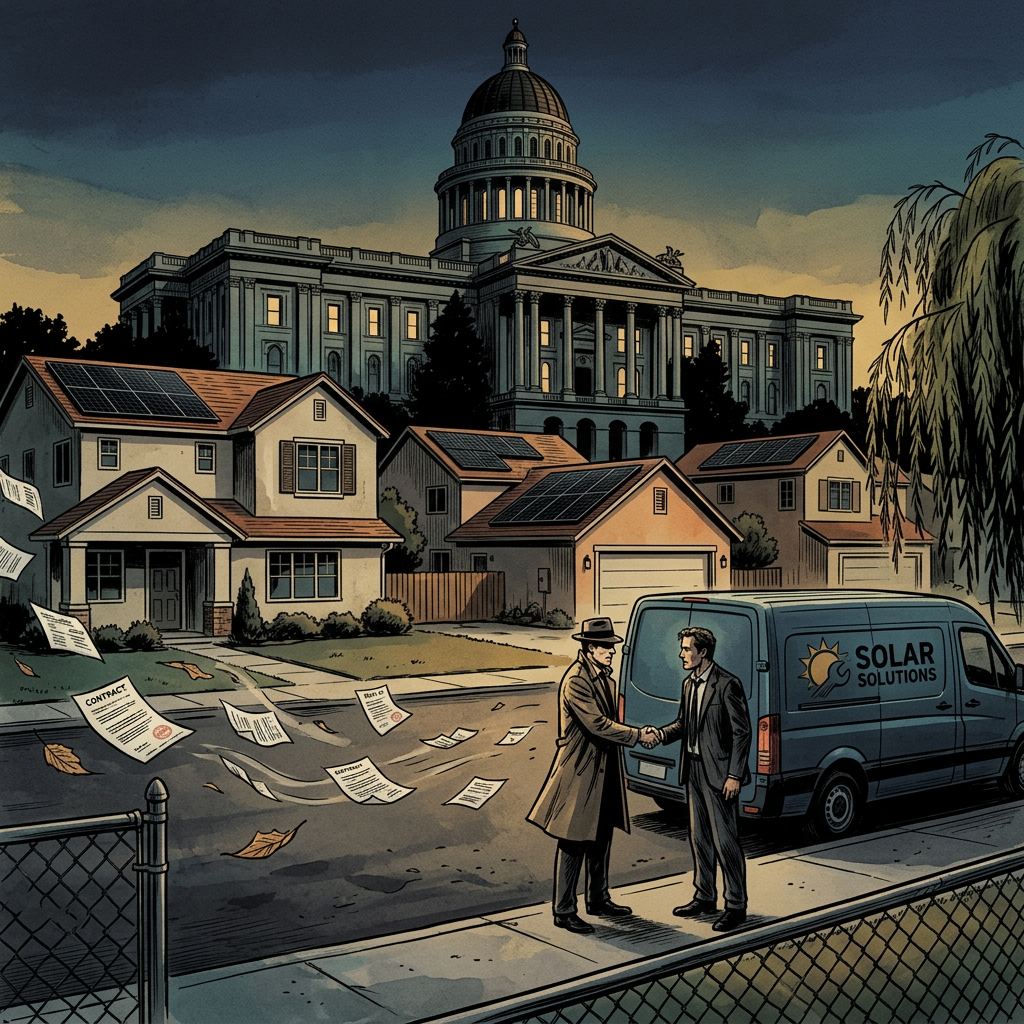
That wall has a paper trail. It runs from Sacramento straight to the company that may be on your roof right now.
A May 2026 investigative report from City Journal documented the collapse of California's Solar on Multifamily Affordable Housing program — nearly $900 million collected, $131 million actually spent on solar installation, and roughly 935,000 promised solar renters who never got panels. The investigation named names, traced donations, and identified appointments. What it revealed isn't just a story about government waste. It's a map of why residential solar contracts in California are so hard to escape — and who benefits from keeping them that way.
Step One: The Program That Was Never Going to Work
The Solar on Multifamily Affordable Housing program — SOMAH — was signed into law under Governor Jerry Brown and has operated under Governor Gavin Newsom. Funded through California's cap-and-trade program, it was designed to route up to $100 million per year toward solar installation on affordable apartment buildings, with a stated goal of 300 megawatts of capacity and one million solar-powered renters by 2030.
After nearly a decade, the California Public Utilities Commission reports the program has installed or reserved 129 megawatts for approximately 65,600 residents. More than $700 million of the collected budget sits unspent. More than 400 applications — roughly one-third of the total — have been cancelled or withdrawn. Projects that survive the process take an average of three and a half years to complete. Some finished systems sat idle for over a year waiting for permission to operate.
The CPUC's own auditors found the program so buried in paperwork and bureaucracy that even enthusiastic property owners walked away. One major contractor put it plainly: people started out excited and ended the process far less so.
This is the agency that also oversees net energy metering policy, sets the rules governing how your solar system connects to the grid, and determines the rate structure that dictates whether your solar contract ever delivers what you were promised. Keep that in mind.
Step Two: Follow the Contractor
Of the projects SOMAH did complete, one company handled 78 percent of them: Sunrun Inc., headquartered in San Francisco, and self-described as the largest residential solar provider in the United States.
That concentration alone is worth pausing on. A state program designed to democratize solar access effectively became a single-vendor operation — and that vendor happens to be the same company whose leases and power purchase agreements dominate the California solar cancellation cases we review at California Solar Exit.
Sunrun's dominance in SOMAH didn't happen by accident. According to the City Journal investigation, Sunrun representatives met with government regulators to discuss the program — including a December meeting where the company actively supported expanding SOMAH's scope and funding. An army of lobbyists supports that access in Sacramento.
And then there are the donations.
Step Three: Follow the Money
California campaign finance records show Sunrun has donated hundreds of thousands of dollars to political candidates in California. The City Journal report identified $50,000 in contributions to Gavin Newsom's campaigns specifically.
Newsom, now governor, has returned the relationship in concrete ways. His administration appointed Sunrun's former public policy manager to the California Energy Commission — the body that sets statewide energy policy and oversees solar program design. He separately appointed Sunrun's former chief policy officer to a regional water quality control board.
These aren't entry-level positions. The California Energy Commission directly influences the rules that govern how residential solar systems are credited, compensated, and regulated. The same commission plays a role in net energy metering policy — including the NEM 3.0 transition that blindsided hundreds of thousands of California solar customers who were sold systems under the promise of full bill elimination that the new rate structure made impossible.
If you signed a solar contract before NEM 3.0 took effect and your savings evaporated when the policy changed, that policy was shaped in part by an agency now staffed with former executives from the company on your roof.
Step Four: What This Means for Your Contract
The paper trail matters because it explains something homeowners in Los Angeles, San Diego, Orange County, the Inland Empire, Sacramento, and the Bay Area keep running into: the system is not neutral.
When you signed a solar lease or power purchase agreement with Sunrun, SunPower, Sunnova, Vivint Solar, or Tesla Energy, you signed a contract drafted by a legal team whose entire job is to make exit difficult. When you financed through GoodLeap, Mosaic, or GreenSky, you took on a loan that may have placed a UCC-1 lien on your home's title without anyone explaining what that meant for your ability to sell or refinance. When the savings projections turned out to be wrong, you discovered that verbal commitments from a sales rep and written contract terms are treated as two entirely different things.
The companies writing those contracts operate in a regulatory environment shaped by their own former executives. The program administrators who were supposed to protect affordable housing solar customers — the same customers who should have benefited from $900 million in public funds — couldn't get a third of applications through the process.
None of that means you're out of options. It means you need to use the options that actually exist — not the ones the system was designed to give you.
What California Law Puts in Your Corner
California's consumer protection framework is among the strongest in the country, and it applies directly to residential solar contracts.
The California Consumer Legal Remedies Act (CLRA) prohibits deceptive representations in consumer transactions. If your sales rep showed you production estimates that overstated what the system would generate, that may constitute a CLRA violation. The California Home Solicitation Sales Act provides specific protections for contracts signed at your residence — which covers the overwhelming majority of residential solar sales. The FTC's cooling-off rule gives you a right of rescission for contracts signed away from the seller's place of business.
And under the FTC Holder Rule, your claims don't necessarily stop at the solar company. If your loan was originated through a third-party lender like Mosaic or GreenSky, the Holder Rule may allow you to assert your claims against the lender directly — even if the original installer has gone out of business, changed its name, or filed for bankruptcy, as Freedom Forever recently did.
These are the tools California Solar Exit works with on every case. The paper trail in Sacramento doesn't close them off — it's just the reason you need someone in your corner who knows how to use them.
The Free Review That Starts the Process
You don't need to decode regulatory filings or track campaign donations to know your situation isn't working. You know it when you're paying both a solar loan and a full utility bill. You know it when a Riverside County title officer finds a lien you didn't know existed. You know it when the numbers your sales rep showed you have no relationship to your actual monthly costs.
What you may not know is exactly where your contract is vulnerable — and that's what the review is for.
California Solar Exit offers a free, no-obligation case review to homeowners across Los Angeles County, Orange County, San Diego, the Inland Empire, the Bay Area, Sacramento, and the Central Valley. We read your contract, identify the misrepresentation or disclosure failures, and tell you plainly what your options are and what it would take to act on them.
The $900 million that was supposed to help California solar customers is still sitting in an account, unspent, while the contractors and lobbyists who shaped the program move on to the next one. Your situation doesn't have to wait for the state to fix itself.
Call (213) 579-5156 or get your free contract review here — no obligation, no pressure, just the paper trail and your options.
Sources: City Journal, "Inside Gavin Newsom's Solar Scam," May 27, 2026 (Christopher F. Rufo and Austen Hufford); California Public Utilities Commission SOMAH Third Triennial Report Draft, 2026; California Energy Center SOMAH program data; California campaign finance records.
Other insights
More from California Solar Exit