Latest insights
Divorce and Your Solar Contract in California: Who's Actually Stuck Paying?

Divorce and Your Solar Contract in California: Who's Actually Stuck Paying?
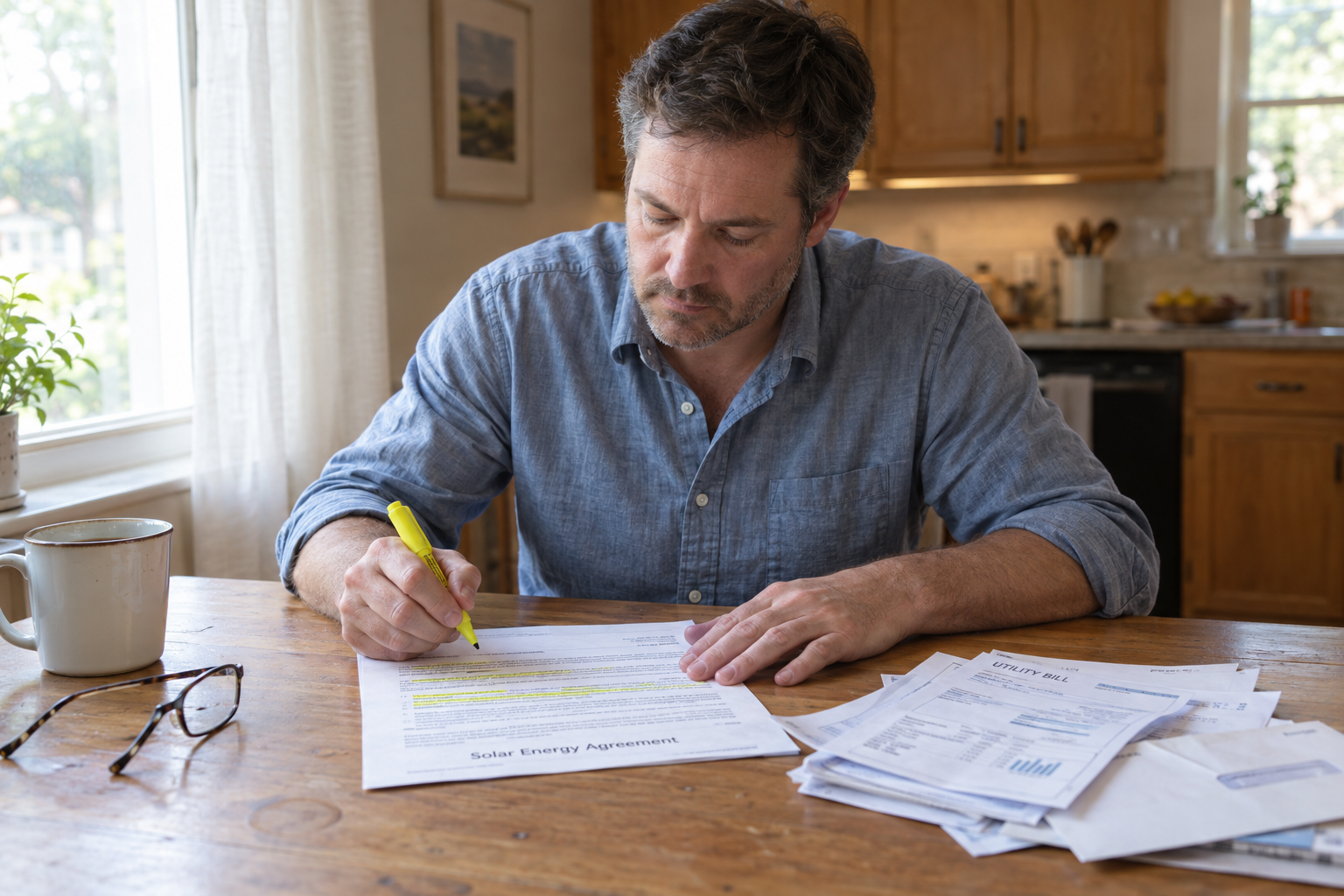
Divorce forces couples to divide the house, the cars, the retirement accounts, and the credit card debt. What almost nobody accounts for is the 20- to 25-year solar lease, PPA, or loan sitting on the roof — a contract that outlasts most marriages and doesn't care whose name is on the settlement agreement.
Family law attorneys are experts in the Family Code, not solar financing. Solar companies are experts in collecting payments, not divorce decrees. That gap is exactly where homeowners get stuck.
Is a Solar Contract Community Debt in California?
California is a community property state. Under the Family Code, most debts incurred during the marriage — regardless of whose name is on the paperwork — are presumed to be community debt, split equally between spouses at divorce. This applies the same way to a mortgage, a car loan, or a credit card.
A solar lease, PPA, or loan signed during the marriage generally falls into the same category. It doesn't matter that only one spouse signed the contract at the kitchen table when the sales rep came by. If the panels went on the house while you were married and before your date of separation, the obligation is presumptively shared — even though only one of you can walk away from it in a settlement.
The one narrow exception: debts incurred after the date of separation are typically treated as separate. So if one spouse adds solar to the house post-separation, that's usually on them alone. Everything signed while the marriage was intact is fair game to be divided, offset, or assigned to one party in the settlement.
What Happens When One Spouse Keeps the House
This is where it gets specific to solar, because a house with solar isn't like a house with just a mortgage.
If a loan financed the system, the panels are an owned asset with real equity value — good and bad. The spouse keeping the house may need to refinance to remove the other spouse's name from the loan, the same way they would with a mortgage. That refinance will hit the same wall covered in our guide to solar liens on California homes: underwriters will find the UCC-1 filing during the title search, and it needs to be addressed — subordinated, paid off, or confirmed as satisfied — before the refinance closes.
If it's a lease or PPA, the situation is different but not simpler. The solar company, not either spouse, owns the equipment. Removing a spouse from that contract usually requires the solar company's approval, the same underwriting process used for any lease transfer. A financially responsible ex-spouse doesn't automatically get removed from a solar lease just because a judge signed a marital settlement agreement — the solar company wasn't a party to that agreement and isn't bound by it.
The Settlement Agreement Doesn't Bind the Solar Company
This is the part that surprises people. A marital settlement agreement can say, in black and white, "Husband assumes full responsibility for the solar contract." That agreement is binding between the two spouses. It is not binding on the solar company or the lender.
If both spouses originally signed the contract, both remain contractually liable to the solar company regardless of what the divorce decree says — until the solar company itself agrees to release one spouse, which usually means a formal assumption or refinance process, not a line item in a settlement. If the paying spouse defaults after the divorce, the solar company or lender can still come after the spouse who was supposedly released in the settlement, and that spouse's only recourse is to go back to family court and enforce the agreement against their ex — a separate, slower fight that doesn't stop collection calls or credit damage in the meantime.
Red Flags to Watch For During a Divorce
- The settlement agreement assigns the solar contract to one spouse but nobody has contacted the solar company or lender to formally process a release or assumption
- The spouse keeping the house is refinancing and the UCC-1 filing hasn't been searched for or addressed
- One spouse is planning to sell rather than keep the house, and the buyer hasn't been told the solar lease exists or must be assumed or bought out before closing
- The original sale involved misrepresented savings projections that neither spouse caught at the time, which may open a rescission path independent of the divorce
- Payments have already lapsed post-separation while the couple sorts out who's responsible, risking a ding to both credit files
What to Do
- Identify the contract type first — loan, lease, or PPA — since each creates a different practical problem in a divorce.
- Pull a UCC-1 search at the California Secretary of State's BizFile Online before finalizing any refinance or buyout involving the house.
- Contact the solar company or lender directly to ask what's required to formally release one spouse's liability — don't assume a settlement agreement alone accomplishes this.
- Get the assumption or release in writing from the solar company before treating the matter as resolved.
- If the underlying contract itself was misrepresented — inflated savings projections, undisclosed escalators, an undisclosed lien — that's worth a separate review regardless of the divorce, since rescission under California consumer protection law can sometimes resolve the debt question entirely rather than just reassigning it.
Frequently Asked Questions
Can a judge order the solar company to release my ex-spouse from the contract?
No. Family court has authority over the two spouses, not over the solar company or lender. A judge can assign responsibility between spouses, but formally releasing someone from third-party liability requires the solar company's own process.
What if my ex-spouse stops paying after the divorce and I'm still on the contract?
You remain liable to the solar company or lender if your name is still on the original agreement, and it can affect your credit even though the settlement assigned payment to your ex. Your recourse against your ex runs through family court, separately from the solar company's collection rights against you.
Does selling the house during a divorce resolve the solar contract automatically?
No. A lease or PPA has to be either transferred to the buyer (with the solar company's approval) or bought out before closing. A loan-secured system's UCC-1 has to be addressed in escrow the same way. Selling doesn't erase the obligation — it just changes who has to solve it and when.
Is a solar contract signed before marriage considered community debt?
Generally no. Debts incurred before marriage are typically separate property of the spouse who incurred them, though payments made from community funds during the marriage can sometimes create a reimbursement claim. This gets fact-specific and is worth reviewing with a family law attorney alongside a solar contract review.
Sorting out a solar lease, loan, or PPA during a divorce? California Solar Exit reviews solar contracts for homeowners across Los Angeles, Orange County, San Diego, the Inland Empire, Sacramento, and the Bay Area — including cases tangled up in a separation or settlement.
Call (213) 579-5156 for a free review, or book a consultation online.
Daniel Merritt, Senior Solar Contract Analyst
California Solar Exit — this content is for general informational purposes only and does not constitute legal advice or create an attorney-client relationship. Consult a family law attorney for advice specific to your divorce.
Other insights
More from California Solar Exit