Latest insights
NEM 3.0 Killed Your Solar Savings in California: Here's What to Do in 2026
NEM 3.0 Killed Your Solar Savings in California: Here's What to Do in 2026

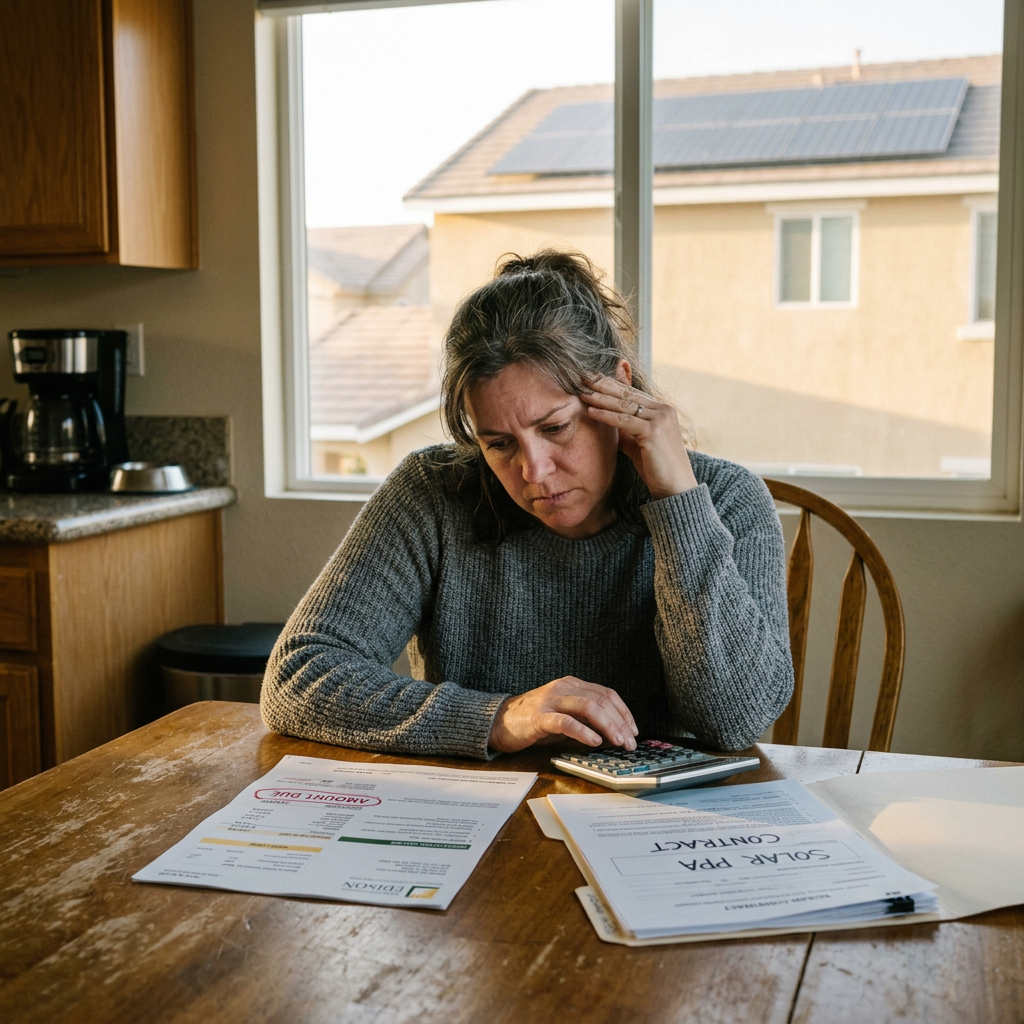
You went solar. You were promised a bill near zero, maybe a small monthly credit, and decades of "free" electricity from your roof. Then your true-up arrived — or your monthly statement crept past $200, $300, sometimes more — and the math your salesperson sketched on a clipboard stopped matching reality.
If you signed a solar contract in California after April 15, 2023, you're on the Net Billing Tariff — what almost everyone calls NEM 3.0. And the savings gap you're feeling isn't a glitch. It's the policy working exactly as the California Public Utilities Commission designed it. The question is whether your installer told you that — and whether what they did tell you crosses into the kind of misrepresentation that gives you a legal way out.
What Changed When NEM 3.0 Took Effect
Under the old policy (NEM 2.0), when your panels pushed extra electricity onto the grid, your utility credited you at roughly the full retail rate — around $0.30/kWh in most of California. Send a kilowatt-hour out, pull a kilowatt-hour back later, and it was close to a wash. That's the math that made solar an obvious win for fifteen years of California homeowners across PG&E, SCE, and SDG&E territory.
NEM 3.0 broke that math. Export credits are now tied to the CPUC's Avoided Cost Calculator (ACC) — wholesale-style rates that change by month, day, and hour. The average export rate dropped roughly 75%, from $0.30/kWh down to around $0.05–$0.08/kWh. Mid-day exports (when most rooftop systems are pushing the most power) are credited at the lowest values of the entire schedule, because the grid is already swimming in cheap solar at noon.
Self-consumed solar still saves you the full retail rate. But anything your panels send out — and on a typical undersized residential system, that's most of your production during work hours — is now worth pennies. Meanwhile, the same utilities that credit you $0.06/kWh for exports will charge you $0.45–$0.55/kWh for the power you pull back during 6–9 PM peak hours.
That's the trap. You produce when power is cheap. You consume when power is expensive. Without a battery, the spread eats your savings — and if you're on a PPA with an escalator clause on top of it, that gap widens every single year.
Why Your Salesperson's Numbers Don't Match Your Bill
Here's where things get legally interesting. NEM 3.0 was approved by the CPUC in December 2022 and took effect April 15, 2023. By the time most homeowners signed contracts in late 2023, 2024, and 2025, the new rules had been in effect for months — sometimes years.
But the sales pitch didn't always update.
California Solar Exit has reviewed hundreds of contracts from homeowners across Los Angeles, the Inland Empire, the Central Valley, Orange County, and the Bay Area. The same patterns keep showing up:
- Savings projections built on NEM 2.0 assumptions. Sales decks quoted "average savings of $1,800–$2,500 per year" using export credits that no longer exist for new customers.
- No mention of TOU rate plans being mandatory. Under NEM 3.0, you're required to be on a time-of-use plan like E-ELEC (PG&E), TOU-D-PRIME (SCE), or EV-TOU-5 (SDG&E). These plans punish evening usage in ways homeowners weren't warned about.
- Battery storage pitched as "optional." Under NEM 3.0, a battery isn't a nice-to-have. Battery attachment rates in California jumped from around 11% before 2023 to nearly 70% by the end of 2024 — because solar-only economics don't pencil anymore. Customers sold a solar-only system in this market were sold an underperforming product.
- No disclosure of the 75% export rate cut. A sales rep showing you a 25-year savings projection has an obligation to know the actual current rules. Some did. Many didn't.
- Inflated production estimates to backfill the missing savings. If the kWh-to-dollar math doesn't work, some installers padded the production side — overstating annual generation to make the payback chart look right.
A solar contract in California is governed by the Home Solicitation Sales Act, the Consumers Legal Remedies Act, and a specific solar-disclosure statute (Business & Professions Code §§ 7169–7170) that requires installers to give homeowners a standardized Solar Energy System Disclosure Document in 12-point font, in the homeowner's preferred language, with specific cost and savings information. If your installer skipped that document, used pre-NEM 3.0 figures in it, or never had you sign it — those are concrete violations, not vibes. (For more on the rescission window and post-signing rights, see our guide on how to cancel a solar contract after signing in California.)
The Legal Picture Just Got More Complicated
NEM 3.0 has been in court since the day it took effect. The Environmental Working Group, Center for Biological Diversity, and Protect Our Communities Foundation filed suit in 2023 arguing the CPUC failed to consider all the benefits rooftop solar provides — to the grid, to disadvantaged communities, and to California's climate goals.
The timeline so far:
- August 2025: The California Supreme Court unanimously ruled that the lower Court of Appeal had used the wrong legal standard and ordered it to reconsider whether NEM 3.0 is legal.
- November 2025: Plaintiffs re-filed briefs at the Court of Appeal.
- March 10, 2026: The Court of Appeal sided with the CPUC a second time, affirming NEM 3.0.
- April 20, 2026: Solar plaintiffs filed a fresh appeal back to the California Supreme Court.
What this means in practice: NEM 3.0 is still the law right now. If the Supreme Court eventually overturns it, that ruling will most likely apply to future installs and possibly to currently-pending interconnections. It is not a magic wand that retroactively fixes your existing solar contract. The bill you're getting today isn't going to be refunded by a court order next year.
That's why the homeowners who get relief are the ones who pursue contract-level cancellation through California consumer-protection law — not the ones waiting for state policy to change.
Who's Most Likely to Have Real Cancellation Grounds
Not every disappointed solar customer has a case. California Solar Exit's contract reviews tend to surface qualifying patterns most often in homeowners who:
- Signed a lease, PPA, or solar loan after April 15, 2023 and were given savings projections that match NEM 2.0 economics.
- Received documents that missed or improperly executed the Solar Energy System Disclosure required by §§ 7169–7170.
- Were sold a solar-only system (no battery) with promises of bill-zeroing or near-zero bills under PG&E, SCE, or SDG&E.
- Had a salesperson handle the entire transaction through DocuSign or in-home pressure tactics without a clear three-day rescission notice or HSSA-compliant disclosures.
- Are now seeing monthly bills that exceed what they paid before going solar, despite a system that's producing the kWh the contract promised.
- Are paying through a third-party lender — and dealer fees got rolled into the principal without clear disclosure. This is especially common with GoodLeap solar loans, along with Sunlight Financial, Mosaic, Dividend, and Service Finance.
If two or more of those describe your situation, your contract probably deserves a closer look than a casual reading by a friend or a Reddit thread can give it.
What "Getting Out" Actually Looks Like
There's no single exit. The right path depends on your contract type, who financed it, and what your installer actually did.
For solar loans (most homeowners through GoodLeap, Mosaic, Sunlight, Dividend, Service Finance): cancellation typically targets the underlying installation contract and the installer's disclosure violations. When the installation contract unwinds, the financing connected to it often unwinds with it.
For leases and PPAs: the path usually involves voiding the long-term agreement based on misrepresentation, missing disclosures, or HSSA violations rather than buying out at the lessor's inflated buyout figure. The specifics differ by company — we've broken down the most common ones in dedicated guides:
- Sunrun (formerly Vivint Solar) contracts in California
- Tesla and SolarCity contracts in California
- Sunnova bankruptcy and what SunStrong customers should do
For homeowners trying to sell: a non-cancellable solar lease or UCC-1 fixture filing on your title is one of the most common deal-killers in California real estate right now. Cancellation pre-sale often saves the transaction.
What cancellation does not include: walking away with the panels free, getting a refund of every payment ever made, or any guarantee about your specific case. California Solar Exit doesn't advise homeowners to stop paying their solar bills, and any honest advocacy firm will tell you the same thing. What it can do is force a contract to be evaluated against the laws that actually govern it — and in a meaningful percentage of post-April-2023 cases, the contract doesn't survive that evaluation.
Frequently Asked Questions
Is NEM 3.0 still in effect in 2026? Yes. NEM 3.0 (officially the Net Billing Tariff) remains the active policy for all new solar interconnections in PG&E, SCE, and SDG&E territory. A second appeal is pending at the California Supreme Court as of April 2026, but the current rules apply while that case proceeds.
Does NEM 3.0 apply to LADWP customers? No. NEM 3.0 only applies to the three investor-owned utilities (PG&E, SCE, SDG&E). LADWP, SMUD, and other municipal utilities have separate net metering programs with currently more favorable terms.
If I'm on NEM 2.0, am I safe? Mostly. If you interconnected before April 15, 2023, you're grandfathered into NEM 2.0 for 20 years from your Permission to Operate (PTO) date. Adding a battery to an existing NEM 2.0 system doesn't change that, as long as the modification doesn't increase system size by more than 10% or 1 kW.
Can I cancel my solar contract just because NEM 3.0 reduced my savings? Not on its own. NEM 3.0 is a regulatory change, not a contract breach by your installer. But if your installer's sales materials, disclosures, or savings projections didn't reflect NEM 3.0 even though they were prepared after April 2023, that's a misrepresentation issue under California consumer-protection law — and that's actionable. Our post-signing cancellation guide walks through the specific grounds.
How long does a solar contract cancellation take in California? Cases vary. A clean rescission case with strong disclosure violations can resolve in weeks. Cases involving leases, third-party financing, or older contracts typically take longer. Most homeowners get clarity within a free contract review.
What does a contract review cost? California Solar Exit reviews contracts at no charge. There's no obligation to engage further after the review — the goal is to tell you whether you have a real path forward or not.
If You're Stuck, Get an Actual Read on Your Contract
NEM 3.0 didn't just lower export credits. It exposed every solar contract signed since April 2023 to a level of scrutiny the industry isn't used to. The installers who quoted honest, NEM 3.0-compliant numbers and steered customers toward batteries have nothing to fear. The ones who copy-pasted 2020 sales decks onto 2024 customers do.
If your monthly statement isn't matching the projection you signed, the right next step isn't another call to your installer's customer service line. It's a free review of the contract itself, against California law as it actually exists in 2026.
California Solar Exit — Serving all of California, remote consultations available. 📞 (213) 579-5156 📍 617 W 7th St, Los Angeles, CA 90017 Book a Free Contract Review →
Other insights
More from California Solar Exit