Latest insights
The FTC Holder Rule: What California Solar Homeowners Need to Know Before They Give Up
The FTC Holder Rule: What California Solar Homeowners Need to Know Before They Give Up
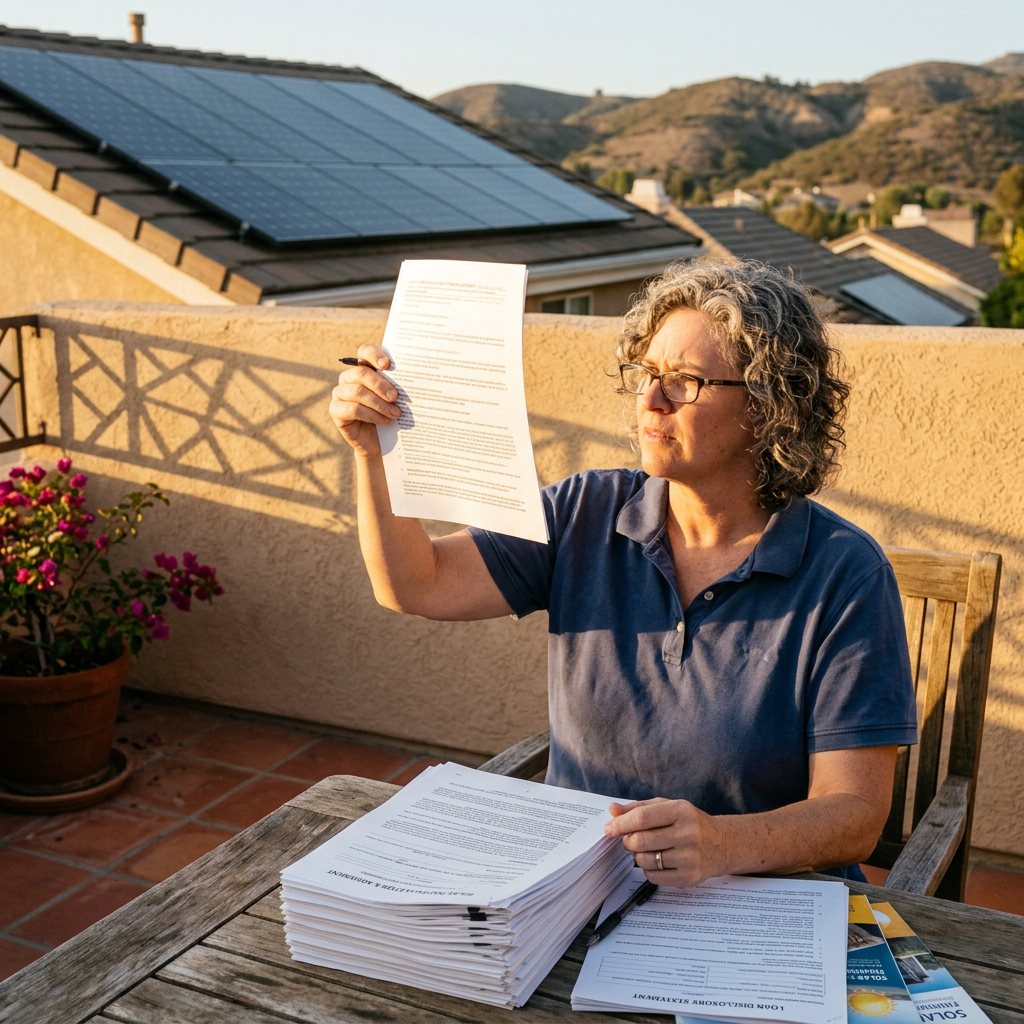
You signed a solar agreement with a company that promised you savings. A lender you'd never heard of paid the installer, and now your monthly payments go to that lender — not the company that knocked on your door. The installer may have gone bankrupt, changed names, or simply stopped returning calls. But the loan? Still very much alive.
What most California homeowners don't realize is that the transfer of your loan to a third-party lender does not wipe out your legal rights against the original seller. A federal regulation called the FTC Holder Rule says the lender that holds your credit contract inherits the same claims you had against the company that sold you the system.
If you were misled, if your system doesn't perform as promised, or if your installer disappeared before the job was done, the lender is not off the hook. If you're not sure whether your situation qualifies, start with our free solar contract review.
What exactly is the FTC Holder Rule?
The FTC Holder Rule — officially 16 C.F.R. Part 433, adopted by the Federal Trade Commission in 1976 — exists because of a trick that sellers routinely used to insulate themselves and their lenders from consumer fraud claims.
Before the rule, a salesperson could sign you up for financing, immediately sell your credit contract to a bank or finance company, and both parties would walk away protected. Courts recognized the bank as a "holder in due course," which cut off any claims you had against the seller once the contract was assigned. The FTC closed that loophole. Today, any company that holds your consumer credit contract — the original lender, a bank that bought the loan, a servicer collecting your payments — is subject to every claim and defense you had against the original seller.
Your rights don't disappear when the contract changes hands. That's the entire point of the rule.
Why does this matter so much for California solar homeowners specifically?
California has more residential solar installations than any other state — over 1.5 million as of 2024, according to the California Energy Commission. That volume came with aggressive sales tactics, inflated savings projections, and a wave of installer bankruptcies that left homeowners from the San Fernando Valley to San Diego's East County making payments on systems that were never finished, never performed as promised, or were never properly permitted.
We covered the scope of that collapse in detail in our post on the 2026 California solar installer bankruptcy wave — if your installer is on that list, the Holder Rule is likely your most direct path to relief.
The solar financing model almost guarantees the rule applies to your situation. Installers like SunPower, Sunnova, Freedom Forever, and regional California dealers don't lend their own money. They partner with solar-specific lenders — Mosaic, GoodLeap, GreenSky, Sunlight Financial, Dividend Finance — who fund the installation and collect your payments for the next two decades. When the installer sold you the system and handed you that lender's application at your kitchen table in Riverside County, Temecula, or the South Bay, they were arranging consumer credit connected to a sale. The FTC Holder Rule applies to that transaction.
And if that installer has since filed for bankruptcy or disappeared — which describes a significant portion of California's solar market between 2024 and 2026 — the lender cannot use that as a shield. You can still assert your claims against whoever is collecting your payments today.
What claims can you raise against your solar lender?
Under the Holder Rule, you can raise against the lender any claim you could have raised against the original seller. In California solar disputes, those most commonly include:
Misrepresentation. If a rep in Orange County, the Inland Empire, or Sacramento told you your electric bill would drop to near zero and it hasn't budged — or went up — that false promise doesn't become the lender's clean slate. The misrepresentation travels with the contract. We see this constantly in cases tied to NEM 3.0, where homeowners were sold systems under old net metering assumptions that the new rate structure made obsolete almost immediately.
Breach of contract. If your agreement included a production guarantee and your system consistently underdelivers, the entity collecting your monthly payment is subject to that breach claim.
Failure to complete the installation. Homeowners across Los Angeles County and the Bay Area were left with half-installed systems when SunPower collapsed in 2024. The Holder Rule means GreenSky or Mosaic can't respond with "not our problem."
Undisclosed liens. Many California homeowners — particularly those trying to sell or refinance in competitive markets like Orange County or the Sacramento suburbs — discovered a UCC-1 financing statement on their home's title that was never disclosed at the time of sale. That failure to disclose is a misrepresentation claim that travels to the holder. If you're in this situation, read our breakdown of solar UCC-1 liens and how they affect your property before you do anything else.
Rescission. When a seller's misconduct is serious enough, courts can grant complete cancellation of the loan — not just a damages award — through a remedy called rescission. Your financial recovery from the lender is otherwise capped at the total amount you've paid under the contract, but rescission is a separate remedy that goes beyond that ceiling.
How do you know if the Holder Rule applies to your loan?
The FTC requires sellers to include a specific all-caps notice in every covered consumer credit contract. Look for this language in your GoodLeap, Mosaic, or GreenSky paperwork:
NOTICE: ANY HOLDER OF THIS CONSUMER CREDIT CONTRACT IS SUBJECT TO ALL CLAIMS AND DEFENSES WHICH THE DEBTOR COULD ASSERT AGAINST THE SELLER OF GOODS OR SERVICES OBTAINED PURSUANT HERETO OR WITH THE PROCEEDS HEREOF. RECOVERY HEREUNDER BY THE DEBTOR SHALL NOT EXCEED AMOUNTS PAID BY THE DEBTOR HEREUNDER.
If that notice is present, the Holder Rule is explicitly incorporated into your contract. If it's missing, the seller was already in violation of federal law when you signed — and that violation itself can support a claim.
Not sure what you're looking at in your documents? Our team reviews contracts for free — submit yours here.
Does the Holder Rule cover solar leases and PPAs?
Generally, no. The rule was built for consumer credit transactions — situations where you financed a purchase through a third-party lender. A solar lease or power purchase agreement works differently: you're paying for a service or for the electricity generated, not purchasing equipment on credit. Leases and PPAs still have strong consumer protection options under California law — the California Consumer Legal Remedies Act, the Home Solicitation Sales Act, and CPUC regulations — but the Holder Rule's direct application is to financed solar loans.
If your contract is with Sunrun, Sunnova, or Vivint Solar and it's structured as a lease or PPA, your path out looks different. It still exists — and you can learn more about how solar contract cancellation works in California regardless of your contract type.
What steps should you take right now?
Gather your original solar loan agreement — every page of it — along with any sales presentation materials, emails, or text messages from the time of sale. Look for the Holder Rule notice. Write down every promise that was made: savings projections, production estimates, bill reduction figures, timeline commitments. Then compare those promises against what's actually happened. The gap between what was promised and what was delivered is the core of your case.
Once you have that documented, put your claims in writing to the lender. Reference the FTC Holder Rule by name — 16 C.F.R. Part 433. Do not simply stop paying — that creates credit and legal risk without building leverage. The goal is to formally assert your rights in a way that creates a record and opens a negotiation.
If that feels like too much to take on against a company like Mosaic or GreenSky on your own, that's a reasonable assessment. These lenders have legal teams that handle consumer disputes every day. Most homeowners in Los Angeles, San Diego, Riverside, and throughout California don't.
California Solar Exit handles all communications with solar companies and lenders on behalf of the homeowners we work with. We've helped more than 500 California families get out of contracts that trapped them. Read about what's driving the surge in solar complaints if you want to understand how widespread this problem has become — and then contact us for a free case review when you're ready.
Call (213) 579-5156 or submit your contract for a free review — no commitment required.
Frequently Asked Questions
Does the FTC Holder Rule apply to my Mosaic or GoodLeap solar loan? In most cases, yes. If a solar company arranged your financing — even by sitting with you while you completed a lender's application — the transaction falls under the rule. Pull your loan documents and look for the all-caps Holder Rule notice to confirm. If you're unsure, submit your contract for a free review.
My installer went bankrupt. Can I still use the Holder Rule? Yes — and this is exactly when the rule is most valuable. The lender that holds your loan cannot use the installer's bankruptcy as a reason to refuse your claims. You assert those claims directly against whoever is collecting your payments today. See our full breakdown of the 2026 California solar installer bankruptcy wave for more on how this works.
What if my system works fine, but I was misled about savings projections or a lien on my home? Performance is only one type of claim. Misrepresentation about savings, utility costs, escalator clauses, or the existence of a UCC-1 lien on your property are all valid grounds — regardless of whether your panels are generating electricity.
Is there a time limit to assert these claims? The Holder Rule doesn't set a hard deadline, but California's statutes of limitations on fraud and breach of contract do. Waiting reduces your options. If you think you have a claim, the right time to review it is now.
Can I cancel my solar loan entirely, or only reduce what I owe? Rescission — full cancellation of the loan — is a remedy courts can grant when the seller's misconduct is serious enough. Your financial recovery from the lender is otherwise limited to what you've paid, but rescission is a separate, more complete remedy. Learn more about how solar contract cancellation works.
How is a UCC-1 lien different from a mortgage lien? A UCC-1 financing statement is filed by the solar lender to secure their interest in the equipment on your property. It's not the same as your mortgage, but it sits on your title and must be resolved before most real estate transactions — sales, refinances, HELOCs — can close. Homeowners in competitive markets like Orange County and the Sacramento suburbs have had home sales derailed because of undisclosed solar UCC-1 filings. If this is your situation, contact us before you list or refinance.
This article is for general informational purposes only and does not constitute legal advice. California Solar Exit is a consumer advocacy firm, not a law firm. Individual results vary. Contact our team for a review of your specific contract and circumstances.
Other insights
More from California Solar Exit