Latest insights
Why Your California Solar Bill Is Still High This Summer
Why Your California Solar Bill Is Still High This Summer
Pacific Gas and Electric has been warning customers directly to brace for steeper summer costs as triple-digit heat pushes air conditioners into overdrive across the state. The California Public Utilities Commission even shifted the timing of the 2026 California Climate Credit specifically so it lands during peak-usage summer months instead of milder ones — a tacit admission that summer bills are the problem.
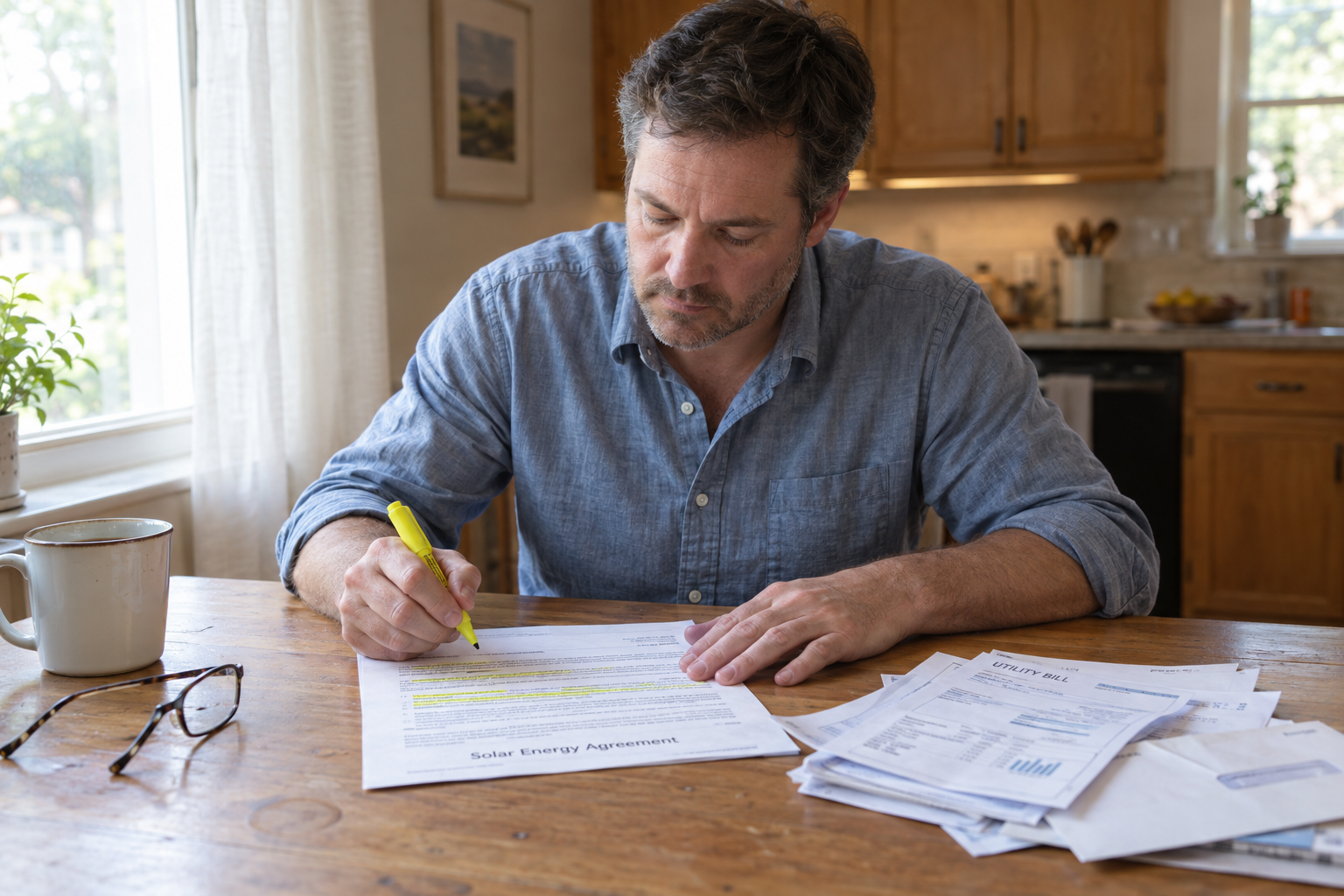
If you have solar and you're still opening a bill that looks nothing like what you were promised, you're not imagining it, and you're not alone. There's a specific mechanism behind it, and it has almost nothing to do with your panels working correctly.
The Promise vs. the Mechanics
Solar sales pitches — especially ones made before April 2023 — commonly promised bills near zero. That promise was built on the old net metering structure, where excess energy you sent to the grid was credited at close to the retail rate you'd pay to pull energy back.
That's not how it works anymore. Under NEM 3.0 — officially the Net Billing Tariff, approved by the CPUC in Decision D.22-12-056 and in effect since April 15, 2023 — the credit for power you export is calculated hourly using an Avoided Cost Calculator. In practice, that credit averages roughly $0.05 to $0.08 per kilowatt-hour, while the power you pull from the grid at peak hours can cost $0.30 to $0.55 per kilowatt-hour. You're exporting cheap and importing expensive, and no amount of production erases that gap.
Non-Bypassable Charges: The Part of the Bill Solar Can't Touch
Even a system that perfectly offsets your usage on paper doesn't zero out your bill, because California law requires solar customers to keep paying certain charges regardless of production. Per the CPUC, NEM customer-generators pay the same non-bypassable charges as everyone else — including the Department of Water Resources bond charge, public purpose program charges, nuclear decommissioning charges, and competition transition charges. These fund low-income and energy efficiency programs, and solar production doesn't offset them. (NEM customers are exempt from separate standby charges, for what it's worth — but that's a different line item than the one driving most complaints.)
Generation vs. Delivery: Why "Fully Offset" Doesn't Mean $0
This is the part almost nobody explains at the sales table. Since July 1, 2024, under CPUC Resolution E-5301, utility bills split "Delivery" charges from "Generation" charges — and your solar export credits can only offset the category they belong to. A generation credit can't be applied to a delivery charge, even if you technically generated more than enough energy over the year. So a homeowner who nets out at zero on generation can still owe real money on delivery charges every single month, including the highest-usage months of summer.
The Timing Mismatch That Gets Worse in a Heat Wave
Solar systems produce their most power in the middle of the day. Air conditioners run hardest from late afternoon into evening, exactly when solar output is dropping. During a heat wave, that mismatch widens: your system is generating its cheap midday surplus while your actual peak draw — and peak rate — hits after the sun has mostly done its work for the day. This is the mechanical reason a "fully sized" system can still leave you with a real bill on the hottest days of the year, and it's baked into the rate structure, not a sign anything is broken.
When a High Bill Despite Solar Crosses Into Misrepresentation
None of the mechanics above are secret — they're published CPUC policy. What matters is what you were told when you signed. If a sales rep quoted near-zero bills, quoted NEM 2.0-era savings after April 2023, or never mentioned non-bypassable charges or the generation/delivery split at all, that's a different problem than normal seasonal variation — and it's the kind of gap our FTC Holder Rule guide and guide to getting out of a solar contract are built around. We also cover how the underlying legal landscape settled in our piece on the NEM 3.0 Supreme Court ruling.
Red Flags Worth Checking on Your Bill Right Now
- Your written contract's savings projection is based on retail-rate net metering, not NEM 3.0 avoided-cost credits
- You were never shown or told about non-bypassable charges at the time of sale
- Your bill shows a generation credit balance sitting unused while you're still paying delivery charges every month
- Nobody explained the time-of-use mismatch between when your system produces and when your usage actually peaks
- Your system was sized to your annual average usage without accounting for summer AC load specifically
What to Do
- Pull your most recent bill and separate the generation and delivery line items — most homeowners have never actually looked at this split.
- Compare your bill's non-bypassable charges against what your original sales contract disclosed, if anything.
- Check PG&E's, SCE's, or SDG&E's time-of-use rate schedule against your actual usage pattern to see how much of your bill is the timing mismatch versus something else.
- If your written contract promised savings under assumptions NEM 3.0 made obsolete, document exactly what was said and when.
- Get your contract reviewed if the gap between what you were promised and what you're actually paying looks like more than normal seasonal variation.
Frequently Asked Questions
Is a high summer bill with solar normal, or a sign something's wrong?
Some increase is normal because of the timing mismatch between solar production and peak AC usage. A bill that looks nothing like what you were originally promised — especially if non-bypassable charges or NEM 3.0's structure were never disclosed — is worth having reviewed.
Can I do anything about non-bypassable charges?
No — they apply to all customers, solar or not, and fund state-mandated public programs. They're not a sign of a bad system or a bad deal; they're a fixed part of every California utility bill.
Does adding a battery fix the timing mismatch?
It can help significantly by letting you store midday production and use it during the evening peak instead of buying it back at retail rates, but it doesn't change the non-bypassable charges or the delivery/generation split.
What if my contract promised a specific dollar amount in monthly savings?
Written, specific savings promises that didn't account for NEM 3.0's structure are exactly the kind of claim worth having reviewed for a potential misrepresentation case.
Solar bill still nowhere near what you were promised? California Solar Exit reviews solar contracts for homeowners across Los Angeles, Orange County, San Diego, the Inland Empire, Sacramento, and the Bay Area.
Call (213) 579-5156 for a free review, or book a consultation online.
Daniel Merritt, Senior Solar Contract Analyst
California Solar Exit — this content is for general informational purposes only and does not constitute legal advice or create an attorney-client relationship.
Other insights
More from California Solar Exit